
Punctuality is the Currency of Trust: The Sociology of 'Lateness' and 'Consideration for Others' in Monochronic Culture Japan

By NIHONGO-AI
AI Engineer/Japanese Language Educator
10/18/2025

Punctuality is the Currency of Trust: The Sociology of "Lateness" and "Consideration for Others" in Monochronic Culture Japan
Introduction
Imagine that the train you regularly use departs "20 seconds" earlier than the scheduled time. Would you even notice? Most people probably wouldn't.
However, in 2017, when Tsukuba Express departed 20 seconds early, the railway company posted an official apology on their website. This news traveled around the world, covered by BBC and The New York Times, reported with amazement as "Japan's excessive time discipline."
For us Japanese, the punctual operation of public transportation is a "premise" as natural as air. However, from an outside perspective, this is an extraordinary social system and a manifestation of national character that supports it. Infrastructure precision shapes national discipline, and national discipline demands infrastructure precision. Japanese society is built upon this strong complementary relationship.
As a Japanese language teacher, you must guide learners with completely different time perceptions into a society dominated by this unique "standard." When faced with their habitual lateness, it's difficult to convince them with just the spiritual argument of "because this is Japan."
In this article, we will structurally unravel Japan's time culture by borrowing insights from cultural anthropology and sociology. Why are Japanese people so strict about time? By understanding the logic behind it, your instruction will become more persuasive and deeply resonate with your learners.
What You'll Learn from This Article
- Cultural Differences in Time Perception: Academic understanding based on Hall's theory.
- The Meaning of Lateness in Japanese Society: The logical structure of "meiwaku" and "theft."
- Explanation Models for Educational Settings: Theoretical armament for instruction that gives learners a sense of conviction.
1. Monochronic vs Polychronic: Hall's Classification
If you dismiss learner lateness as a matter of "individual character" or "laziness," you'll miss the essence. In most cases, it stems from fundamental friction caused by differences in "time perception" in the cultural sphere where they were raised.
American cultural anthropologist Edward T. Hall classified world cultures based on their attitudes toward time into "Monochronic (single-time) cultures" and "Polychronic (multi-time) cultures." This framework is extremely useful for understanding intercultural friction.
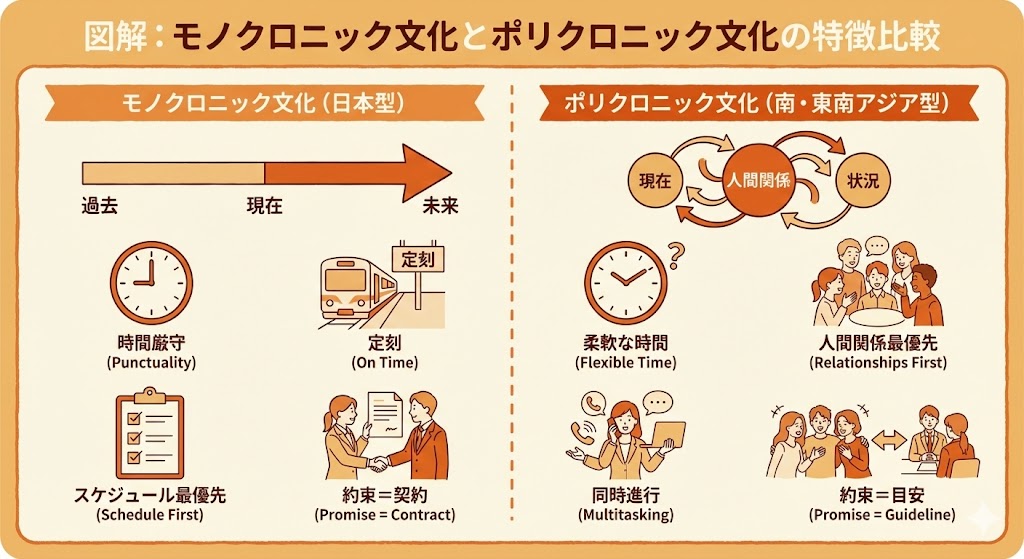
1.1 Monochronic Cultures (Japan, Germany, North America, etc.)
In these cultural spheres, time is perceived as "a single line." It flows irreversibly from past to future, is divisible, and is a precious resource to be managed. As the saying "Time is money" indicates, wasting time is considered sinful.
- Characteristics:
- Schedules and plans are top priority.
- Focus on one thing at a time.
- Time is a "promise" to be kept.
- Task completion and deadlines tend to take priority over human relationships.
1.2 Polychronic Cultures (South Asia, Southeast Asia, Latin America, Arab countries, etc.)
In contrast, in these cultural spheres, time is perceived more flexibly and fluidly, like a collection of "circulating points." Time is merely the background of human activity, not an absolute standard in itself.
- Characteristics:
- Current situations and human relationships are top priority.
- Multiple things are done simultaneously in parallel.
- Time is merely a "guideline."
- Dialogue with people present and responses to unexpected events are valued over predetermined schedules.
Clash of Time Perceptions
When learners from Nepal or the Philippines show up at 9:15 after being told to gather at 9:00, it's because for them, that's within the acceptable range of a "guideline." In their culture, bumping into a friend on the street and having a conversation may be judged as more important as a human being than arriving on schedule.
Teachers need to understand that their behavior doesn't stem from "laziness" but is based on a different value system of "relationship-centered time management." On top of that, they must make learners recognize that they are on a field where "different game rules" called Japan apply.
Below is a comparison table summarizing the differences in time perception between both cultures.
[Diagram] Time Perception in Monochronic and Polychronic Cultures
| Item | Monochronic Culture (Japanese Type) | Polychronic Culture (South/Southeast Asian Type) |
|---|---|---|
| Time Perception | Linear, irreversible resource | Cyclical, fluid background |
| Priorities | Schedule, deadlines, efficiency | Human relationships, current situation, dialogue |
| Perception of Lateness | Lack of trust, disrespect to others | Situational adjustment, acceptable range |
| Nature of Promises | Absolute contract | Changeable guideline |
| Ideal Behavior | 5 minutes early, as planned | Flexible response, adaptability |
2. Lateness as "Meiwaku": The Logic of Theft
So why is Japanese society particularly strict about time, even among monochronic cultures? It's because it's deeply connected to Japan's unique social norms of "consideration for others" and the concept of "meiwaku."
"Theft" of Others' Time
In Japanese society, lateness is not merely a violation of rules. It is recognized as a "moral violation" against the person being kept waiting.
From a monochronic perspective, time is finite property. Making someone wait 10 minutes means you have unilaterally taken 10 precious minutes of that person's life without their consent. To put it extremely, it's equivalent to "theft of property."
"Dominant Act" Creating Asymmetry in Relationships
From a sociological perspective, a temporary power relationship emerges between "the one making wait" and "the one being made to wait." The one making wait has the power to deprive the other of freedom of action and restrain them until their arrival. Whether intentional or not, this becomes a kind of "dominant act."
Japanese culture values harmony and emphasizes equal relationships. Unilaterally making someone wait and taking a superior position is strongly avoided as selfish behavior that disturbs harmony.
"5 Minutes Early" as an Expression of Humility
The "5 minutes early" or "10 minutes early" behavior recommended in Japanese educational settings and business. This is not merely risk hedging.
It's a manifestation of maximum respect and consideration for the other person: "I respect your time. I will absolutely not make you wait." The act of arriving early and waiting is an expression of "humility" that disciplines oneself and honors the other, and is the practice of Japanese virtue.
As a teacher, try telling late learners this: "○○-san, when you're late, the person waiting feels sad thinking 'I'm not valued.' In Japan, keeping time is a message saying 'I care about you.'"
3. Application in Educational Settings: Beyond Cultural Relativism
Having understood the theoretical background, how should we incorporate it into actual instruction? Cultural relativism that settles with "it can't be helped because of cultural differences" won't help learners survive in Japanese society.
It's effective to explain from a more utilitarian approach, based on the stance that "your culture is wonderful too, but the rules are different here."
Explanation from Economic Rationality of "Trust (Credit)"
In capitalist society, especially in highly organized societies like Japan, "trust" functions like currency. Let's explain this to learners in an understandable way.
- Example Instructional Phrases: "In Japan, 'trust' is like a credit card. Keeping time is the same as making credit card payments on time. If you're late every time, your 'credit score' goes down, and eventually no one will do business with you (you won't be put on part-time job shifts, won't be entrusted with important work). It's very difficult to restore a credit score once lost."
By presenting it as a matter of economic rationality directly connected to their interests rather than spiritual theory, it becomes easier to promote behavioral change.
Teaching Together with Ho-Ren-So (Reporting, Liaison, Consultation)
It's also effective to handle lateness in the context of "Ho-Ren-So," the basics of Japanese business skills.
Teach that not only is lateness itself bad, but "not sharing the information that you'll be late in advance" is a serious fault that delays organizational response and expands damage.
- Teaching Points: "It's not your fault that the train was delayed. But it's your responsibility that you 'didn't contact us immediately.' In Japan, the rule is to communicate bad news as quickly as possible."
Conclusion: The Significance of Sharing Time
What we're teaching learners is not simply how to read a clock or ride a train. It's the "etiquette" for functioning as part of the massive and precise system called Japanese society, and also a "rite of passage" to be recognized as a member of that community.
Keeping time strictly means sharing the same "context of time." It's a declaration of intent: "I accept the rules of this community and will live on the same playing field as everyone else," and it's the greatest consideration for others—an expression of "compassion."
The clash between monochronic and polychronic cultures is inevitable. However, logically understanding that structure, respecting learners' cultures while carefully explaining the logic of Japanese society—only we Japanese language teachers, who are bridges between two cultures, can do this.
I hope that from your classroom, as many people as possible will graduate who, despite having backgrounds in different time cultures, will gain trust in Japanese society and thrive actively.
