
No More Awkwardness! Master the Magic Word 'Chotto...' - How to Decline Without Saying 'NO'

By NIHONGO-AI
AI Engineer/Japanese Language Educator
8/1/2025

No More Awkwardness! Master the Magic Word 'Chotto...' - How to Decline Without Saying 'NO'
Introduction
"Would you like to have lunch together this Saturday?" "No, I can't go. I'm busy."
...If you answered like this, take a close look at the Japanese person's face. Did you notice a moment when time seemed to stop, or perhaps a slightly sad expression?
As a Japanese language teacher for over 10 years, I've worked with countless learners. I've often witnessed how the most diligent students faithfully use the textbook "iie" (no) they learned, unintentionally creating walls between themselves and others. Direct translations of English "No, thank you" into "Iie, kekkou desu" or blunt rejections like "ikemasen" (I can't go) cut through Japanese conversational context like unexpectedly sharp knives.
Japanese communication is a "high-context culture" that values context and atmosphere over the words themselves. Here, "not speaking directly" isn't considered dishonest, but rather "kindness (consideration) that preserves the other person's dignity and maintains relationships."
This article will teach you the "art of declining" in 3 steps - how to communicate your intentions smartly without hurting others. Master this, and you'll no longer fear declining invitations starting tomorrow.
What You'll Learn in This Article
- Variations of "cushion words" to prevent abrupt rejection
- The essence of Japanese's most useful magic word "chotto..." (well...)
- Non-verbal techniques (pauses and expressions) to help others "read between the lines"
- How to end conversations while maintaining positive relationships
Step 1: The Magic Cushion "Ainiku desu ga..." (Unfortunately...)
When declining something in Japan, never start directly with "ikemasen" (I can't go) or "dekimasen" (I can't do it). The iron rule is to first insert "cushion words" that either express "gratitude" for the invitation or "apologetic feelings" about having to decline.
Why Are Cushions Necessary?
Imagine a car's turn signal. By signaling before turning, following cars can mentally prepare, right? Cushion words work the same way. They send a signal saying "I'm about to say something slightly disappointing," which has the effect of softening the impact of rejection.
List of Commonly Used Cushion Words
| Expression | Nuance | Usage Scene | Target Person |
|---|---|---|---|
| Ainiku desu ga | Unfortunately (unluckily) | Business, formal | Boss, clients |
| Sekkaku desu ga | I feel bad wasting your kindness | General (especially invitations) | General |
| Arigatai no desu ga | I'm grateful, but | Casual to polite | Friends, colleagues |
| Moushiwake arimasen ga | With apologetic feelings | Very polite, business | Superiors |
Specific Usage Examples
First, let's practice saying these words out loud.
【Example 1: Lunch Invitation】 Colleague: "How about having lunch together today?" You: "Oh, thank you! Sekkaku desu ga, I brought a bento today..."
【Example 2: Drinking Party Invitation】 Boss: "How about a drink tonight?" You: "Thank you for the invitation. Ainiku desu ga, I have a prior engagement today..."
Just by adding this initial phrase, the other person mentally prepares thinking "Ah, today won't work."
Step 2: The Ultimate Word "Chotto..." and the Acting Power of "Silence"
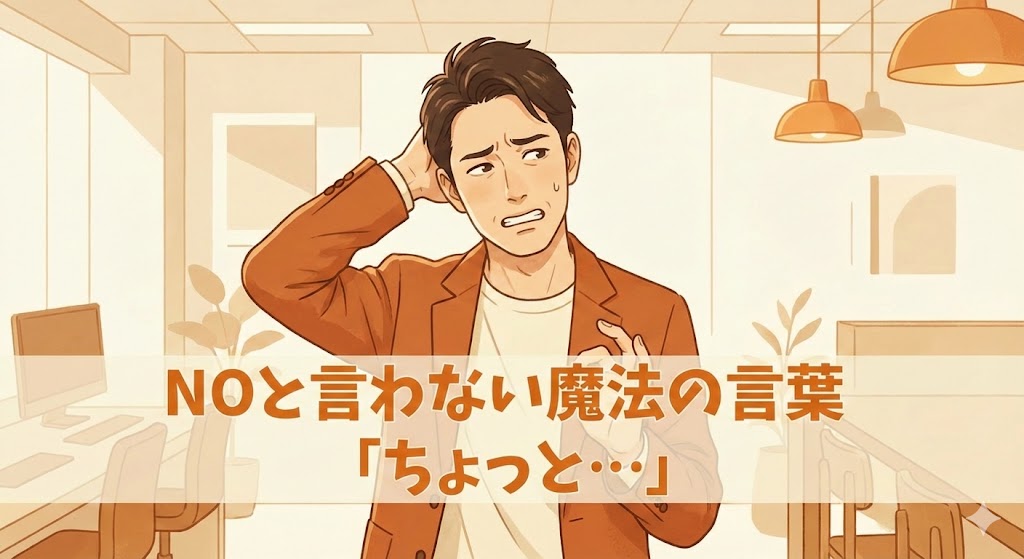
This is the core of this article. After placing your cushion word, instead of saying a specific "NO," use Japanese's most versatile magic word: "Chotto... (Well...)"
"Chotto" is a Substitute for "NO"
You might have learned "chotto (a little)" in beginner textbooks, but in declining situations, the meaning is completely different. In this context, "chotto" functions as "ambiguous negation" that encompasses all negative content: "(circumstances are) bad," "(conditions don't) match," or "(I'm not) inclined."
"Trailing Off" and "Complicit Understanding"
Japanese people prefer not to finish sentences completely. By trailing off with "...desu ga..." or "...na no de..." they let the other person "read between the lines" and reach the "NO" conclusion themselves. This creates a situation where you didn't directly say "NO," but rather the other person understood it was impossible on their own. This "unspoken understanding" creates Japanese harmony (wa).
Practice: 3-Second "Silence" Training
Don't open your mouth immediately when invited. Try "acting" with these steps:
- Look away: Don't stare directly into their eyes; look slightly down and to the side.
- Make an "um" sound: Vocalize your troubled state.
- Wait 3 seconds: This "pause (Ma)" gives the other person time to realize "Ah, I'm being declined."
- Say "Chotto...": With an apologetic face, draw out the ending.
【Conversation Example 3: Invited to a Weekend Event】 Friend: "Can you come to Sunday's BBQ?" You: "Um... (3 seconds of silence with a troubled face) Sunday is, chotto... (trailing off)" Friend: "Ah, I see. You have plans. Got it!"
Here, you didn't say "I can't go" or "I'm busy." However, your "chotto..." and "silence" as non-verbal communication conveyed your declining intention 100%.
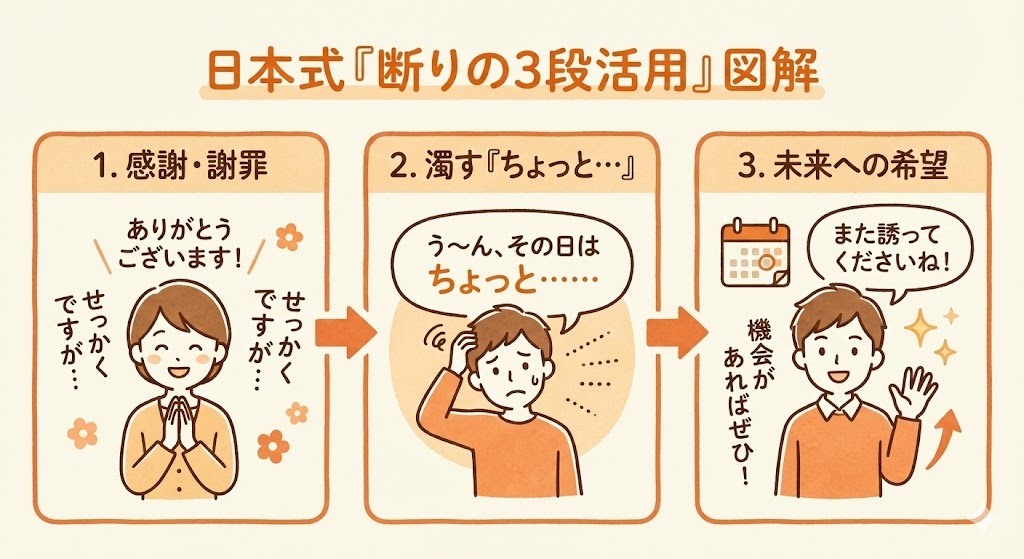
Step 3: Even if It's White Lies, Offer "Alternatives" or "Future Possibilities"
After trailing off with "chotto...," ending the conversation there might make the other person wonder "Do they dislike me?" So finish with a positive message showing "I do want to meet with you."
"Social Courtesy" Phrases That Maintain Relationships
Even if you don't have specific plans to meet next time, adding these words is Japanese etiquette. This isn't a "lie" but rather a message (kindness) saying "I can't this time, but I value our relationship."
- "Mata sasotte kudasai" (Please invite me again): Shows you're not rejecting the invitation itself.
- "Kikai ga areba, zehi" (If there's an opportunity, definitely): Implies that while this time didn't work out, next time might.
- "Mata kondo onegaishimasu" (Please ask me again next time): A set phrase to end the conversation politely and positively.
Specific Usage Examples
【Example 4: Declining Offered Sweets】 "Thank you. But I'm a bit full right now, so... I'll have some later."
【Example 5: Declining a Project Request】 "I'm honored to be asked. However, I'm currently tied up with other projects... I'd definitely like to help in another opportunity."
By keeping a window open to the "future," the other person can gracefully back down without feeling the shock of "rejection."
Common Mistakes: NG Patterns vs OK Patterns
Let's look at mistakes learners often make in comparison format.
1. Giving Too Much Detail in Reasons
- NG: "Sunday is my mother's birthday, and we have to go to a family meal at 10 o'clock, so I can't go to the BBQ."
- OK: "Sunday, I have **chotto a family matter... ** Please invite me again!"
Explanation: Giving detailed reasons can sound like "excuses" or give the other person room to pursue with "How about from 2 PM then?" Being vague is a kindness that protects both parties' privacy.
2. Starting Conversations with "Iie" (No)
- NG: "Iie, kekkou desu" (No, I'm fine)
- OK: "Arigatou gozaimasu. Ima wa daijoubu desu" (Thank you. I'm fine right now)
Explanation: "Iie" is a very strong negation in Japanese. Even when declining services, starting with "Thank you" flows more smoothly.
3. Expression Too Bright
- NG: (With a smile) "I can't go!"
- OK: (With a troubled face) "Chotto... it might be difficult..."
Explanation: In Japan, showing an apologetic "troubled face" when declining is essential. Declining with a smile risks being misunderstood as "I'm declining because I don't want to go with you."
Ready to Use! Scene-Specific Declining Phrase Collection
Business Scenes
- "Sekkaku no ohanashi desu ga, watashi dewa chikarabusoku de shite..." (It's a wonderful opportunity, but I lack the ability...) (When declining a big role)
- "Sukejuuru wo kakunin shimashita tokoro, ainiku sono hi wa..." (After checking my schedule, unfortunately that day...) (When declining meetings)
Casual Scenes
- "Aa, sono hi wa chotto senyaku ga atte... gomen ne!" (Ah, that day I have a prior engagement... sorry!) (When declining hangouts)
- "Kyou wa chotto hayaku kaeranakya ikenakute... mata kondo!" (Today I have to go home early... next time!) (When declining after-parties)
Shopping or Restaurants
- "Uun, sukoshi kangaesasete kudasai" (Hmm, let me think about it a little) (When persistently offered products. Store staff will back down after this)
Summary: Ambiguity is "Kindness"
How was it? "Not speaking clearly" is neither dishonest nor indecisive. It's a sophisticated Japanese communication technique that protects others' feelings from direct negation and maintains the "harmony" of the situation.
Don't forget the three steps you can practice starting today:
- Cushion first: Absorb the shock with "Thank you" or "Sekkaku desu ga"!
- Blur with "Chotto": Don't finish your sentence, create silence (3 seconds), and let them read between the lines!
- Close with the future: Keep the relationship with "Please invite me again"!
As a Japanese language teacher, I guarantee this: The moment you master "chotto...," your Japanese will dramatically start sounding "Japanese-like."
Next time someone invites you, courageously but apologetically try saying "Ah, chotto..." In that moment, a new comfortable "harmony" should be born between you and the other person.
