
Why Don't Japanese People Say Everything? The Truth Behind 'Grammar of Silence' and High-Context Culture

By NIHONGO-AI
AI Engineer/Japanese Language Educator
8/7/2025

Why Don't Japanese People Say Everything? The Truth Behind 'Grammar of Silence' and High-Context Culture
Introduction
"Mr. Yamada, would you like to have dinner together this Saturday?" "Ah, I'd really like to go, but... well, that day is a bit... inconvenient for me..."
If you're learning Japanese, you've probably heard conversations like this at least once. And you might have thought: "Wait, are you going or not? Just say it clearly!"
As a Japanese language teacher for over 10 years, working with many learners, this "Japanese that doesn't finish sentences" is one of the biggest walls that intermediate and advanced students face. One business professional learner was told "We'll consider it" in a business negotiation and waited a whole week expecting a positive outcome. However, no reply ever came. This was because that "We'll consider it" actually meant a polite "No."
Why don't Japanese people say "No" clearly, instead ending sentences halfway? This isn't mere indecisiveness, but rather a sophisticated communication strategy cultivated by Japanese culture.
This article will uncover the true nature of Japanese "silence" through three key points:
- The Mechanism of High-Context Culture: Why "understanding without words" works.
- The Functional Beauty of 'Grammar of Silence': Why not completing sentences is considered polite.
- Practical Advice for 'Sasshi' (Reading Between the Lines): How to interpret and respond to ambiguous rejections.
The essence of Japanese people lies hidden in the realm of the unspoken. Let's explore this together.
1. Prologue: The Invisible Wall of "NO"
In many cultural spheres, particularly Western countries, the primary purpose of communication is "information transmission." There, clearly stating "Yes/No" is considered the speaker's responsibility. However, in Japanese communication, "relationship harmony (Wa)" takes priority over "accuracy of information."
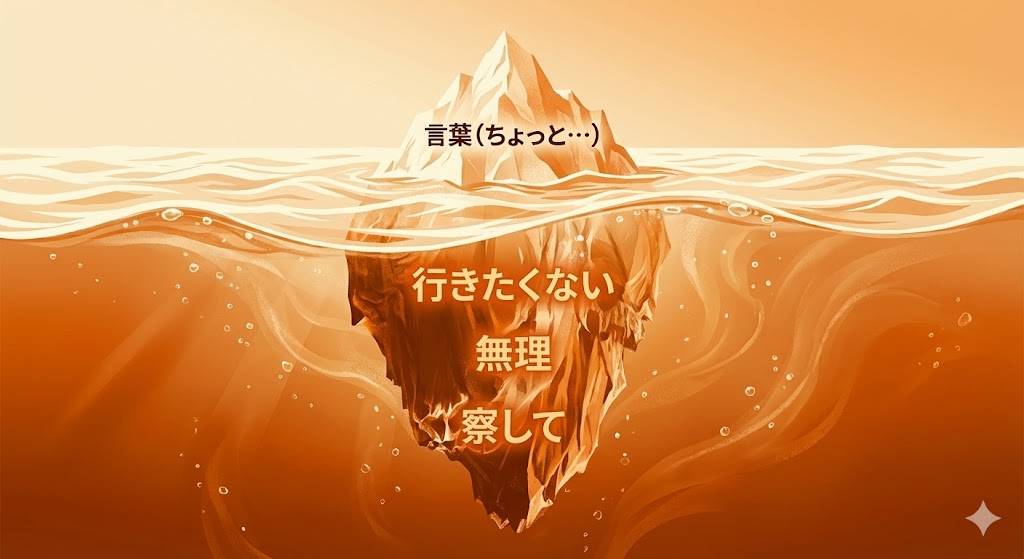
Words Are Just the Tip of the Iceberg
The "iceberg model" is useful for understanding Japanese communication. The "words" visible above the surface are actually just a small part of the information. Below the surface lies a vast amount of "unspoken information" including the situational context, relationships between people, facial expressions, and silence.
For example, the phrase "We will consider it" that frequently appears in business scenes. If you take this literally as "positive consideration," your expectations may be betrayed. In many cases, this is a euphemistic rejection born from the consideration of "not wanting to directly deny your proposal and damage your face."
2. High-Context Culture and the Obligation of 'Sasshi'
In the "high-context culture" proposed by cultural anthropologist Edward Hall, Japan occupies an extremely prominent position worldwide.
"Understanding Without Words" Is Proof of Trust
High-context culture refers to a culture where little information is verbalized in communication, with a high dependence on context and shared knowledge. In Japan, "understanding without words" is considered ideal communication, and listeners bear the "receiver responsibility" to grasp the speaker's intentions.
Conversely, in "low-context cultures" at the opposite extreme, "if you don't say it, it won't be understood" is the principle, and speakers bear the responsibility to communicate clearly.
The Kindness of Not Making Others "Say It"
In Japanese society, making someone clearly say "I don't want to" is considered a "Face Threatening Act (FTA)" that embarrasses the other person and causes psychological burden.
For example, when feeling cold because a window is open during a meeting, instead of directly asking "Please close the window," Japanese people might only present the fact: "It's a bit chilly today." When someone hears this and spontaneously acts by thinking "Ah, they want the window closed," this represents the complete form of Japanese "thoughtfulness."
| Comparison Item | Japanese Style (Sasshi) | Western/Low-Context Style | Required Action |
|---|---|---|---|
| Expression of Intent | Ambiguous, indirect | Clear, direct | Read between the lines |
| Requests | Wait for others to notice | State clearly in words | Anticipate by observing others |
| Rejection | Blur reasons, include silence | Explain reasons logically | Withdraw without probing deeper |
3. "Grammar of Silence": The Functional Beauty of Incomplete Expressions
Japanese has a rich variety of grammatical techniques called "incomplete expressions" that deliberately avoid completing sentences.
The Strategy of Stopping at "ga," "kedo," and "node"
The phenomenon of ending sentences with conjunctive particles like "ga," "kedo," and "node" is not merely a grammatical deficiency. These function pragmatically as "softeners" showing consideration.
【Conversation Example: Declining an Invitation】
A: "Would you like to go to a movie tomorrow?"
B: "I'd really like to go, but... (silence)"
By stopping at "...but," Person B avoids having to say the rejection word "I can't go." At the same time, they're delegating the initiative for subsequent judgment (whether to withdraw gracefully saying "Ah, you must be busy, maybe next time" or to persist further) to the other person. This is strategic ambiguity designed to respect the other person's "face" and avoid confrontation.
The Effectiveness of Silence (Ma)
In Japanese conversation, silence is not "awkwardness" but is positively valued as "Ma" - a pause that shows mental organization or respect for the other person. A few seconds of silence after being asked a question becomes a signal of sincerity, meaning "I'm seriously considering your question."
4. Case Study: The Intensity of Rejection Contained in "Chotto"
The Japanese word "chotto" carries completely different weight from the English "a little bit."
"Chotto..." Is the Complete Form of "Impossible"
When someone says "Sunday is chotto..." it doesn't mean "slightly inconvenient" but essentially means "impossible."
A common mistake many learners make here is probing deeper by asking "Why not?" for specific reasons. For Japanese people, giving too many specific reasons risks seeming "excuse-heavy" or "dishonest."
The Most Refined Way to Decline: Abstraction
Actually, keeping reasons abstract with phrases like "I have some business to attend to" or "I have an unmovable appointment..." is the most refined adult way to decline. This is consideration to prevent the other person from having to judge the validity of reasons, and it's also a manifestation of Japanese "Uchi-Soto" (inside-outside) culture that values the distinction between public and private matters.
5. Conclusion: Trust Relationships That Share Silence
In Japanese society, silence and incomplete expressions are not communication breakdowns. Rather, they are proof of deep trust in the other person's ability to infer, believing "they should understand without me saying it."
Gently reading unspoken rejections and quietly withdrawing - when you can share this "perfect understanding," you're finally recognized as a member of that community (an insider).
What You Can Do Starting Today
- Replace "No" with "Chotto...": Avoid direct negation and try trailing off at the end of sentences.
- Don't Fear 3 Seconds of Silence: By pausing instead of answering immediately, you can project thoughtfulness.
- Practice 'Sasshi': When you sense someone hesitating, try withdrawing with "maybe another time" instead of probing deeper.
Ambiguity is not dishonesty, but a form of "kindness" to avoid hurting others. Master Japan's "grammar of silence" to build richer human relationships.
