
「Oh, about the other day...」I Couldn't Say Those Words. How I Nearly Lost Trust in Japan and Was Saved by My Notebook

By NIHONGO-AI
AI Engineer/Japanese Language Educator
10/1/2025

"Oh, about the other day..." I Couldn't Say Those Words. How I Nearly Lost Trust in Japan and Was Saved by My Notebook
Introduction
"Huh? Why does that senior colleague seem a bit cold to me lately...?"
Have you ever felt this way when you started working in Japan? I have. And not just once or twice.
I could communicate, I did my work without mistakes. Yet somehow, the gears of workplace relationships seemed to be slightly misaligned. At the time, I never dreamed that the cause was the absence of just "one word."
In this article, I'll share a "failure story" I experienced as a foreign worker in Japanese society, told from my perspective as a Japanese language teacher with over 10 years of experience observing many learners. This is a story about an invisible rule in Japanese human relationships: "re-gratitude" (saikansha).
And I'll also secretly share with you the small "secret weapon" that saved me, someone with little confidence in their memory.

Prologue: My Manners That I Thought Were Perfect
This happened shortly after I started working in Japan. One lunchtime, a senior colleague at work said, "I'll pay today, so order whatever you like."
I was delighted and ordered a slightly expensive set meal, eating until I was full. Then, facing my senior who had finished paying, I said in the cheerful voice I had learned at Japanese language school:
"Thank you for the meal! It was delicious!"
And a perfect 90-degree bow. My senior smiled and said, "No problem, let's work hard this afternoon."
I gave myself a mental fist pump. "Perfect. I've mastered Japanese etiquette." That's what I believed.
However, I noticed something strange the next morning. When I arrived at work and greeted that senior with "Good morning!", they just kept looking at their computer screen and replied in a small voice, "Oh, morning..."
Where did that warm smile from yesterday go? Had I done something to offend them? From that day on for several days, I felt like there was a thin, invisible wall between us.
Turning Point: The Boundary Between "Persistent" and "Polite"
One day, as I was spending these uncomfortable days, a Japanese colleague who couldn't bear to watch approached me in the break room.
"Hey, ○○-san. You didn't say 'Thank you for yesterday' to Taguchi-senpai first thing in the morning, did you?"
I couldn't believe my ears. "What? But I said it properly yesterday in front of the restaurant! Should I say it again? Wouldn't that be kind of persistent?"
In my home country's culture, gratitude was something you "completed on the spot." I even thought that bringing it up repeatedly would seem clingy and burden the other person.
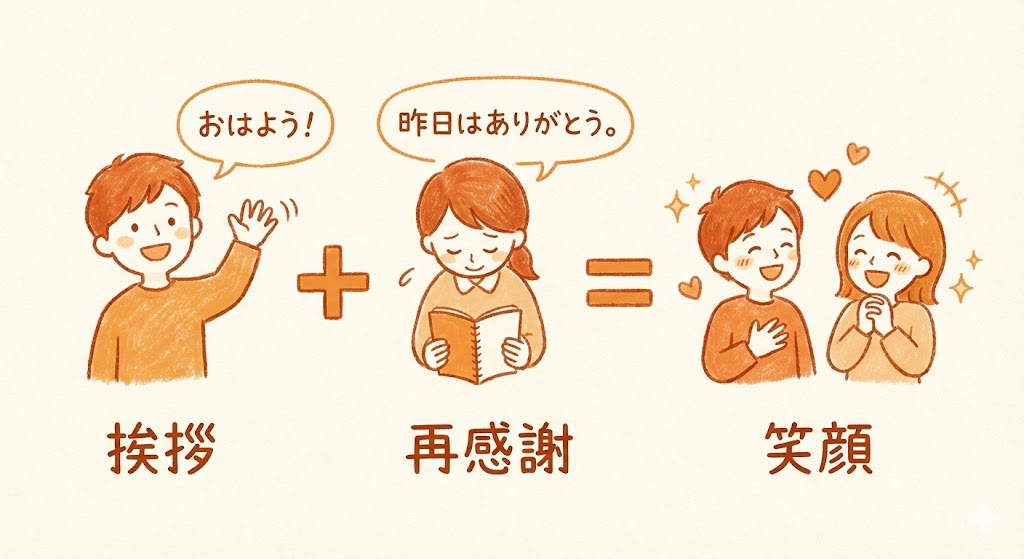
My colleague looked a bit troubled but kindly explained: "Well, I understand how you feel. But in Japan, by saying thank you again with the first words when you meet next, the relationship kind of resets, or moves to the next stage. It's like a sign saying 'I haven't forgotten yesterday's kindness.'"
"A sign." Those words struck my heart. I had forgotten to give that sign. Even though I was speaking grammatically correct Japanese, within the cultural context, I was becoming "a rude person."
Practice: The Terrifying "Re-gratitude" Challenge
I understood the logic. But when it came to actually practicing it, it was incredibly scary.
A few days later, on another occasion, the section chief shared some expensive sweets he had received from a client with everyone in the department. I accepted them saying "Thank you!" on the spot.
The real test was the next morning. On my way to work, my heart was pounding. "What if they give me a 'What are you talking about?' look?" "Maybe they'll think I'm being persistent after all..."
I entered the office and saw the section chief. I took a deep breath and, after my usual "Good morning," mustered up the courage to continue:
"Oh, Section Chief, good morning. Um, thank you for the delicious sweets yesterday. My family enjoyed them too."
After a moment of silence, the section chief looked up and his expression brightened. "Oh, really! They were good, weren't they? I'll bring more if I get the chance."
At that moment, I felt the office atmosphere become soft and warm. It was like magic. Just one word, just mentioning the past, and the invisible distance between the section chief and me instantly closed.
"Ah, so this was it." I finally felt like I had found the key to human relationships in Japanese workplaces.
Solution: I'm Revealing My "Topic Notebook"
Having learned the power of "re-gratitude," I had one big problem. I have a catastrophically bad memory.
When spending busy days, I tend to forget "who" did "what" for me. By the next morning, I'd be thinking, "Huh? Did something happen yesterday?"
So what I came up with was a secret weapon called the "Topic Notebook (Memo)."
I decided to make full use of the memo section in my smartphone's contacts app and schedule book. The method is simple. Whenever someone does something kind for me, I leave a one-line memo that same day.
For example, like this:
10/1 Taguchi-senpai: Treated me to lunch (yakiniku)10/5 Sato-san: Helped me prepare meeting materials10/10 Section Chief: Received souvenir cookies
Then, just before meeting that person the next morning, I secretly "cheat" by looking at this memo. "Alright, I need to thank Taguchi-senpai for the yakiniku," I confirm before going to greet them.
This memo habit has become the strongest tool for proving my "sincerity." Rather than relying on memory, I rely on records. This is a method I strongly recommend to my students as a Japanese language teacher.
10 "Re-gratitude" Phrases You Can Use Starting Today!
For those of you wondering "What exactly should I say?", I'll introduce phrases I actually wrote in my topic notebook and used. Try using these as "greeting + α."
- When treated to a meal: "Thank you for the delicious ○○ the other day. I had a really enjoyable time."
- When receiving a souvenir: "My whole family enjoyed the sweets you gave me."
- When someone gives you information: "I went to the restaurant you told me about over the weekend! It was really great."
- When someone listens to your concerns: "Thank you for listening to my concerns the other day. It really put my mind at ease."
- When someone helps with work: "Thank you so much for covering my shift the other day when you were busy. It really helped me out."
- When borrowing something: "The book I borrowed was very educational. Thank you."
- When someone shows concern for your health: "Thank you for your concern about my health the other day. I'm completely recovered now."
- When someone returns from a trip: "Welcome back! Thank you for covering ○○ while you were away."
- For small kindnesses (like sharing an umbrella): "Thank you for letting me share your umbrella the other day. You really saved me."
- When receiving a polite email: (When meeting in person next) "Thank you for your thoughtful email the other day."
Epilogue: The Next Word Creates the Future
"Thank you for yesterday."
This single phrase is not an attachment to the past. It's a message directed toward the future, saying "I value my relationship with you."
As a Japanese language teacher, I want to convey not only how to use words, but also the "heart" that those words carry.
If you're feeling a bit tired of human relationships in your Japanese workplace, try writing a small memo in the corner of your notebook, even if you're skeptical. And the next morning, muster up the courage to say those words.
Surely, the other person's smile will brighten your new day. So, who will you express your "re-gratitude" to tomorrow morning, and what will you say?
Share this post:
Share your take on X (feel free to edit the text). Adding your native language and age group makes it valuable data on how Japanese is really used!

Related Articles

From 'I'm Scared of Trash Day' to Befriending My Elderly Neighbor: The 'Magic Greeting' for Surviving in Japan
By NIHONGO-AI
AI Engineer/Japanese Language Educator
Date
2/18/2026

The Day I Made the CEO a Doorman: What I Learned About Trust Through the 'Elevator Button Wars'
By NIHONGO-AI
AI Engineer/Japanese Language Educator
Date
10/10/2025

How the Magic Phrase 'Shikata-ga-nai' Saved Me from the Exhaustion of Always Being 'Right'
By NIHONGO-AI
AI Engineer/Japanese Language Educator
Date
2/27/2026