
Switch Your 'Behavior' Before Speaking Japanese: 5 Behavioral Code Steps for People from Low-Context Cultures

By NIHONGO-AI
AI Engineer/Japanese Language Educator
4/1/2026

Switch Your "Behavior" Before Speaking Japanese: 5 Behavioral Code Steps for People from Low-Context Cultures
Introduction
"I can speak the language, but the atmosphere got weird..." Have you ever experienced this?
Person A attended a meeting at a Japanese company. They were fully prepared and confident. When the facilitator asked a question, they immediately raised their hand and made a quick decision, saying, "Let's go with this plan!" However, for some reason, the room fell completely silent.
When Person B declined a request from a colleague, they directly translated "No, I can't do that" and clearly stated, "Iie, sore wa dekimasen." The other person closed their mouth, and the subsequent interaction became awkward.
Both of them can speak Japanese well enough. The problem was not their vocabulary, but the rules of behavior.
Japanese has a unique set of rules not just for the meaning of words, but for "how to act." This is called a "behavioral code" [1]. It's like switching your entire behavior, not just switching languages.
In this article, you will learn the following three points:
- 3 basic rules of Japanese communication
- A 5-step checklist you can use starting today
- Common mistakes that make people think, "So close!"
Vocabulary and behavioral codes are different skills [2]. However, both can definitely be acquired through practice.
3 Rules of the "Japanese Mode"
There are three main pillars that support Japanese communication.
Rule 1: Uchi and Soto (Inside and Outside)
In Japanese, words and attitudes change drastically depending on whether you are dealing with the "inside" (uchi: colleagues, in-group) or the "outside" (soto: others, clients) [7].
To a close colleague, you might say, "Tanaka-san, chotto ii?" (Hey Tanaka, got a minute?). But to a client, it becomes "Tanaka-sama, shosho yoroshii deshou ka" (Mr. Tanaka, may I have a moment of your time?). This is different from switching between Formal and Informal in English. The Japanese uchi/soto concept requires switching writing style, vocabulary, topics, and attitude all together [7].
When your boss's glass is about to empty at a drinking party, your body moves to pour a drink before words come out: "Sosogimashou ka" (Shall I pour you a drink?)—this is an everyday scene of the uchi consideration culture. Noticing the other person's glass before your own, that anticipation is proof that you are inside the uchi.
Rule 2: Not Speaking Clearly = Consideration
Japan is a prime example of a high-context culture [5][6]. Because it is a culture where "context and atmosphere carry the meaning," words are sometimes intentionally left vague. "Not speaking clearly" is not rude; it functions as consideration for the other person.
Please check the figure and table below.
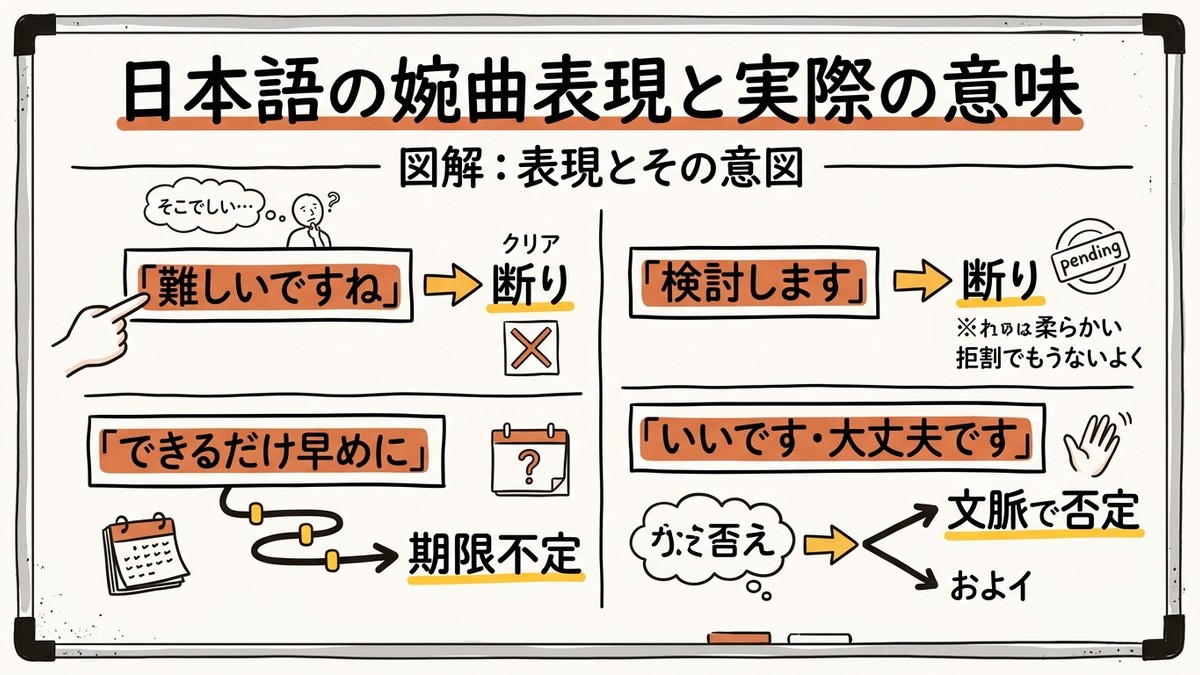
| Statement | How it is received in a low-context culture | Actual Meaning |
|---|---|---|
| "Muzukashii desu ne" (It's difficult) | It's difficult, but we will try | Almost certainly a refusal [19] |
| "Kentou shimasu" (I will consider it) | Positively considering it | In many cases, a refusal [19] |
| "Dekiru dake hayame ni" (As soon as possible) | As soon as possible | The deadline is unclear [18] |
| "Ii desu" / "Daijoubu desu" (It's fine / It's okay) | OK / No problem | Depending on the situation, a refusal [18] |
A situation where someone is told "Daijoubu desu" (It's okay) and proceeds thinking it means "OK"—when it was actually a refusal—happens frequently both in the workplace and among friends [18]. The fact that the single phrase "Ii desu" is an ambiguous word used for both affirmation and negation is one of the biggest stumbling blocks for Japanese learners.
Rule 3: Silence is a Container for Information
Silence is not a "state of nothingness." The Japanese concept of "ma" (pause/space) signifies careful consideration, agreement, respect, or indirect disagreement [13].
When your boss goes silent during a meeting, they are neither angry nor troubled. It is a sign that means, "I am thinking carefully right now." If you misread this as an "awkward silence" and keep talking, you will disrupt the flow of the room [13].
I have heard many times from foreigners working in Japan stories like, "I thought my Japanese boss's silence meant they were angry, so I kept apologizing." Just by reframing silence as a container for information, the way you read the atmosphere in a Japanese setting will change.
5 Steps You Can Take Starting Today
Once you understand, the next step is practice. There is no need to overthink it. Just trying them one step at a time is perfectly fine.
Step 1: Don't Rush the Silence (The 3-Second Rule)
When the other person goes silent, wait for just 3 seconds first [13]. Silence is not a sign of "the end," but a sign of "thinking."
After a presentation, Person D faced a silence where their boss said nothing. In the past, they would have immediately opened their mouth to ask, "Any opinions?", but this time they waited 3 seconds. Then, the boss slowly nodded and said, "That's a good proposal." It was a moment where simply waiting drew out the other person's true intentions.
Step 2: Soften Refusals with "Chotto..." (A little...)
A direct "No" has a huge impact in the Japanese business scene [14]. Just by making it ambiguous with "Chotto muzukashii desu ne" (It's a little difficult) or "Sono hi wa chotto..." (That day is a little...), you can refuse while leaving room for the other person.
Even when turning down a friend's invitation, "Chotto sono hi wa tsugou ga..." (My schedule is a little... on that day) keeps the subsequent relationship smoother than saying "Ikemasen" (I can't go). Refusing while simultaneously saving the other person's face—this is the essence of euphemistic expressions.
Step 3: Do One Round of "Nemawashi" Before a Meeting
Nemawashi is a uniquely Japanese practice of individually consulting with stakeholders and hearing their opinions before an official meeting begins [15]. If you feel that "I suddenly propose things in meetings and nothing gets approved," you might be missing this nemawashi.
The day before proposing a new plan, Person C asked a senior team member, "I'm thinking of making this kind of proposal tomorrow, what do you think?" At the meeting the next day, they quickly gained consensus with, "I think it's a good idea." A single round of nemawashi changes the temperature of the room [15].
For those who are used to "making immediate decisions in meetings," nemawashi looks like a roundabout way. However, if you view it as risk management to eliminate rework after implementation, it is actually an efficient process.
Step 4: Anticipate Pouring Drinks, Bowing, etc.
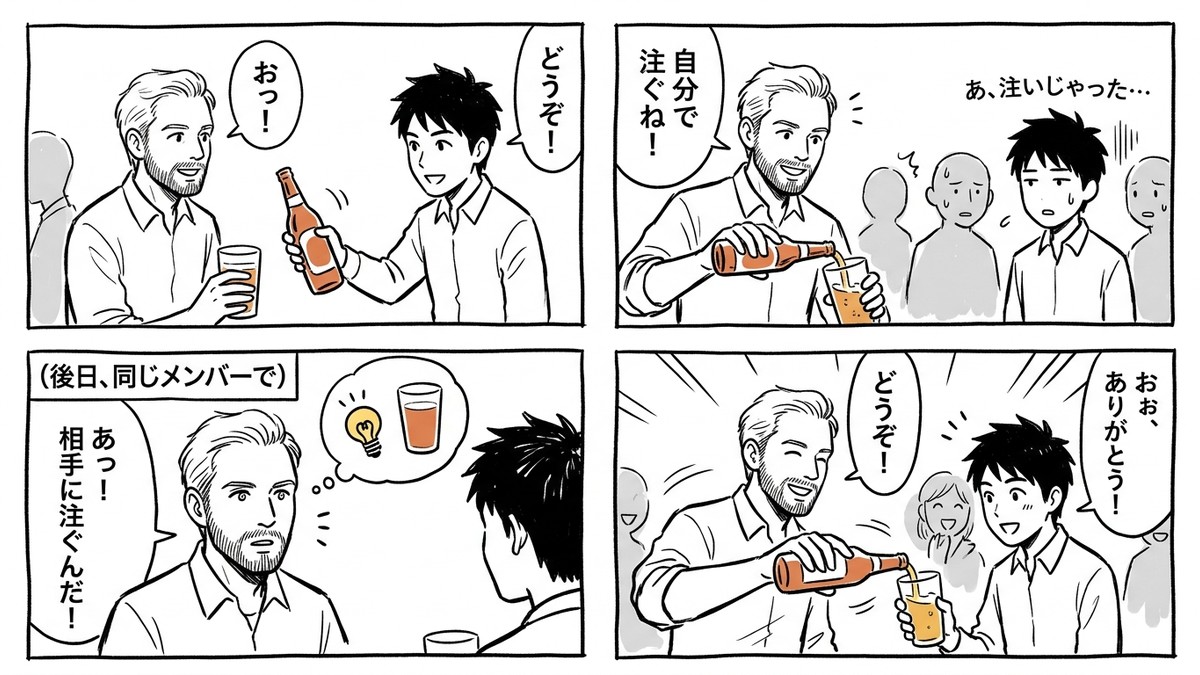
"Reading the air" (Kuuki wo yomu, or KY) means anticipating the other person's feelings not from words, but from the overall movement of the situation [16][17]. When you receive a beer bottle at a drinking party, pouring into the other person's glass before your own—this is a basic action of the uchi culture.
Even if you do it consciously at first, it will become a natural movement as you repeat it. Through the stages of "Observation -> Conscious Execution -> Automation," the behavioral code will become ingrained in your body.
Step 5: Turn On "Observation Mode"
When you join a new place or team, try to dedicate yourself to being an "observer" for the first three times. Who speaks first, at what timing tea is served, what kind of conversations are exchanged before a meeting—just by watching that flow, the behavioral code will become visible.
Pragmatic transfer (applying the rules of your native language directly to Japanese) is almost never pointed out by the other person [10]. Even if they feel "something is off," no one will tell you—noticing that gap yourself is what this observation mode is for. Observation mode is the first gateway to learning behavioral codes.
Common Mistakes: Self-Checklist
If any of the following ring a bell, it's a chance to review.
- Interpreting "Ii desu" or "Daijoubu desu" as an affirmation and proceeding with the conversation [18]
- When silence falls, continuing to talk to fill the void [13]
- Suddenly making a proposal in a meeting without prior consultation and being thought of as "underprepared" (lack of nemawashi) [15]
- Taking "Muzukashii desu ne" or "Kentou shimasu" as a Yes/Maybe [19]
- Pouring into your own glass first at a drinking party, changing the atmosphere of the room
None of these are "malicious actions." You simply didn't know the behavioral code. Now that you know, you can fix them one by one.
Conclusion
When you feel "I can speak the language, but something feels off," the problem is neither vocabulary nor pronunciation. It's simply that "the behavioral code hasn't been switched" [1][2].
This doesn't mean you are rude or impolite; it just means there is another skill that requires practice. Language ability and cultural behavior are different skills, but both will definitely improve with accumulation.
Here are three things you can do starting today:
- In your next meeting, if silence falls, try waiting for just 3 seconds.
- In a situation where you need to refuse, try using "Chotto..." just once.
- In a new team, first try watching the flow of the room in "observation mode" for three occasions.
Both Japanese vocabulary and behavioral codes are parts of the same language. Let's cultivate both, not just one or the other.
References
- Molinsky, Andrew, "Cross-Cultural Code-Switching: The Psychological Challenges of Adapting Behavior in Foreign Cultural Interactions," Academy of Management Review, Vol. 32(2), pp. 622–640, 2007. https://journals.aom.org/doi/10.5465/AMR.2007.24351878
- "Cross-cultural code-switching – the impact on international medical graduates in New Zealand," BMC Medical Education, 2023. https://link.springer.com/article/10.1186/s12909-023-04900-2
- "High-context and low-context cultures," Wikipedia. https://en.wikipedia.org/wiki/High-context_and_low-context_cultures
- "高コンテキストと低コンテキスト文化とは?日本語は高コンテキスト?低コンテキスト?," TCJ日本語教師養成講座. https://xn--euts3n8lg6bk91h.jp.net/tcj-column/高コンテキストと低コンテキスト文化とは?/
- "日本語の上達に欠かせないウチとソト ―― 日本の敬語は複雑?," TCJ日本語教師養成講座. https://xn--euts3n8lg6bk91h.jp.net/tcj-column/日本語の上達に欠かせないウチとソト/
- "語用論的転移とは?," 毎日のんびり日本語教師. https://mainichi-nonbiri.com/jltct/pragmatic-transfer/
- "Silence in Japanese Business Culture and Communication," Commisceo Global. https://commisceo-global.com/articles/silence-in-japanese-business-culture-and-communication/
- 宗 甜甜, "日本語の「断り」に関する研究の動向 ―依頼に対する場合―," 日本大学大学院総合社会情報研究科紀要 No.19, pp.207–218, 2018. https://gssc.dld.nihon-u.ac.jp/wp-content/uploads/journal/pdf19/19-207-218-Zong.pdf
- "The Invisible Hand: How Nemawashi Shapes Every Decision in Japan," GLOBIS Europe. https://globis.eu/nemawashi-in-japanese-culture/
- 日高美咲・小杉考司, "「空気を読む」という表現の社会心理学的研究," Core(学術論文リポジトリ). https://files01.core.ac.uk/download/pdf/35427095.pdf
- "空気を読む日本人," 関西外国語大学リポジトリ, 2020. https://kansaigaidai.repo.nii.ac.jp/record/7929/files/j23_08.pdf
- "日本語はハイコンテクストで外国人に分かりづらい?ビジネスで使えるコミュニケーション術4つ," Asia to Japan. https://asiatojapan.com/jgs/recruitment-how-to/high-context/
- ラムサル ビカス, "エッセイ:日本語のあいまいさ," SGRAレポート(公益財団法人 渥美国際交流財団), 2017. https://www.aisf.or.jp/sgra/combination/sgra/2017/8724/
