
The True Cause of 'Speaking but Not Communicating'—The Theory of Pragmatic Transfer and Behavioral Code-Switching

By NIHONGO-AI
AI Engineer/Japanese Language Educator
4/3/2026

The True Cause of "Speaking but Not Communicating"—The Theory of Pragmatic Transfer and Behavioral Code-Switching
Introduction
"The client said, 'That would be difficult,' so I assumed we could proceed with a few adjustments and moved forward with the project. But the following week, I received an email officially rejecting it."
This is a true story I heard from an advanced Japanese learner. Their vocabulary and grammar were flawless. Yet, a severe breakdown in communication had occurred.
The true cause of this "speaking but not communicating" phenomenon lies in pragmatic transfer. Pragmatic transfer refers to the act of carrying over the sociolinguistic norms of one's native language directly into situations where a second language is used [10]. The most serious issue is that, unlike grammatical errors, pragmatic failures are not corrected by native speakers [10]. Learners continue to create a sense of discomfort, and time simply passes without them ever realizing it.
In this article, I will systematically explain the following three points:
- Why Japanese is positioned at the extreme right end of the high-context culture spectrum.
- The two types of pragmatic failures and how they differ.
- How to lower the psychological cost of switching behavioral codes.
The Three-Layer Structure of Japanese as a High-Context Culture
Cultural anthropologist Edward T. Hall classified cultures along a spectrum of "high-context" and "low-context" [5]. In high-context cultures, meaning is embedded more in non-verbal cues, context, and shared knowledge than in linguistic messages. Japan is positioned at the extreme right end of this spectrum [5][6].
Consider the following everyday conversation:
A: "Where are you heading?" B: "Just stepping out for a bit." (Chotto soko made)
The information content is practically zero, but native Japanese speakers accurately read the intention: "Please don't pry" [6]. This is typical of high-context communication. Meaning resides outside the words themselves—and the structure supporting this is made up of the following three layers.
Layer 1: Uchi (Inside) and Soto (Outside) Entirely Dictate Linguistic Behavior
The distinction between Uchi (inside) and Soto (outside) is qualitatively different from the English concepts of Formal/Informal [7]. It is a framework for all linguistic behavior, dictating everything from style and vocabulary to topics and attitudes. At a drinking party, the moment a boss's glass is empty, a subordinate grabs a beer bottle before saying a word—this physical act embodies the Uchi relationship. It is not uncommon to hear stories of a foreigner pouring their own drink, causing the room to fall silent.
Layer 2: The Coexistence of Honne (True Feelings) and Tatemae (Public Facade)
Tatemae is the public face maintained to preserve social harmony, while Honne represents one's true inner feelings [12]. The divergence between what is said and what is truly meant is the norm, but this is not deception. It is a highly sophisticated communication skill designed to protect group harmony.
Layer 3: Silence ("Ma") as a Container of Information
The Japanese concept of silence, or "Ma," has its roots in Zen philosophy [13]. It carries active meanings such as deep thought, agreement, or indirect disagreement. In low-context cultures, silence during a meeting is interpreted as "awkwardness." In Japan, however, it is a signal of "sincerity and thoughtfulness" [13].
"My Japanese boss fell silent. I thought he was angry, so I kept apologizing. Later, I found out he was just seriously considering my proposal."
This misreading of silence is one of the most serious types of behavioral code errors.
Two Types of Pragmatic Transfer and Typical Misuses
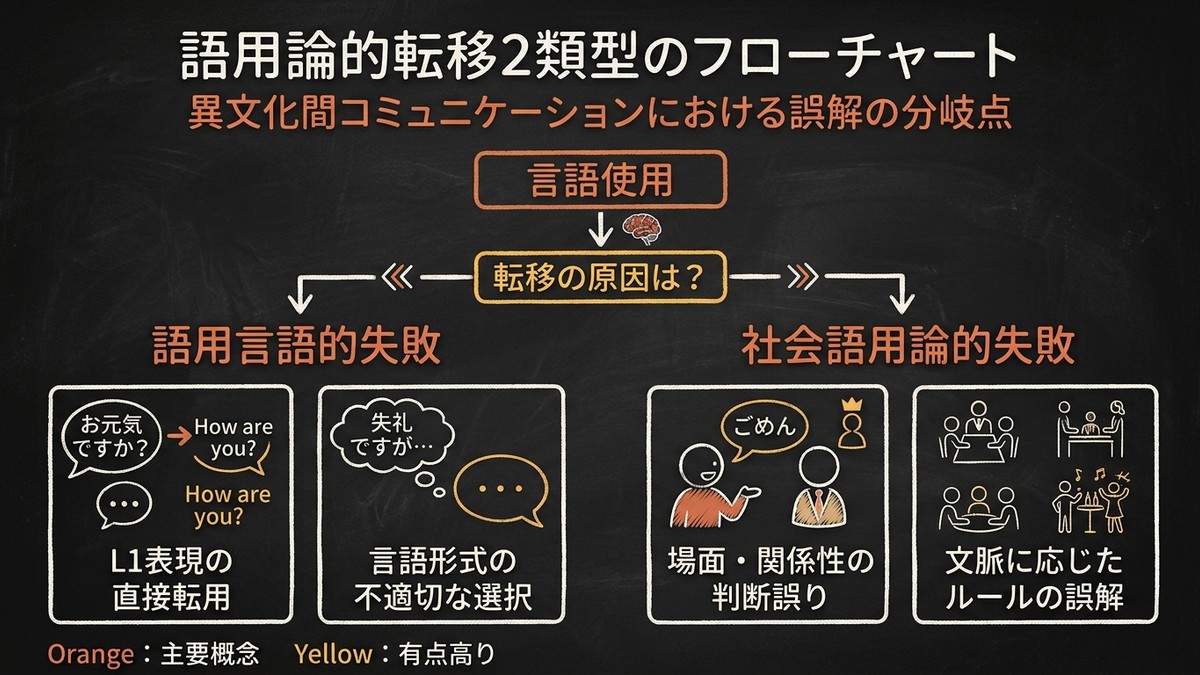
There are two types of failure in pragmatic transfer [10][11].
| Failure Type | Definition | Typical Bad Example |
|---|---|---|
| Pragmalinguistic Failure | Direct transfer of L1 expressions at the vocabulary/syntax level | Translating "No, I can't" directly as "Dekimasen" and using it |
| Sociopragmatic Failure | Social judgments regarding situations/relationships differ from the native language | Lacking euphemism in refusals and using overly direct expressions |
Pragmatic Transfer Seen in "Refusals"
"Refusing" a request is a speech act where pragmatic transfer appears most vividly [14]. In English, it is natural to refuse explicitly, such as "I'm sorry, I can't make it." In contrast, the following expressions are used in Japanese:
- Euphemistic Refusal (Example 1): "Well... that day is a bit difficult..."
- Euphemistic Refusal (Example 2): "Definitely next time..."
- Bad Pattern: "No, I cannot go." (Iie, ikemasen)
"Ikemasen" (I cannot go) is grammatically accurate. However, it is too direct and can cause rifts in relationships.
The Confusion Caused by Ambiguous Words
In Japanese, there are expressions whose meanings can reverse depending on the context [18].
- "Ii desu" (It's fine): Can mean "That works for me" (affirmative) or "No, thank you" (polite refusal).
- "Daijoubu desu" (It's okay): Similarly holds both affirmative and negative meanings.
- "Kentou shimasu" (I'll consider it): In Japanese, this is a euphemism leaning towards a negative response, but to English speakers, it sounds like "We'll consider it" (implying possibility) [19].
- "Dekiru dake hayame ni" (As soon as possible): Lacks a specific deadline, making it sound indefinite to those from low-context backgrounds [18].
The "That would be difficult" episode at the beginning is a typical example of this. "Difficult" (Muzukashii) is not "under consideration" but a euphemism for "refusal" [19]. Even if Japanese classrooms teach that "Muzukashii desu ne = refusal," not many learners can successfully apply it in actual business negotiations.
The Danger of Uncorrected Failures
Grammatical errors are sometimes gently corrected, like "You mean X is Y, right?" However, pragmatic failures are not corrected [10]. Native speakers quietly judge, "This is just the kind of person they are," and distance themselves. Nothing is communicated to the learner—this is the most dangerous aspect.
The Psychological Costs of CCCS and Effective Switching Strategies
Molinsky termed the act of consciously deviating from one's own behavioral norms in cross-cultural situations as "Cross-Cultural Code-Switching (CCCS)" [1]. CCCS entails three psychological costs:
- Authenticity Challenge: The conflict with one's own values, feeling that "this is not the real me."
- Competence Challenge: The anxiety over a lack of skill, feeling that "I can't switch effectively."
- Resentment Challenge: The anger over forced conformity, wondering "Why am I the only one who has to change?"
Bilingual and Bicultural Are Different Things
Switching languages and switching cultural frames are different abilities [3]. Even if someone is bilingual, if they are not bicultural, "Cultural Frame Switching (CFS)" is less likely to occur [3].
Person A, who speaks English and Japanese fluently, is always direct in their remarks even during Japanese meetings. They have not adapted to the Japanese style of Nemawashi (consensus-building) or the "Ma" (pause/silence) during Q&A sessions.
This is the fundamental difference between being bilingual and being bicultural. Switching language codes does not automatically mean switching cultural frames.
Viewing Nemawashi as Risk Management
Nemawashi is the practice of consulting individually with stakeholders to build consensus before an official meeting [15]. Similarly, Ringi is a process where a proposal document is circulated and approved by each hierarchical level [15]. If a foreigner suddenly presents a "new proposal" in a meeting, they will be met with distrust for lacking prior Nemawashi.
This practice becomes easier to understand if you reframe it as an act to "prevent root rot." When reinterpreted as risk management to eliminate rework during the implementation phase, it functions not as a forced custom, but as a rational consensus-building process.
The Double Bind of KY (Reading the Room)
The concept of "Kuuki wo yomu" (reading the room/atmosphere) became popular around 2007 [16][17]. It refers to sensing and adapting to the mood of the room, collective consensus, and unspoken expectations. Herein lies a paradox.
- Japanese Workplaces: Reading the room and refraining from speaking -> Evaluated as "thoughtful."
- Low-Context Organizations: Taking the same action -> Evaluated as "someone with no ideas" [18].
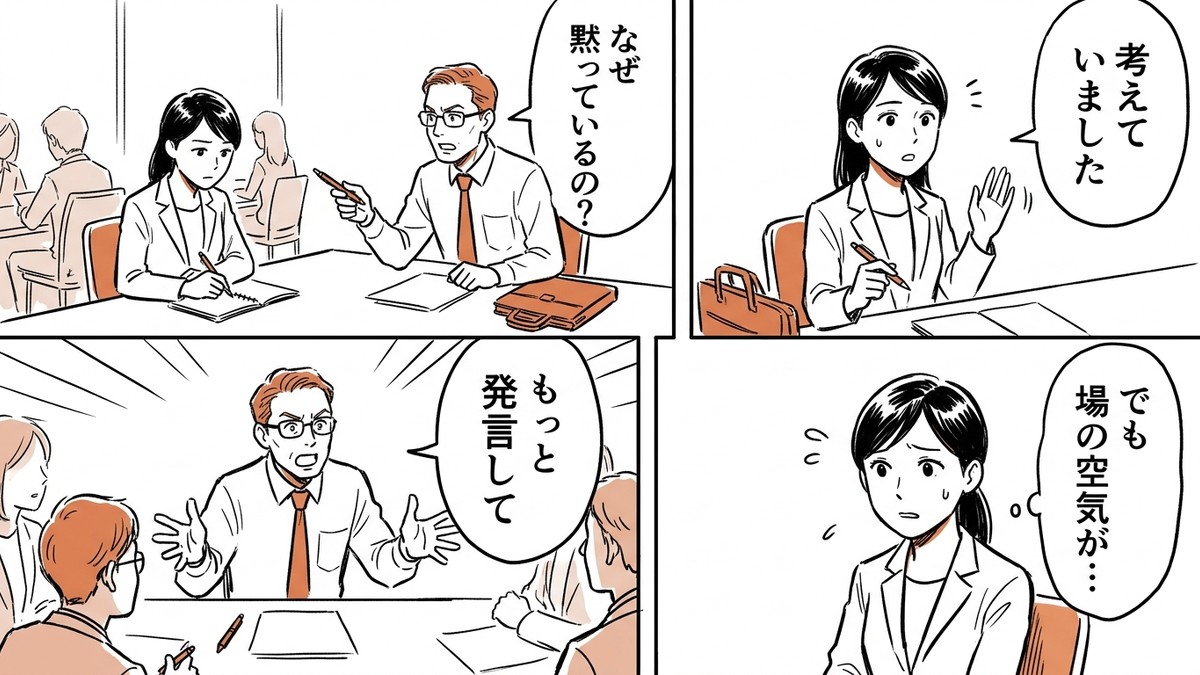
"Enryo" (restraint/hesitation), which is considered a virtue in Japan, becomes a "signal of incompetence" in Western organizations—this is the double bind of behavioral codes. The correct answer changes 180 degrees depending on which context you are working in.
Cognitive Shifts to Lower the Cost
Research shows that people who view both cultures as "complementary" rather than "conflicting" experience lower psychological costs when switching [3]. Simply shifting your cognition from "I am acting out the Japanese style" to "I am mastering another rational logic" significantly reduces feelings of exhaustion. The perspective that you possess two sets of intellectual tools is the key to making CCCS sustainable.
Conclusion
Let's review what we have learned in this article.
- Japanese is at the extreme right of high-context: Meaning resides outside of words—in context, non-verbal cues, and silence. The three layers of Uchi/Soto, Tatemae, and Ma form its foundation.
- There are two types of pragmatic failures, and they go uncorrected: Pragmalinguistic failures (direct translation type) and sociopragmatic failures (misjudging the situation) quietly accumulate, unlike grammatical errors.
- Switching behavioral codes requires both skill and cognition: A cognitive frame that shifts from "conflict" to "complement" is the key to lowering psychological costs.
What You Can Do Starting Today
- Practice not interrupting "Ma": Make it a habit to wait 3 seconds instead of immediately filling the silence in a conversation. Silence in Japanese has meaning. When you stop trying to fill it, the other person's true intentions will become visible.
- Role-play euphemistic refusals: Repeatedly practice refusal scenarios using phrases like "Well... that's a bit difficult..." and "Definitely next time..." to internalize them. Just knowing them in your head won't allow you to use them in actual situations.
- Practice Nemawashi: Consciously take the step of asking for opinions individually from stakeholders before making an important proposal. A "prior word" builds the foundation of trust.
Pragmatic competence is not acquired overnight. However, simply knowing the fact that "failures are not corrected" is the first step toward awareness. From "speaking" to "communicating"—crossing that bridge starts today.
References
- Molinsky, Andrew, "Cross-Cultural Code-Switching: The Psychological Challenges of Adapting Behavior in Foreign Cultural Interactions," Academy of Management Review, Vol. 32(2), pp. 622–640, 2007. https://journals.aom.org/doi/10.5465/AMR.2007.24351878
- "The Potential Cost of Cultural Fit: Frame Switching Undermines Perceptions of Authenticity in Western Contexts," Frontiers in Psychology, 2018. https://pmc.ncbi.nlm.nih.gov/articles/PMC6306435/
- "High-context and low-context cultures," Wikipedia. https://en.wikipedia.org/wiki/High-context_and_low-context_cultures
- "What are High-Context and Low-Context Cultures? Is Japanese High-Context or Low-Context?," TCJ Japanese Language Teacher Training Course. https://xn--euts3n8lg6bk91h.jp.net/tcj-column/高コンテキストと低コンテキスト文化とは?/
- "Uchi and Soto, Essential for Improving Japanese — Is Japanese Keigo Complicated?," TCJ Japanese Language Teacher Training Course. https://xn--euts3n8lg6bk91h.jp.net/tcj-column/日本語の上達に欠かせないウチとソト/
- "What is Pragmatic Transfer?," Mainichi Nonbiri Nihongo Kyoushi. https://mainichi-nonbiri.com/jltct/pragmatic-transfer/
- "Pragmatic Transfer in Intermediate Japanese Learners' Apology Speech Act," Journal of Japanese Language Education and Linguistics, 2023. https://journal.umy.ac.id/index.php/jjlel/article/view/15260
- "Honne and tatemae," Wikipedia. https://en.wikipedia.org/wiki/Honne_and_tatemae
- "Silence in Japanese Business Culture and Communication," Commisceo Global. https://commisceo-global.com/articles/silence-in-japanese-business-culture-and-communication/
- Tiantian Zong, "Trends in Research on 'Refusals' in Japanese: In the Case of Requests," Bulletin of the Graduate School of Social and Cultural Studies, Nihon University, No.19, pp.207–218, 2018. https://gssc.dld.nihon-u.ac.jp/wp-content/uploads/journal/pdf19/19-207-218-Zong.pdf
- "The Invisible Hand: How Nemawashi Shapes Every Decision in Japan," GLOBIS Europe. https://globis.eu/nemawashi-in-japanese-culture/
- Misaki Hidaka & Takashi Kosugi, "A Social Psychological Study on the Expression 'Reading the Air' (Kuuki wo yomu)," Core (Academic Paper Repository). https://files01.core.ac.uk/download/pdf/35427095.pdf
- "The Japanese Who Read the Air," Kansai Gaidai University Repository, 2020. https://kansaigaidai.repo.nii.ac.jp/record/7929/files/j23_08.pdf
- "Is Japanese High-Context and Hard for Foreigners to Understand? 4 Communication Skills for Business," Asia to Japan. https://asiatojapan.com/jgs/recruitment-how-to/high-context/
- Bikas Ramsar, "Essay: The Ambiguity of Japanese," SGRA Report (Atsumi International Scholarship Foundation), 2017. https://www.aisf.or.jp/sgra/combination/sgra/2017/8724/
