
I Was Afraid of Silence — The Day I Learned the Meaning of 'Ma' in a Japanese Conference Room

By NIHONGO-AI
AI Engineer/Japanese Language Educator
4/10/2026

I Was Afraid of Silence — The Day I Learned the Meaning of "Ma" in a Japanese Conference Room
Introduction
Thin afternoon light filtered through the conference room window.
Across the table, Department Head Tanaka sat with his eyes cast down on a document, saying nothing. Five seconds. Ten seconds. The second hand of the wall clock ticked away, sounding strangely loud.
"...Oh no. I've made him angry."
That single thought was all that filled my mind. Had something gone wrong in the presentation? Were there errors in the numbers? Or had I chosen my words poorly? I could feel cold sweat running down my back as I desperately searched for what to say next.
It had been about six months since I came to Japan. I had studied Japanese at a language school and had gotten reasonably good at everyday conversation. But I still had no idea how to handle "silence."
In this article, I'll share the story of that mistake and what I came to understand from it. By the end, you'll have a clearer picture of:
- Why silence in Japan is sometimes neither anger nor rejection
- The unique breadth of meaning carried by the word "ma"
- How changing your interpretation changes your actions and the atmosphere of a situation
An Afternoon of Apologies
That day, I was there to present an overview of a new project. I had prepared slides and double-checked all the figures beforehand. When I finished my fifteen-minute explanation, I quietly thought to myself, "That went pretty well."
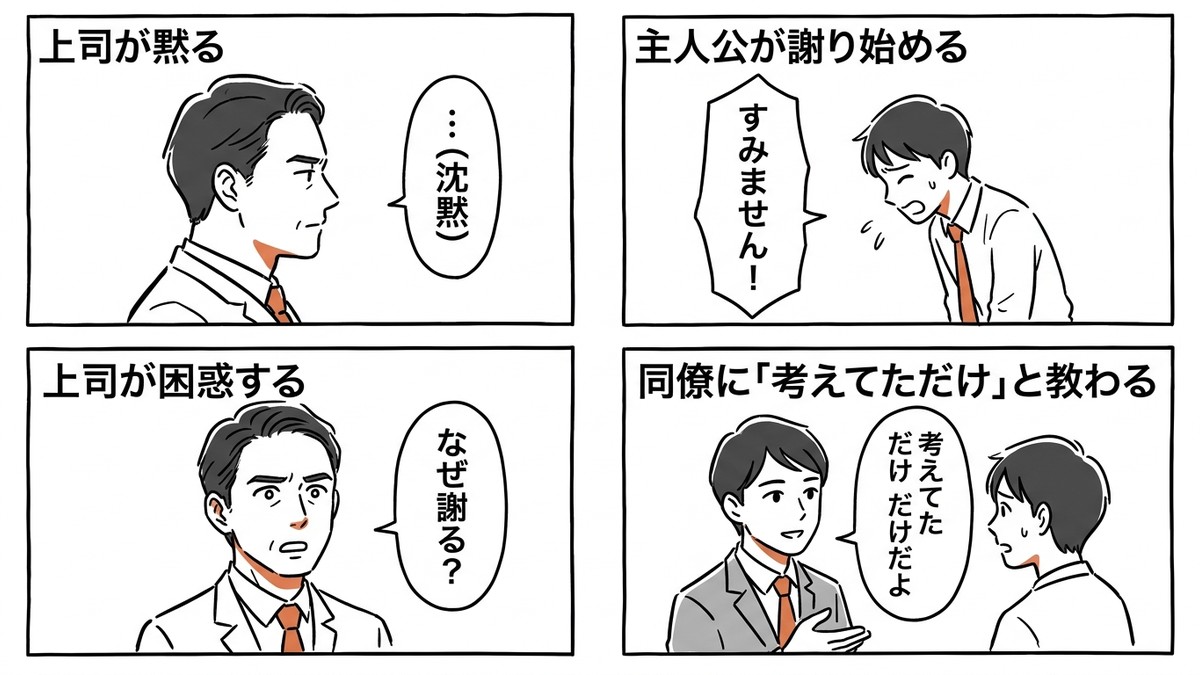
The moment I finished, Department Head Tanaka dropped his gaze to the documents in front of him. And then he went silent.
At first I thought, "Maybe he's turning a page." But there was no sound of pages turning. His hand didn't reach for his coffee cup. He was simply there, quietly.
In my home country, silence during a discussion is usually a sign of disapproval. When someone doesn't like a proposal, when they're angry, or when they're exasperated — that's when people go quiet. At least, that's what I had always learned.
So the longer the silence stretched on, the more my conviction grew. "This is bad. I've done something wrong."
"Um, I'm sorry. Was there something that concerned you?"
The words tumbled out faster than I intended. The department head slowly looked up and shook his head.
"No, it's not that..."
"If my explanation was unclear, I can go back to the beginning and start over."
"No, it's fine."
"Um, was there a problem with the budget estimate? I can revise it..."
"What? No, that's not—"
Looking back now, the department head was simply organizing the contents of the proposal in his head. He was probably rechecking the numbers mentally and cross-referencing them with the schedule. But to me in that moment, the silence looked like nothing but a "warning sign." Even as I could feel his expression gradually shifting to confusion with each apology, I kept apologizing.
When the meeting ended and I stepped into the hallway, my colleague Matsumoto-san fell into step beside me.
"Hey, are you okay? You were apologizing like crazy in there."
"...The department head was angry, wasn't he? Did I do something wrong?"
Matsumoto-san thought for a moment, then said:
"That silence? I don't think he was angry at all. He was just thinking, I'm sure of it."
"Thinking...?"
"Tanaka-san is always like that. He's the type of person who listens to what you say, properly organizes it in his own mind, and then responds. That pause — that's his signal for 'I've taken this seriously.'"
I was speechless.
On the way home, I turned that silence over and over in my mind. I remembered the department head's face as he stared at the documents. It really wasn't the face of someone angry. It was the face of someone concentrating.
The Day My Interpretation Changed
From the day Matsumoto-san told me about it, the word "ma" never left my mind.
The Japanese word ma is not simply a stretch of silence. It is a concept used in theater, music, and everyday conversation alike — referring to an intentional "quiet space." Within this single word is packed an active set of meanings: time to organize one's thoughts, time to choose words carefully, a signal that something is being received with sincerity.
Once I understood that meaning, the way I saw silence began to shift, little by little.
Two weeks later, there was another meeting. When I finished giving my progress report, my supervisor went silent again.
The old me would have opened my mouth without a moment's pause: "Is there anything unclear?" But this time, I chose to wait.
One second. Two seconds. Three seconds.
Repeating silently to myself, "I don't need to fill the silence. This is time for them to think," I stayed quietly where I was. Three seconds honestly felt quite long. Still, I didn't open my mouth.
"...I see. Alright then, let's take another look at that cost."
My supervisor spoke slowly. There was real substance to the words. Having received the report, a concrete next action had emerged. With a simple "Yes, I'll check on that," the meeting wrapped up neatly.
Just by waiting three seconds, the whole atmosphere of the room was completely different.
Then there was another change. This time, situations began to arise where I myself went silent.
In one meeting, I was suddenly asked for my opinion. An answer didn't come to me right away. The old me would have bought time with filler words like "Um, well..." But this time, I paused for a moment before speaking.
"...Thinking about the goals of this project, I believe Option A would be better."
The conference room went quiet for two or three seconds. But no one rushed me. My supervisor nodded and said, "Yeah, that's one way to look at it."
Rather than rushing to answer, pausing for a moment before speaking gives words more weight. When I realized that, that afternoon of endless apologies felt a little more distant.
I was no longer afraid of silence.
Conclusion
It has been several years since that silence in the conference room.
Now, when someone goes quiet, my first thought is never "they're angry." I've come to feel it's one of two things: "they're thinking" or "they're choosing their words." When my interpretation changed, my behavior changed. I stopped apologizing in situations that didn't call for it. I stopped rushing to fill silences. I became able to pause briefly before speaking myself.
Changing your interpretation before expanding your vocabulary — that, I can now say clearly, was the shortest path to changing my behavior.
The realization that muzukashii desu ne ("that's difficult") can be a roundabout refusal, that kentō shimasu ("we'll consider it") is a sign that nothing will happen right away, that mata kondo ("some other time") is a gentle rejection — the ability to notice the meanings hidden beneath these expressions also began with that misreading of silence. Whether it's silence or words, if you read only the surface, you miss what matters most.
Here are three things you can start doing today:
- When someone goes silent, wait three seconds first. Whether that silence means anger or thought usually becomes clear after three seconds.
- Don't rush to answer yourself. Pausing briefly before speaking adds weight to your words.
- Hear "that's difficult," "some other time," and "we'll consider it" as indirect expressions. Simply being aware that something may lie beneath the words changes how Japanese sounds to your ears.
Silence is not emptiness.
It is a vessel for the time in which the other person is turning something over in their mind. The day I understood that, the way I engage with the Japanese language changed, just a little.
Share this post:
Share on X and tell us what you think! It helps if you add your region, age, native language, and community.

Related Articles

Does 'Uh-huh, uh-huh' Mean I'm Being Rushed? — A Miscommunication About Backchannels and Silence I Noticed on a Japanese Phone Call
By NIHONGO-AI
AI Engineer/Japanese Language Educator
Date
6/14/2026

Those 3 Seconds as the Elevator Doors Close
By NIHONGO-AI
AI Engineer/Japanese Language Educator
Date
5/26/2026

Untitled (en)
By NIHONGO-AI
AI Engineer/Japanese Language Educator
Date
5/14/2026