
Holding My Breath on a Packed Train — Until I Learned That Silence Is a Form of Warmth

By NIHONGO-AI
AI Engineer/Japanese Language Educator
4/24/2026

Holding My Breath on a Packed Train — Until I Learned That Silence Is a Form of Warmth
Introduction
On my first morning commute after arriving in Tokyo, I boarded the train.
The moment the doors slid shut, I noticed: no one was talking.
The car was packed shoulder to shoulder, yet all I could hear was the sound of the wheels on the rails. Hands gripping the hanging straps, shoulders swaying slightly with the motion, everyone facing straight ahead, standing still as stone statues. Even by the windows where the morning light streamed in, not a single person made a sound. Dozens of people filled the car, yet each one was isolated like a small island unto themselves.
"Did I do something wrong?"
The thought crept in, and I stole a glance at the person next to me. But their eyes stayed fixed on their phone screen, not once looking my way. The person in front, the person behind — everyone was silent.
I tried offering a smile, but no one noticed. For some reason, that silence felt like it was reproaching me.
In this piece, I want to share the experience of finally understanding what that strange quietness meant. By the end, three things will naturally fall into place: ① why Japanese trains are so extraordinarily silent, ② why "silence" and "coldness" are entirely different things, and ③ why "being quietly present together" is the Japanese way of showing warmth.
"Is Everyone Angry?" — The Source of My Confusion
Back home, buses and trains were lively places.
"Hey, did you hear about yesterday?" "I really want to go back to that place." "Is the transfer at the next stop?"
Even strangers would catch each other's eyes and share a small smile, exchange a few words. Liveliness was a sign of energy; silence, if anything, signaled that something was wrong.
So the quiet of Tokyo's trains struck me as "rejection."
One morning, I worked up the courage to speak to the person beside me.
"Excuse me, is the next stop Shibuya?"
They stiffened slightly, said only "Yes, that's right," and immediately went back to staring at their phone. They had answered me, but I was left feeling oddly apologetic. "Maybe I shouldn't have asked," I thought, readjusting my grip on the strap.
On another day, a seat opened up. I turned to someone standing nearby and asked, "Would you like to sit?" They declined — "No, I'm fine" — and quietly looked away. No smile, no word of thanks, just a silent, gentle withdrawal.
Every morning I boarded that train, my spirits sank a little. "People in Tokyo are cold" — I was on the verge of concluding exactly that.
Beyond the Curtain — The Night Everything Transformed
That same evening, a colleague invited me to an izakaya near the office.
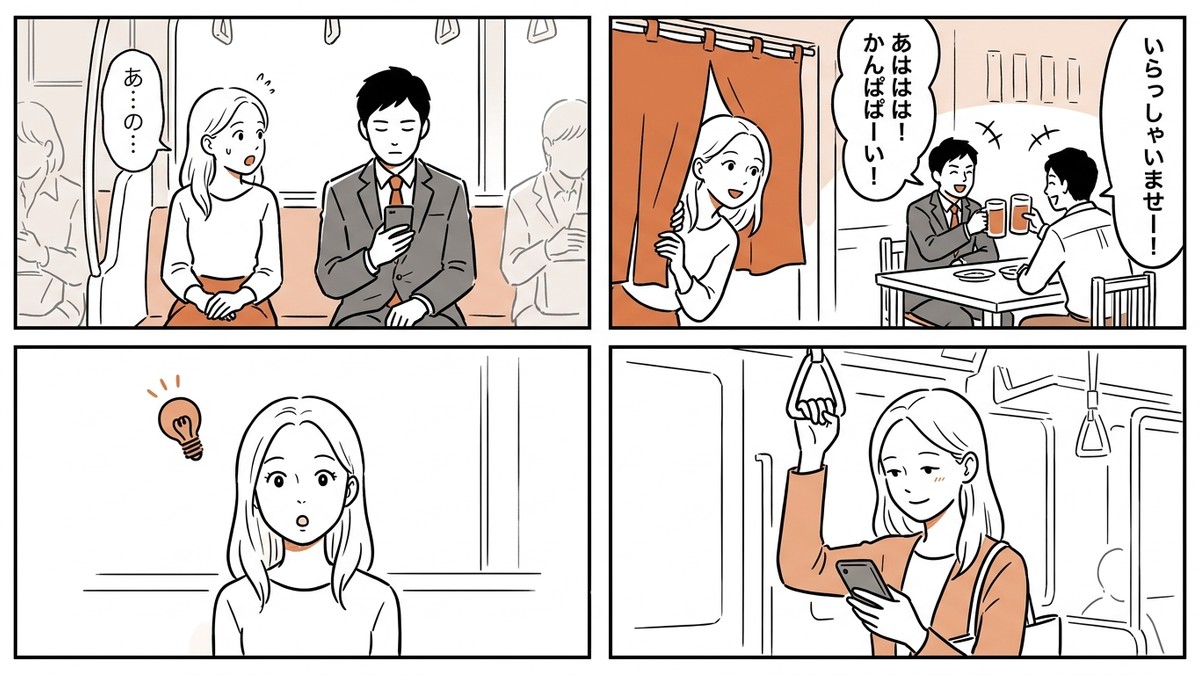
The moment I ducked through the noren curtain, a booming "Irasshaimase!" rang out to greet me.
Inside, the place was bright, warm, and full of laughter. At a table in the back, several men in suits sat with flushed faces, deep in animated conversation.
"And then what do you think the manager said?" "No way! Hahaha!" "Just one more round! Hey — excuse me!"
I stopped in my tracks.
I recognized one of those men. He had been standing next to me on the train that very morning — the one who had stared in silence at his phone. Now he was doubled over with laughter.
"He wasn't cold at all."
In that instant, something inside me loosened. The silence on the train hadn't been rejection. He had simply been following the rules of that space. The train was a place for quiet; the izakaya was a place for noise. That was all there was to it.
"Otsukaresama!" voices called out, and the clinking of glasses filled the air. The same person, so completely transformed by place. That vivid contrast struck me, oddly, as something beautiful.
"I'm Allowed to Be Here" — A Morning of Realization
The next morning, I boarded the commuter train again.
This time I tried something different. I stopped trying to talk to anyone and simply stayed quiet. I took out my phone and looked at the screen. I let myself sway with the motion of the train and stood there in silence, just like everyone around me.
And then something strange happened.
I stopped feeling out of place.
That silence began to feel less like pressure and more like a "pact." "We don't speak here. Everyone agrees to this. So do I." — By joining that small, unspoken agreement, a quiet sense of being accepted slowly spread through me.
"I'm allowed to be here."
No words, no smiles exchanged — just sharing the same space and the same silence. And yet, somehow, that was what it felt like. It was a feeling learned not through language, but through the body.
The silence of the train is a kind of courtesy. And courtesy is a wordless message that says, "I'm thinking of you." "I won't disrupt your time. I'll leave your morning undisturbed." — That meaning was quietly woven into the silence all along.
Back home, "speaking up" was the signal that said "I'm interested in you." On Tokyo's trains, "staying silent" was the signal that said "I respect you."
The same warmth, simply expressed in completely opposite ways.
Conclusion — Silence Is Not a Wall, But an Invitation
When I first came to Japan, the silence on the trains made me anxious.
No one smiling, no one talking, no one making eye contact. "Do they dislike me?" I wondered. But one evening at an izakaya, and the train ride the following morning, taught me otherwise.
That silence was not "keep out" — it was an invitation saying "let's be quiet together."
Strangers quietly upholding the same unspoken rules, wordlessly telling each other "you belong here." Tokyo's trains carry that kind of soft, warm agreement. No one teaches it to you. You absorb it naturally, simply by standing there in silence.
If you ever find yourself unsettled by the quiet on a train during your life or travels in Japan, remember this: that silence is not shutting you out — it is welcoming you in.
Here are three things you can start doing today.
- Blend into the silence on the train. Gently resist the urge to speak, and step into the same quietness as those around you. A subtle sense of belonging will quietly take hold.
- Step into a lively space like an izakaya. Watching someone who was silent on the train burst into laughter will dissolve any misreading of "coldness" in an instant.
- Read silence as a "message," not a void. Japanese silence carries meaning in place of words. Developing the habit of looking for that meaning will open up a deeper understanding of Japanese culture.
Share this post:
Share on X and tell us what you think! It helps if you add your region, age, native language, and community.

Related Articles

Does 'Uh-huh, uh-huh' Mean I'm Being Rushed? — A Miscommunication About Backchannels and Silence I Noticed on a Japanese Phone Call
By NIHONGO-AI
AI Engineer/Japanese Language Educator
Date
6/14/2026

Those 3 Seconds as the Elevator Doors Close
By NIHONGO-AI
AI Engineer/Japanese Language Educator
Date
5/26/2026

The Day I Became 'Invisible'—What I Learned About True 'Thoughtfulness' on Japan's Packed Trains
By NIHONGO-AI
AI Engineer/Japanese Language Educator
Date
9/10/2025