
Does 'Uh-huh, uh-huh' Mean I'm Being Rushed? — A Miscommunication About Backchannels and Silence I Noticed on a Japanese Phone Call

By NIHONGO-AI
AI Engineer/Japanese Language Educator
6/14/2026

Does 'Uh-huh, uh-huh' Mean I'm Being Rushed? — A Miscommunication About Backchannels and Silence I Noticed on a Japanese Phone Call
Introduction
Have you ever felt like you were being hurried along when the other person kept saying "uh-huh, uh-huh" in the middle of a conversation?
I'm an international student who had just arrived in Japan on an exchange program. My Japanese is still a work in progress — I get through each day learning one word at a time. For someone like me, there was one thing about speaking Japanese that I just couldn't settle into: the sheer frequency of the other person's backchannels.
The prime example was M, a friend I made almost immediately after arriving in Japan. M is a native Japanese speaker — born and raised in Japan, and my very first Japanese friend. Kind and easy to talk to, yet whenever we spoke on the phone, M would layer responses over my words — "un," "naruhodo," "sō nanda" — one after another. In those early days, I found it a little hard to take.
In this essay, I want to share three things I realized through a particular phone call with M and the offhand remark that followed. Why is Japanese conversation so saturated with backchannels? Why did the same "silence" look completely different to M and to me? And how did a single candid admission close that distance?
Why I Used to Struggle with "Uh-huh, Uh-huh"
It was nine o'clock at night. I called M to confirm where we were meeting the next day. All I needed to ask was whether the north exit would work. It was supposed to be a simple call.
"Hello, so about tomorrow…" I began, and immediately came back "un." "We're meeting at the station, and…" "Un, un." "Outside the ticket gate at the north exit…" "Naruhodo, naruhodo."
With every sentence — no, in the middle of every sentence — M's backchannels would slip in. In the conversational rhythm I grew up with, repeatedly chiming in while someone is still talking is more or less a signal that says "hurry up" or "I already get it." So inwardly, I started to panic a little. "Am I being rushed? Is my story too long?"
Trying to calm down, I paused. Just two seconds or so of silence while I assembled my next sentence in my head. To me, it was nothing — a completely ordinary pause. Going quiet when you're thinking is perfectly natural.
But in those two seconds, I could tell that M on the other end of the line had suddenly started to fidget.
"…Hello? Can you hear me?"
M's voice had taken on a faint note of anxiety. I quickly said "yeah, I can hear you," but inside I was genuinely puzzled: "I was just thinking — why the worry?" After we hung up, a nagging feeling stayed with me. Too many backchannels, and then a moment's silence sends the other person into a panic. Japanese phone calls feel so hectic — that's honestly what I thought at the time.
"That Silence Scared Me," M Said
I finally told M about that uneasy feeling a few days later, when the two of us went to a café.
"Hey, can I ask you something? You say 'un, un' a lot while I'm talking, you know. You don't have to rush me, it's okay."
I meant it as a light joke. But M looked a little surprised, then laughed with a hint of embarrassment.
"Oh, I wasn't trying to rush you at all. If anything, it's the opposite — I just naturally say it to let you know I'm listening."
"The opposite?"
"Yeah… and, honestly," M went on, "on that phone call the other day, you suddenly went quiet for a moment. I was really anxious. I kept thinking, 'Did the call drop?' 'Did I say something that bothered you?' Those few seconds actually scared me a little."
I was speechless.
The one who had been scared wasn't me. It was M who had found that silence frightening. To me, silence was simply "time to think." To M, it was "a moment when our connection might have snapped."
Later, my Japanese teacher said much the same thing in class. In Japanese conversation, it's normal to regularly voice the fact that you're listening, and when that signal suddenly falls away, the speaker tends to worry about whether their words are getting through. That's why M had kept returning a steady stream of "un" and "naruhodo" — and why M had been so unsettled by my brief silence.
The Misunderstanding Was Mutual
My whole perspective flipped around.
I had thought there were too many backchannels; M had found the silence scary. But neither of us was right or wrong. We had simply grown up with different rules for conversation. The same "un, un" I read as rushing, M was sending as "I'm listening to you." The same two seconds of silence I experienced as thinking time, M received as a thread that had been cut. The misunderstanding ran both ways.
After that, I made a conscious effort to offer small backchannels in return — "un," "naruhodo," "sō nanda." At first it still felt unnatural, and it took courage to interject while the other person was speaking. But the next time I called M, when M was partway through explaining where to meet, I gathered my nerve and said out loud: "Naruhodo!"
And I could swear M's voice brightened just a little. The pace of the story seemed to ease off, ever so slightly.
"…It got through," I thought. That single "naruhodo!" had put M at ease on the other end of the line.
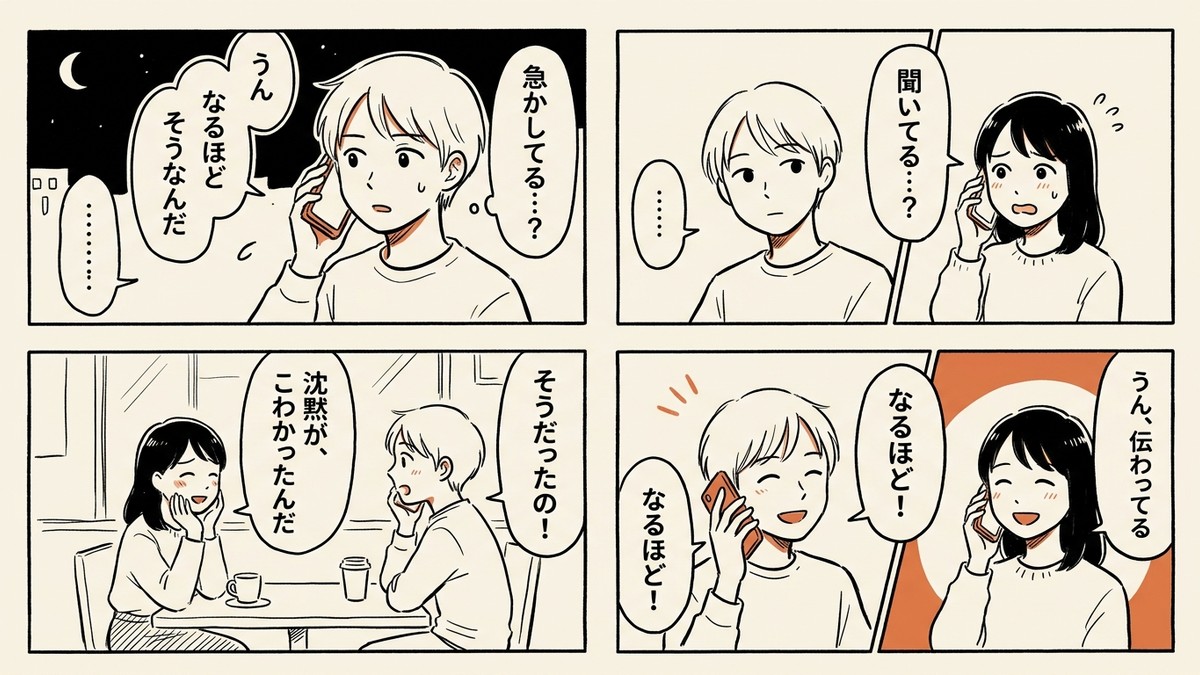
And at the same time, M's "un, un" no longer sounded like rushing to me either. I finally understood: it had always been an outstretched hand — "I'm here, listening to you."
Conclusion
Have you ever felt thrown off in a foreign-language conversation because someone gave too many backchannels, or because staying quiet for just a moment made the other person worry?
If that conversation was in Japanese, before blaming the other person, try to remember: that constant "un, un" is almost never a sign of impatience — it's a signal that says "I'm listening." And those few seconds of silence that feel like nothing to you might feel, to the other person, like the connection has been severed.
Here are three small things you can try starting today:
- Even if the other person's backchannels feel excessive, don't assume it's rushing — try receiving it first as a sign that they're listening to you
- When you fall silent to think, murmur a soft "um" or "let me see" to signal "we're still connected"
- Pick one — "naruhodo," "un," or "sō nan desu ne" — and consciously offer it in your next conversation
When conversations cross wires, it's no one's fault. The rhythms we grew up with are simply a little different. Once you realize that, the person on the other end of the line suddenly feels a lot closer. That "un, un" and that two-second silence — I can see now that they were both moments of caring about each other.
Share this post:
Share on X and tell us what you think! It helps if you add your region, age, native language, and community.

Related Articles

I Was Afraid of Silence — The Day I Learned the Meaning of 'Ma' in a Japanese Conference Room
By NIHONGO-AI
AI Engineer/Japanese Language Educator
Date
4/10/2026

Holding My Breath on a Packed Train — Until I Learned That Silence Is a Form of Warmth
By NIHONGO-AI
AI Engineer/Japanese Language Educator
Date
4/24/2026

Those 3 Seconds as the Elevator Doors Close
By NIHONGO-AI
AI Engineer/Japanese Language Educator
Date
5/26/2026