
Those 3 Seconds as the Elevator Doors Close

By NIHONGO-AI
AI Engineer/Japanese Language Educator
5/26/2026

Those 3 Seconds as the Elevator Doors Close
Introduction — Those 3 Unforgettable Seconds
The moment of parting reveals a person's true manners.
I had not known this for a long time. I had been teaching Japanese for over ten years and had led countless lessons on etiquette — and yet, the first time I actually witnessed it was on a certain autumn afternoon.
My first visit to a Japanese office was at the end of October. I was there for a meeting tied to a magazine feature. I collected a badge at the reception desk, was guided down a hallway, and shown into a small, windowless conference room. I spoke with my contact, Ms. Tanaka, for about an hour. Tea was served, materials spread across the table, and before I knew it, the air had taken on the feel of early evening.
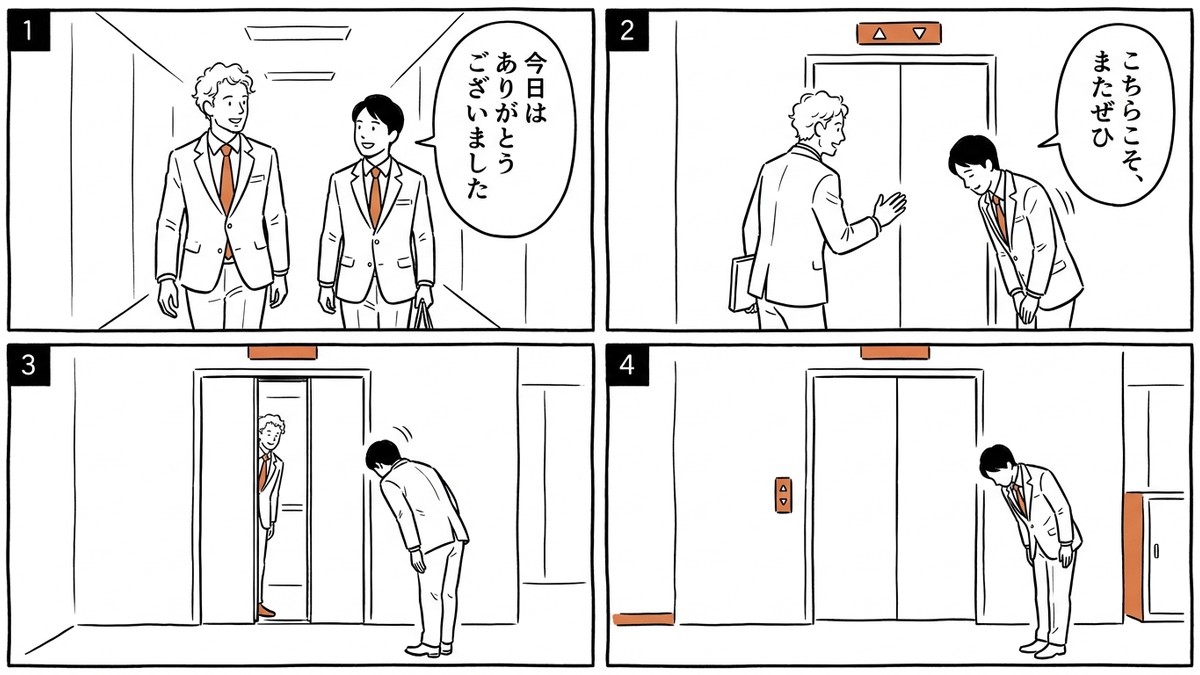
As I was leaving, Ms. Tanaka said, "I'll walk you to the elevator," and rose from her seat to accompany me down the hallway. When we reached the elevator lobby, she pressed the button and stood beside me. As we waited, she offered a few words of thanks for the meeting, giving a gentle bow as she spoke.
The doors opened.
I stepped inside, saying, "Thank you so much for today. Until next time."
The doors began to close.
On an impulse, I glanced back.
Ms. Tanaka was still there. Head bowed deeply, utterly still. The gap between the doors grew narrower and narrower — five centimeters, three centimeters, one centimeter — and still, her head did not move. In the soft light of the hallway, her silhouette alone looked as though time had stopped.
"Wait — she's still bowing...?"
The doors closed with a metallic click. The elevator began to move. For a long while afterward, I kept turning that lingering image over in my mind.
In this piece, I want to write about that experience and what I came to understand only in hindsight. I hope it reaches those with an interest in Japanese manners, those who have worked or studied in Japan, or anyone who has ever had the vague sense that Japanese greetings seem somehow more deliberate.
A Contrast with How I Say Goodbye
As I stepped out of the elevator, walked out of the building, and made my way toward the station, I kept turning those 3 seconds over in my mind.
Farewells in my own country are far more casual.
When parting with friends, we say "See you" or "Later," give a quick wave or a hug, and walk away. In professional settings, it's perfectly normal to shake hands, say "Thank you," and head off without looking back. If anything, not lingering too long has always felt like its own form of consideration. Hardly anyone turns around after they've already walked away.
Ms. Tanaka's way of saying goodbye was entirely different.
A feeling crept in slowly — did I leave too abruptly? It took time to put into words. I had been teaching courtesy as a Japanese language instructor, and yet, in that real-life moment, I had missed something. It was a quiet, gentle sense of having fallen short.
She had not moved from the spot until the doors were fully closed. She had stayed bowed, motionless.
What on earth had that been?
The Day I Went Back
A few weeks later, I visited the same office on separate business.
This time, I was paying attention. As I was leaving, Ms. Tanaka walked me to the elevator lobby again. She pressed the button by the doors, saying, "Please take care." The doors opened, and as I stepped in, I turned around.
Ms. Tanaka was bowing deeply.
The doors began to close.
And again — her head did not move.
Through the narrowing gap, I could make out Ms. Tanaka's back. Shoulders slightly rounded. Posture quietly, carefully held. The doors moved slowly but surely toward each other. And still, she did not leave.
"She is going to stay here until my presence has completely disappeared."
That realization didn't come as a surprise. It was closer to warmth — something that settled gently into the center of my chest. I found myself bowing in return. As the doors continued to close, and the elevator car grew dark around me, I could not bring myself to lift my head for a moment.
In that instant, I felt I had touched something.
The Word "Zanshin"
Afterward, I came across the word zanshin.
It is a concept used in martial arts and the tea ceremony. Even after a technique or movement has concluded, one does not relax one's mind — one continues to remain aware of the other person. That is its meaning.
In kendo, one does not drop one's guard after striking. In kyudo, one does not break one's posture after releasing the arrow. In the tea ceremony, one continues to handle the utensils with care even after the tea has been served. In each case, the "moment the action ends" is not, in fact, the end. The state in which "the heart is still present" is considered the very essence of the technique or the courtesy.
When I learned that word, it overlapped perfectly with the image of Ms. Tanaka.
Even after the doors had closed, Ms. Tanaka was still in the middle of seeing me off. Until my presence had completely disappeared, she did not leave. Her body remained in the hallway, but her heart was still turned toward me.
The phrase "leaving one's heart behind" settled into me with a quiet rightness.
A farewell is not about "ending" — it is about "keeping one's heart directed toward the other person until the very last moment." Ms. Tanaka's bowed back taught me this without a single word. It isn't written in any manual. It isn't taught in any class. And yet, in those 3 seconds as the elevator doors closed, it was unmistakably there.
In Closing — Staying Just a Little Longer
Since then, the way I say goodbye has changed, just a little.
When I step into an elevator and the doors begin to close, I no longer turn away immediately. I keep my head bowed just a little longer — until the other person's figure disappears from view. That's all it is.
And yet, something is different.
The act of parting feels as though it has shifted — from an "action that completes" to an "attitude that continues until the very end."
Here are three things I'd like you to try, starting today.
First: don't walk away the instant you say goodbye. Stay where you are until the other person has fully departed or passed out of sight. Second: keep bowing until the elevator doors have closed completely. Rather than lifting your head the moment the doors shut, wait until they are fully closed, hold that position for one beat, and then return to upright. Third: don't immediately reach for your phone the moment after parting. Let the time you shared with that person linger just a little longer.
Zanshin is not a difficult philosophy. Three seconds is enough. Remaining in place. Still being there, even after the other person can no longer see you. That alone is enough for people to sense true courtesy.
I can still picture Ms. Tanaka clearly — standing motionless beyond those half-closed doors on that autumn afternoon. Those 3 seconds quietly taught me what the essence of Japanese courtesy truly is.
Share this post:
Share on X and tell us what you think! It helps if you add your region, age, native language, and community.

Related Articles

Holding My Breath on a Packed Train — Until I Learned That Silence Is a Form of Warmth
By NIHONGO-AI
AI Engineer/Japanese Language Educator
Date
4/24/2026

"I Was Just Thinking" — What Talented Engineer Mr. Li Learned from the Silence in the Workplace
By NIHONGO-AI
AI Engineer/Japanese Language Educator
Date
12/19/2025

Does 'Uh-huh, uh-huh' Mean I'm Being Rushed? — A Miscommunication About Backchannels and Silence I Noticed on a Japanese Phone Call
By NIHONGO-AI
AI Engineer/Japanese Language Educator
Date
6/14/2026