
Untitled Post (en)

By NIHONGO-AI
AI Engineer/Japanese Language Educator
5/14/2026

title: '"So, What's Your Point?"——The Five Minutes That Changed My Japanese' excerpt: "The day a perfectly prepared five-minute report crumbled with a single sentence. What I learned wasn't grammar — it was the feeling of handing someone a map of your message." tags: ["Japanese Learning", "Personal Experience", "Business Japanese", "Cross-cultural Communication"]
"So, What's Your Point?"——The Five Minutes That Changed My Japanese
Introduction
That morning, my notebook was filled with perfect Japanese.
It was spring, about six months after I had joined the company. I had stayed up late the night before preparing for the next morning's briefing. The week's project progress, the challenges, the next steps. I read through my carefully organized notes over and over, checked my pronunciation, and finally went to sleep.
"This time, it will go well."
I was certain of it.
If you're learning Japanese, you probably know this feeling. You've prepared carefully, spoken accurately and fluently — yet the look of understanding never appears on the other person's face. That frustration comes from something different from a simple lack of vocabulary.
In this article, I'll share the three things I realized from my own "five-minute collapse." Why accurate Japanese sometimes fails to get through. What power lies in the phrase "Ketsuron kara mōshiagemasu to" (To come to the point first). And how the sense of handing someone a map of your message can change your relationship with Japanese.
The Five-Minute Collapse
The next morning, when I walked into the meeting room, I felt a quiet confidence.
Standing before Section Chief Tanaka, I began to speak.
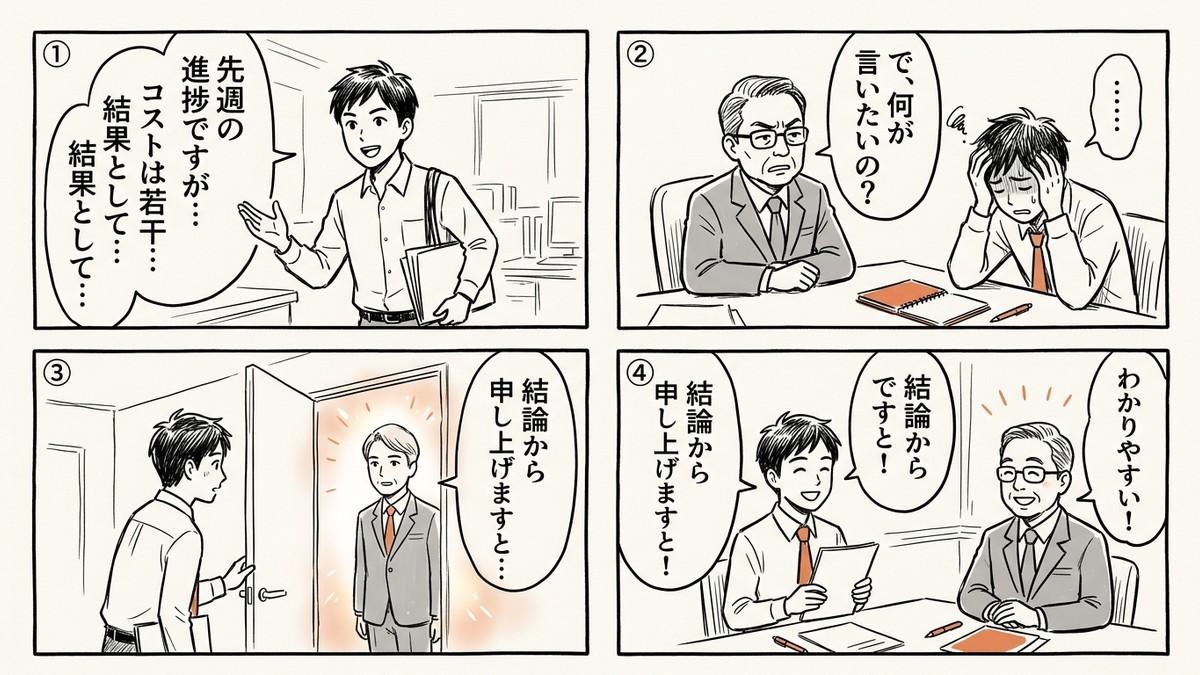
"Regarding last week's progress — Project A is on schedule. However, there has been a delay in receiving a response from the other party, which may affect the timeline. As a countermeasure, we decided to proceed with Plan B in parallel. Costs will increase slightly, but we determined this would spread the risk. As a result, we expect the direction to be finalized by the end of this week."
For five minutes, I didn't stumble once. There shouldn't have been any grammatical errors. Every word I had prepared had come out neatly, just as planned.
But then a silence fell.
Section Chief Tanaka said, furrowing his brow slightly:
"So, what's your point?"
My mind went completely blank.
"What? I said everything…" I thought to myself, but my mouth didn't move.
What's my point? Hadn't I just finished saying everything? Yet there was no look of understanding on Section Chief Tanaka's face. If anything, he looked slightly tired, like someone who had been kept waiting too long.
I had spoken accurately, yet nothing had gotten through. That contradiction drove itself deep into my chest.
The meeting ended shortly after. Out in the hallway, I stood clutching my notebook to my chest. The words "But I was accurate" kept going around and around in my head. I had read many grammar books. I had practiced my pronunciation. But that silence — that, I couldn't explain.
The Answer Was in the Hallway
That afternoon, I was walking down the hallway.
The door to a meeting room was slightly ajar, and I could hear the voice of my senior colleague, Yamamoto-san, coming from inside.
"To come to the point first — this week's sales exceeded our target by 10%."
I stopped in my tracks without thinking.
After those words, I could sense the atmosphere in the room shift. It felt as though everyone listening had simultaneously moved into a posture of attentive listening. Yamamoto-san then went on to explain each reason carefully, one by one. No one interjected. Everyone was following the conversation as if they had a map in hand.
Ah — so that's it.
A jolt like electricity ran through me.
Why had Yamamoto-san's report landed so smoothly? The answer was simple. The listeners had known where the story was going. Traveling with a map versus traveling without one — even on the same road, the experience is completely different. My five-minute report had been dragging people along with no map at all.
Section Chief Tanaka had been asking for a "map" of my message. "Where is this going?" "What's the most important thing?" Without knowing that upfront, people get lost trying to follow along. I had been lining up accurate words while forgetting to hand the other person a map.
"To come to the point first."
That single phrase had been serving as the map.
The Morning of the Next Report
One week later, the night before the next morning briefing. I opened my notebook again.
But this time, I wrote differently. First, I wrote down "the one thing I most want to say." Then the reasons and the details. The order of preparation was reversed.
The next morning, standing before Section Chief Tanaka, my heart was pounding.
"To come to the point first — Project A will be completed on schedule."
My voice trembled a little. But I said it.
Section Chief Tanaka's expression softened gently.
"Good, go on."
Those two words — how happy they made me. I talked about the reasons. I talked about the concerns. I talked about the countermeasures. Section Chief Tanaka listened in silence all the way to the end.
"That was easy to follow!"
After the meeting ended, Section Chief Tanaka said that to me.
A warm feeling spread slowly through my body. It wasn't so much that my Japanese had improved — it felt more like I had become a little better friends with Japanese.
This kind of expression isn't limited to business reports. With slight adjustments, it works in everyday situations too.
"To cut to the chase — tomorrow's meeting has been cancelled."
"In a word — this project is a success."
"To give you the key point first — the costs came in within budget."
The words may change to fit the situation, but the sense of "handing over the map first" stays the same.
Conclusion
From that five-minute collapse, I learned one thing.
Mastering a language isn't only about learning the right words. Developing the sense of handing the other person a "map of your message" — that is the key that opens the door to true communication.
The phrase "To come to the point first" is not grammatically difficult. But for me to feel in my bones when, why, and how to use it — I needed one collapse first. Failure is the fastest teacher.
Here are three things you can start doing today.
First, the next time you need to tell someone something, try saying "the one thing you most want to say" out loud at the very beginning. Building the habit of writing from the conclusion when you prepare will also make a difference.
Next, when you listen to Japanese people in conversation or giving reports, pay attention to "which words made the path of the message visible." "Mazu" (first), "yōsuru ni" (in short), "ketsuron kara iu to" (to conclude) — simply becoming conscious of those kinds of words will change how you read the map.
Finally, try saying "Ketsuron kara mōshiagemasu to" out loud once today. A short sentence is fine. "To come to the point first, I am studying Japanese." That's enough.
That one phrase that reached my ears in the hallway that morning — I still hold it dear, even now.
Share this post:
Share on X and tell us what you think! It helps if you add your region, age, native language, and community.

Related Articles

Those 3 Seconds as the Elevator Doors Close
By NIHONGO-AI
AI Engineer/Japanese Language Educator
Date
5/26/2026

I Was Afraid of Silence — The Day I Learned the Meaning of 'Ma' in a Japanese Conference Room
By NIHONGO-AI
AI Engineer/Japanese Language Educator
Date
4/10/2026

Magic Words or a Wall? A Japanese Teacher's Message on the Warmth of 'Sasshi' Hidden in Silence
By NIHONGO-AI
AI Engineer/Japanese Language Educator
Date
3/26/2026