
5 Tips for a Farewell Bow That Makes People Want to See You Again [Zanshin Practice Guide]

By NIHONGO-AI
AI Engineer/Japanese Language Educator
6/14/2026
![5 Tips for a Farewell Bow That Makes People Want to See You Again [Zanshin Practice Guide]](/_next/image?url=%2Fimages%2Fblog%2F080%2Fhero.jpg&w=1920&q=80)
5 Tips for a Farewell Bow That Makes People Want to See You Again [Zanshin Practice Guide]
Introduction — Why Bowing So Often Goes Wrong
Have you ever felt like something seems off about your bow, even though you're doing it properly?
During a class at a Japanese language school, one student came to me with a concern: "I bow every single time, but my teacher always says something is missing." As we talked, it became clear that their angle and posture were both correct. Yet something was different. The source of that "something" turned out to be the way they finished the bow.
After lowering their head, they would immediately lift it back up and start walking away.
The truth is, what shapes the impression of a bow is neither the angle nor the speed — it's the few seconds after you raise your head. In this article, we'll clearly explain the following three points:
- The types of bows and how to use them in different situations
- A 5-step method for farewell bows that make people want to see you again
- Three common mistakes learners make and how to fix them
The key concept here is "zanshin (残心)." It may sound difficult, but the meaning is quite simple: "continuing to hold feelings toward the other person even after an action is complete" — that is zanshin [1]. It is a principle shared across nearly all martial arts and traditional arts in Japan, including kendo, judo, and the tea ceremony [2], and it is deeply connected to the saying "begin with courtesy, end with courtesy" [3]. This spirit is, in fact, the very essence of bowing.
The 3 Types of Bows and How to Choose for Each Situation
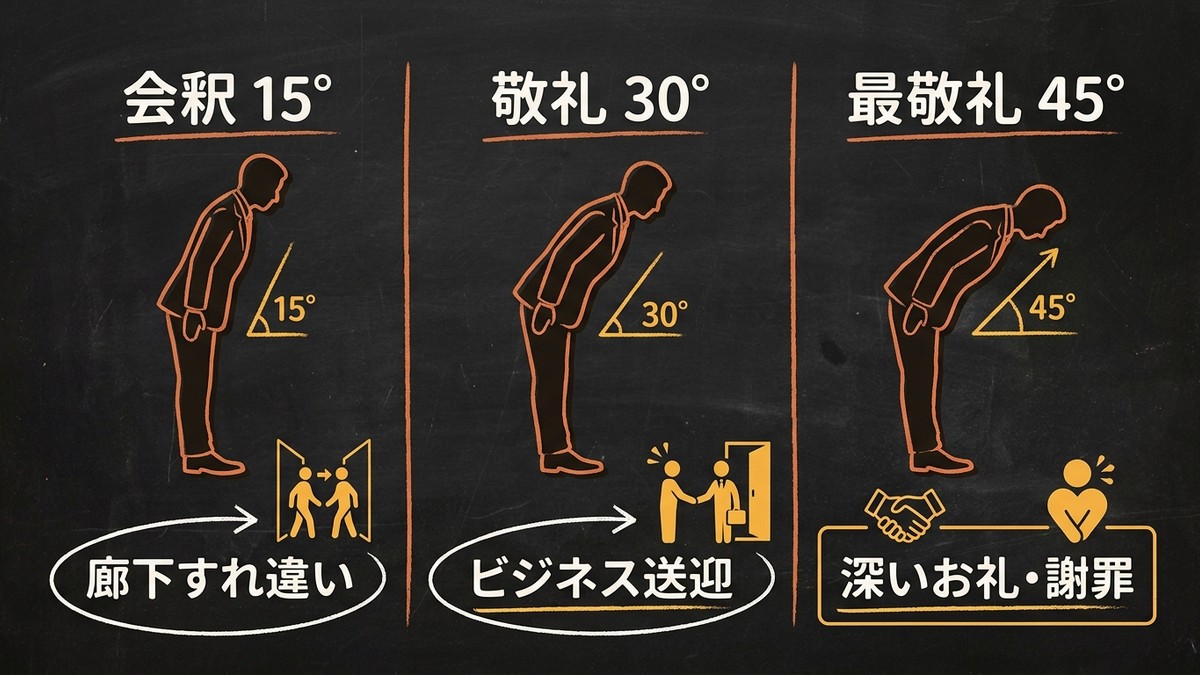
There are three main types of bows in Japan. Let's start by reviewing this foundation [4].
| Type | Angle | Main occasions |
|---|---|---|
| Eshaku (会釈) | Approx. 15° | Passing someone in the hallway; walking in front of others |
| Keirei (敬礼) | Approx. 30° | Greeting business clients; welcoming and seeing off guests; general customer service |
| Saikeirei (最敬礼) | Approx. 45° | Sincere apologies; formal expressions of gratitude; important occasions |
For farewells, the standard is keirei (30°) or deeper. Sending someone off with only a light eshaku can give the impression that you are treating them casually, so be careful [4].
Examples by situation:
- Example ① Passing your supervisor in the hallway → Eshaku (15°), a light dip of the head
- Example ② Seeing off a client → Keirei (30°), a full, deliberate bow
The 5 Steps of a Zanshin Bow
Here is the heart of the article. We'll break down the farewell bow with zanshin in mind into five distinct movements.
Step 1: Bow to at least 30°, and lower slowly
Keep your back straight and tilt your upper body forward from the waist. Think of it not as dropping your neck, but as inclining your whole body. "Slow" is the right speed. Bowing too quickly makes it look like a perfunctory, going-through-the-motions bow [5].
In new employee training at Japanese companies, angle, speed, eye direction, and tone of voice are all trained together as a set [5]. This reflects just how much importance is placed on both the lowering and the raising of the bow.
Step 2: Hold the position for 2–3 seconds
After lowering your head, don't raise it right away. Hold that position for 2–3 seconds. This "pause" (ma) is the first step of zanshin. Approach those still seconds as if you are pouring your feelings of "thank you very much" into them.
Step 3: Raise your head slowly and meet the other person's eyes
After raising your head, don't look away immediately. Make eye contact for just a moment and offer a soft smile. This conveys the message: "I am truly seeing you."
Step 4: Coordinate your words with your bow
Words such as "arigatou gozaimashita" (thank you very much) and "shitsurei itashimasu" (excuse me / I'll be on my way) should be paired with the bow [6]. It looks natural either to begin lowering as you say the words, or to start lowering after you have finished saying them.
- NG Pattern ①: Saying "Osaki ni shitsureishimasu" (I'll head out first) without bowing, then walking off → Words alone are incomplete. They only reach the other person when paired with a physical gesture [6].
- OK Pattern ①: Say "Osaki ni shitsureishimasu" while performing a keirei bow, then wait to receive the other person's "Otsukaresama deshita" before walking away.
Step 5: Wait until the other person is out of sight
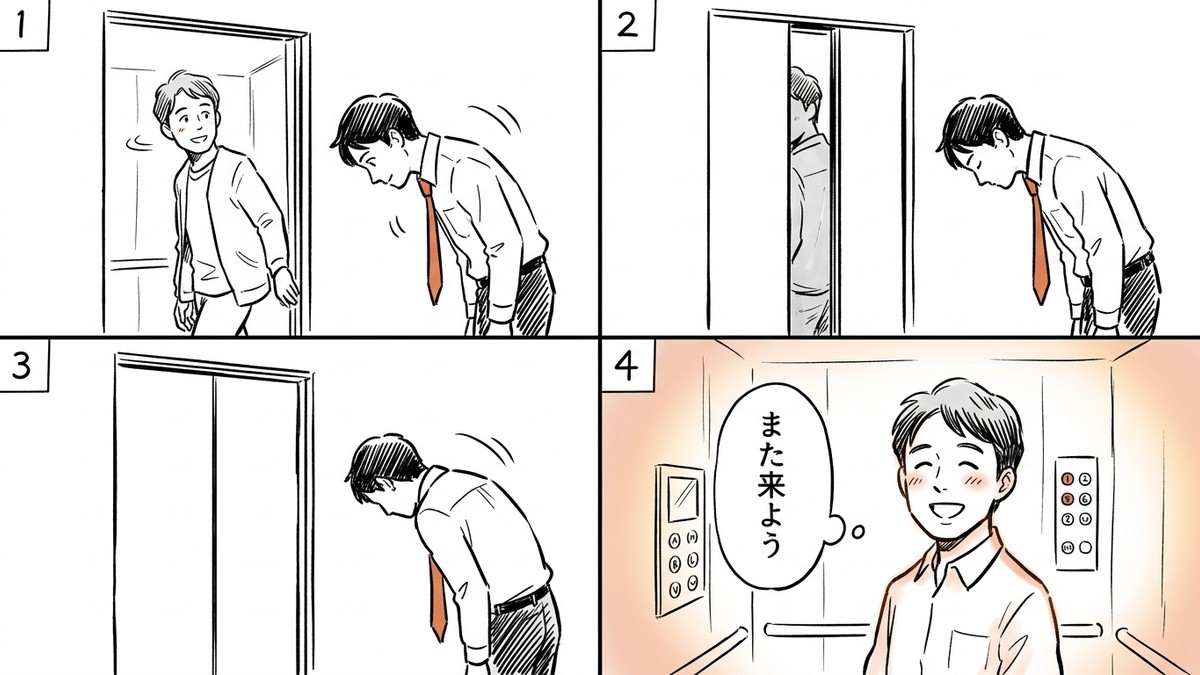
This is the essence of zanshin. After the other person has left, or after the elevator doors have closed, you should not move away immediately.
There is a Japanese customer service saying: "Three steps to welcome, seven steps to see off (demukae sanpo, miokuri nanaho)**" [7]. It means that seeing someone off is more important than welcoming them. Because the farewell is the "last impression that lingers," you must not let your guard down.
Formal etiquette in front of an elevator:
- Example ③ After pressing the elevator button, wait with a light eshaku while the doors are open.
- Example ④ Once the other person has stepped in and the doors begin to close, bow deeply (30° or more).
- Example ⑤ Do not raise your head until the doors have fully closed [8].
Guidelines for how far to see guests off from an entrance or building:
- Example ⑥ Regular visitors → See them off to the elevator lobby and keep bowing until the doors close [8].
- Example ⑦ Important clients → Accompany them all the way to the building entrance or exit.
- Example ⑧ When a guest's car departs → Keep bowing until the car is no longer visible.
Those few seconds of "continuing to bow until the door is fully closed" are among the moments that visitors to Japan most often describe as deeply moving [9]. The sight of hotel or ryokan staff bowing until a guest's car disappears from view — that is a real-life example of zanshin that makes people say, "I want to come back."
Three Common Mistakes
Here are three mistakes often made by Japanese language learners and those new to professional settings [10]. Even when vocabulary and grammar are in order, mistakes like these arise when someone hasn't yet developed an intuitive sense of "what level of etiquette to perform in which situation" [10].
Mistake ①: Raising your head too quickly
You bow — but the moment you lift your head, your gaze is already pointed in another direction. This is the single most common pattern. To the other person, it reads as a superficial, going-through-the-motions bow.
- NG Pattern ②: Say "arigatou gozaimashita" while lowering your head, raise it again in 0.5 seconds, and immediately start walking away.
- Fix: After lowering your head, hold for 2–3 seconds. After raising it, make brief eye contact before moving.
Mistake ②: Seeing the guest off too close to the door
Seeing a visitor off only at the office entrance (just inside the door) and immediately heading back in can give the impression that you're in a hurry for them to leave [8].
- NG Pattern ③: See the guest off near the door and disappear back into the room the moment you see their back.
- Fix: Walk with them to the elevator lobby and don't leave the spot until the doors have closed.
Mistake ③: Using words without a bow
The words "arigatou gozaimashita" are perfectly spoken, but the body doesn't move. When words and physical expression aren't paired together, the other person is left with the impression that "the politeness didn't quite come through" [11][5].
- NG Pattern ④: Saying "Yoroshiku onegaishimasu" without any accompanying movement.
- OK Pattern ②: During a face-to-face farewell, bow with your whole body at the same time as you speak.
Incidentally, the Japanese habit of bowing while on the phone often strikes foreigners as puzzling [9], but this is because bowing in Japan has taken root not merely as a gesture for the other person to see, but as a physical habit that aligns and settles one's own feelings. It is evidence that bowing exists somewhere deeper than mere "communication" — beyond the functional and into something more personal.
Summary
The difference between someone whose bow feels right and someone whose bow seems "off" is not angle or speed. It is simply whether or not there is zanshin in the way they finish.
Let's review what we covered in this article.
- There are three types of bows; for farewells, keirei (30°) or deeper is the standard.
- The five steps of zanshin in practice: "lower slowly → hold → raise slowly and make eye contact → pair with words → wait until the other person is out of sight."
- The three typical mistakes are: raising your head too quickly, seeing the guest off too close to the door, and using words without bowing.
It is not "the action is done, so I'm done" — it is keeping your heart with the other person until they are no longer in sight — that is the essence of zanshin [1].
Three things you can do starting today:
- At your next farewell, try holding your bow for 2–3 seconds before raising your head.
- Decide not to raise your head until the elevator doors have completely closed.
- Practice a farewell that makes people want to see you again — try a role-play at work or in front of a mirror.
Just a few seconds at the moment of parting can leave a lasting impression in the other person's heart. Whether you are learning Japanese or working in customer service, try bringing just one element of zanshin into your next "goodbye." Your impression on others will surely change.
References
- "残心(ざんしん)," Japan Karate Federation. https://www.jkf.ne.jp/karate-word/kw-zamshin
- "残心," Wikipedia (Japanese). https://ja.wikipedia.org/wiki/残心
- "礼に始まり礼に終わる," Judo Channel (judo-ch.jp). https://www.judo-ch.jp/dictionary/terms/rei/
- "How to Bow: An Essential Form of Respect in Japan," nippon.com. https://www.nippon.com/en/guide-to-japan/gu020001/
- Cynthia Dickel Dunn, "Bowing Incorrectly: Aesthetic Labor and Expert Knowledge in Japanese Business Etiquette Training," In: Japanese at Work: Politeness, Power and Personae in Japanese Workplace Discourse, Springer, 2017. https://link.springer.com/chapter/10.1007/978-3-319-63549-1_2
- "Japanese Business Phrases at Work: お先に失礼します(Osaki ni Shitsureishimasu)," Coto Academy. https://cotoacademy.com/osaki-ni-shitsureishimasu/
- "お迎え3歩、お見送り7歩," NIKKEI Style (Nikkei Inc.), 2013. https://style.nikkei.com/article/DGXDZO52019490S3A220C1W05001/
- "お客さまを「お見送り」する作法~「最後の数秒」で、お客さまの心をつかむ!," Insource (insource.co.jp). https://www.insource.co.jp/gam-batte/cs/article/service_cs_up62.html
- "The Awkward Art of Saying Goodbye in Japan," GaijinPot Blog. https://blog.gaijinpot.com/awkward-art-saying-goodbye-japan/
- Yogyanti, "Pragmatic Failures in Japanese Conversations Among Beginner Japanese Language Learners Leading to Face-Threatening Acts," KIRYOKU, vol. 8, no. 2, Universitas Diponegoro, 2024. https://ejournal.undip.ac.id/index.php/kiryoku/article/view/66637
- Eugenia Diegoli, "The affective meanings of bowing in a web corpus of Japanese," Journal of Pragmatics, vol. 251, Elsevier / ScienceDirect, 2025. https://www.sciencedirect.com/science/article/pii/S0378216625002607
