
Japan's Public Manners Explained! 3 Practical Steps to 'Reading the Room' — From Trains to Cafés

By NIHONGO-AI
AI Engineer/Japanese Language Educator
4/14/2026

Japan's Public Manners Explained! 3 Practical Steps to 'Reading the Room' — From Trains to Cafés
Introduction
8 a.m. on the Yamanote Line. The moment the doors close, it's as if someone has switched off all sound. Up to eight people are crammed into every square meter, yet all you can hear is the faint rumble of the train.
One of my foreign students rode a Tokyo train for the first time and said to me, "Sensei, did everyone practice this together?" And honestly — that level of silence is remarkable.
What makes it even more puzzling is that those same people, when they head to an izakaya in the evening, blend effortlessly into a space filled with laughter and loud voices. The person who was dead silent on the train becomes a completely different person at the izakaya — this isn't a contradiction; it's Japan's cultural concept of "switching modes."
In this article, you'll learn three things:
- The cultural reasons why Japanese people's behavior changes dramatically depending on the setting
- The "correct behavior" for trains, cafés, and izakayas respectively
- How to turn "reading the room" into concrete, actionable steps
Knowing the background — not just "follow the rules because they're rules" — will make life in Japan much easier for you.
Quick Manners Reference by Setting — Trains, Cafés, and Izakayas Compared
Let's start by reviewing the appropriate behavior for each setting at a glance.
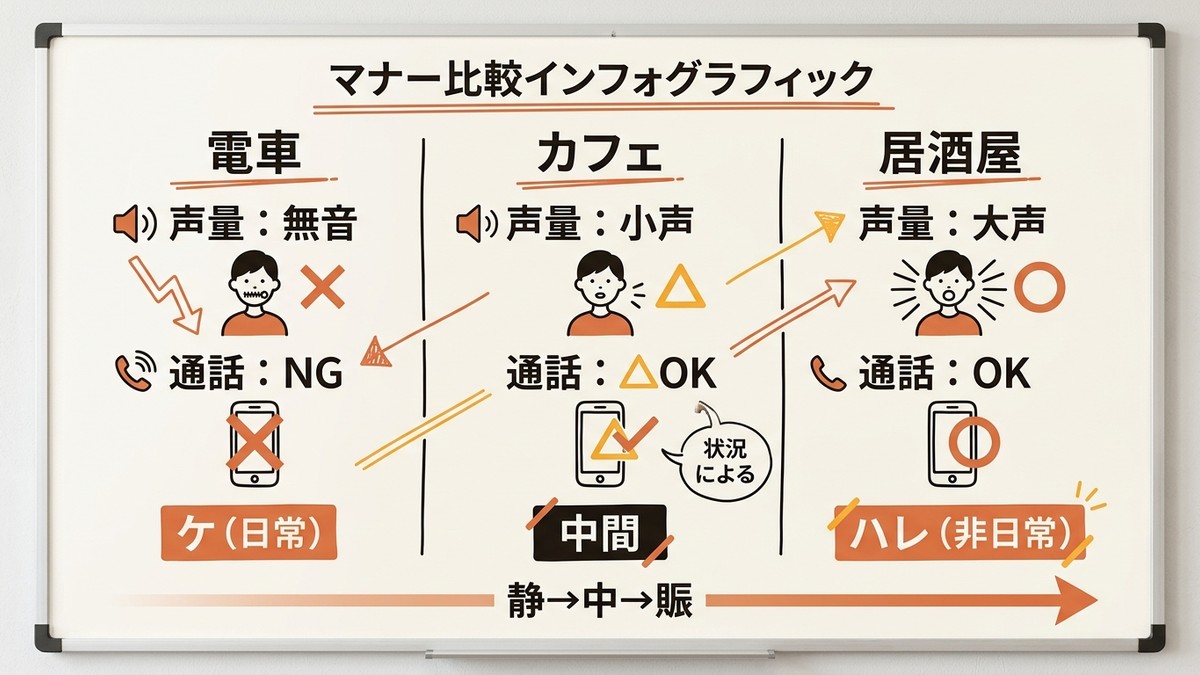
| Setting | Volume Level | Phone Calls | Laughter | Nature of the Space |
|---|---|---|---|---|
| Train | Near silence | Not OK (generally) | Not OK | Everyday (Ke) |
| Café | Quiet voice OK | Brief, quiet calls OK | OK if subdued | In between |
| Izakaya | Loud voice OK | Totally fine | Very welcome | Special occasion (Hare) |
A useful concept for explaining these differences is "Hare and Ke" [7]. "Ke" refers to ordinary, everyday life, while "Hare" refers to special occasions like festivals and banquets. The train is an everyday means of transportation used every day (Ke), so keeping quiet and not causing disruption is considered natural behavior. An izakaya, on the other hand, is a special time (Hare) when you deliberately gather with others after work — being lively is exactly what's called for. A café sits right in the middle. Quiet conversation with friends is perfectly fine, but avoid long, loud phone calls.
The Real Reason Trains Are So Quiet
JR East and other major railway companies in the Kanto region unified their rules in 2003 to require passengers to "turn off mobile phones near priority seats." This was later relaxed in 2015 to "turn off phones only when the train is crowded" [2].
The rules have changed, but the habit of staying quiet has remained. Why?
According to sociological analysis, train passengers "maintain social order by pretending to be indifferent to one another" [17]. The reason people can stay calm even while packed in close physical contact with strangers is that everyone follows an unspoken agreement: don't look, don't listen, don't engage. When someone suddenly starts talking loudly on the phone, this quiet order instantly collapses. The strong aversion to causing inconvenience — expressed in Japanese as "meiwaku wo kakeru" (causing trouble to others) — is deeply ingrained, and this feeling shapes the atmosphere inside trains.
3 Steps to Turn "Reading the Room" Into Action
"Reading the room" (kuuki wo yomu) is the ability to sense the mood and feelings of those around you — without anyone putting it into words — and act accordingly [6]. It can feel difficult because no one explains it out loud, but breaking it down into the following three steps makes it manageable even in an unfamiliar setting.
Step 1: Spend 5 Seconds "Listening" to the Volume Level When You Enter
When you enter a new place, take just 5 seconds to gauge the volume of voices around you.
- When you get on a train → If it's near-silent, don't talk either
- When you enter a restaurant → If you can hear normal conversation, it's fine to talk normally too
- When you enter a meeting room → If everyone is quiet, sit down quietly and wait
Just by "listening," you'll automatically understand the unwritten rules of the space. Those 5 seconds before you take out your smartphone can prevent the majority of social missteps.
Step 2: Match the Majority
Once you've gauged the volume level, adjust to those around you. "What everyone else is doing" is the correct behavior for that setting.
If everyone on the train is quietly looking at their smartphones and one person alone starts talking loudly on the phone, they'll be labeled "KY (kuuki ga yomenai)" [6]. KY is a Japanese slang term that spread in the late 2000s, referring to someone who "can't read the room." Conversely, if the tables around you at an izakaya are all having a great time, there's absolutely no need to hold back and speak in a hushed voice. Being lively is the right call in that setting.
Step 3: When in Doubt, "Wait and Watch"
If you still can't judge what to do, don't act immediately — take a moment to observe.
- Don't know when to speak up in a meeting → First watch what the other participants do
- Not sure how casual you should be with someone you've just met → Match the other person's pace
- Don't know a shop's rules → Watch what the other customers are doing
"Waiting and watching" isn't being overly reserved. It signals that you're trying to accurately read the situation — and in Japan, this makes a positive impression.
Common Mistakes and How to Recover
Here are three common scenarios and how to recover from them.
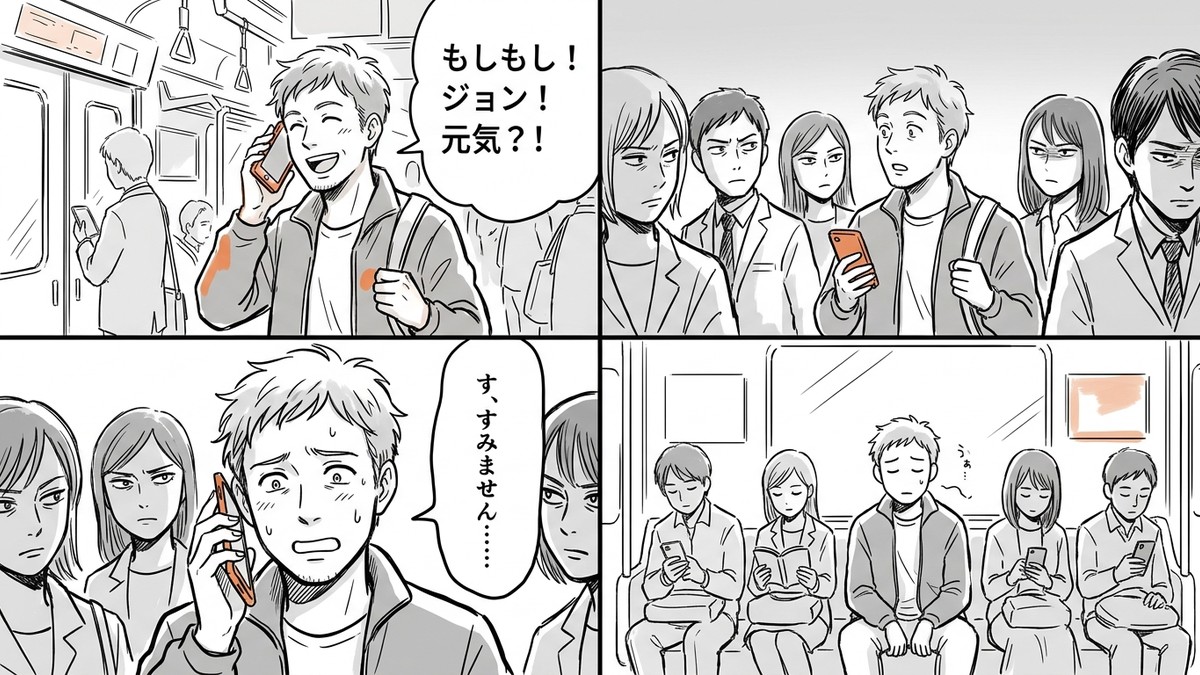
Mistake 1: Talking Too Loudly on the Train
The problematic scene: "Hello? John! How are you? Where are you right now?!" (speaking loudly on the phone on the train)
Recovery: Immediately say "Sorry, I'll call you back later" and hang up. If you feel people glancing at you, a brief bow is all you need. Since Japanese people tend to avoid prolonging awkward situations, as soon as you quiet down, the atmosphere will naturally return to normal. There's no need to over-apologize.
Mistake 2: Misreading Silence as Anger
Japanese conversation includes the concept of "ma" (間) [9]. A pause in the middle of a conversation is not a sign that the person is "angry" or "bored" — it's a signal that they are "carefully taking in what you said."
The wrong reaction: The other person goes quiet for a moment, so you say: "Oh, did I offend you? I'm so sorry! I think the way I said it was wrong, really…" (anxiously keep talking)
The right approach: Wait quietly for 2–3 seconds. Silence is not a "conversation failure." Research by Nakane (2007) documents cases where foreign teachers misread Japanese students' quiet listening as "disinterest" or "lack of understanding" [3]. The other person is simply searching for their next words, so waiting is the best response.
Mistake 3: Taking Indirect Expressions at Face Value
Japanese has a range of "indirect expressions" (enkyoku hyōgen) — soft ways of saying no without saying it outright [13]. Here are some common examples:
| Japanese phrase | What it actually means |
|---|---|
| "Sō desu ne……" (with a long pause) | Somewhat opposed, or hesitant |
| "Chotto muzukashii desu ne" | Almost certainly a refusal |
| "Kentō shite mimasu" | No for now, but not an outright rejection |
| "Nakanaka……" | Quite difficult — probably no |
| "Sō desu ka" (brief, with flat intonation) | Internally negative |
The problematic scene: A: "Can you come with us this weekend?" B: "Hmm, that's a bit difficult…" A: "Well, what about next week?"
B has already communicated "I can't make it." The right way to receive this is: "I see, that's a shame. Please let me invite you again another time."
The phrase "chotto……" can actually be a clear-cut refusal — learning to read these indirect expressions takes practice in cultural context, not just Japanese grammar.
Summary
This article covered three key points:
- The correct behavior differs by setting: Trains (Ke — quiet) and izakayas (Hare — lively) are opposite spaces. Use cafés as the middle ground between the two.
- "Reading the room" can be practiced in 3 steps: ① Listen to the volume level for 5 seconds → ② Match the majority → ③ When in doubt, wait and watch.
- You can recover from mistakes: If you talk too loudly on a train, just go quiet immediately and you'll be fine. Silence is not anger — it's "ma." Make a habit of reading indirect expressions through context.
Staying quiet isn't about being excluded or being forced to endure something. It's Japan's unique form of participation — a way for strangers to share the same space together. The silence on a train is not the product of rules; it's a behavior that everyone chooses in order to coexist.
Three things you can start doing today:
- When you get on a train or enter a café, make a habit of spending 5 seconds "listening" to the volume around you.
- When someone says "chotto muzukashii desu ne," receive it as a polite refusal.
- When there's a silence in conversation, resist the urge to fill it — try waiting quietly for 2–3 seconds.
Just these three things will make your communication in Japan significantly smoother. Give them a try starting today.
References
- "車内での携帯電話の利用マナーについては、どのような呼びかけを行っていますか," East Japan Railway Company (JR East). https://jreastfaq.jreast.co.jp/faq/show/1090?category_id=39&site_domain=default
- Nakane, Ikuko, "Silence in Intercultural Communication: Perceptions and Performance," John Benjamins Publishing Company, 2007. https://benjamins.com/catalog/pbns.166
- "Ba no kuuki wo yomu," Wikipedia. https://en.wikipedia.org/wiki/Ba_no_kuuki_wo_yomu
- "Hare and Ke," Wikipedia (Japanese). https://ja.wikipedia.org/wiki/ハレとケ
- "A Perspective on the Japanese Concept of 'Ma'," Japan House Los Angeles. https://www.japanhousela.com/articles/a-perspective-on-the-japanese-concept-of-ma/
- "Pragmatic Failures in Japanese Conversations Among Beginner Japanese Language Learners Leading to Face-Threatening Acts," ResearchGate (academic paper). https://www.researchgate.net/publication/388298569_Pragmatic_Failures_in_Japanese_Conversations_Among_Beginner_Japanese_Language_Learners_Leading_to_Face-Threatening_Acts
- "なぜ電車で電話する人にイラッとするのか…社会学者が指摘「無関心を装い保っている車内秩序が破られる瞬間」," PRESIDENT Online. https://president.jp/articles/-/84236?page=1
