
Silence as the Language of Intimacy: Decoding Japan's Public Spaces and Intercultural Communication Through Ma, Uchi/Soto, and Hare/Ke

By NIHONGO-AI
AI Engineer/Japanese Language Educator
4/19/2026

Silence as the Language of Intimacy: Decoding Japan's Public Spaces and Intercultural Communication Through Ma, Uchi/Soto, and Hare/Ke
Introduction
"Why are Tokyo's trains so quiet?"
This question, raised by an exchange student in class, has stayed with me ever since. She was a native Spanish speaker who described how conversations and laughter flow naturally among passengers on the Madrid Metro. The reason Tokyo's commuter trains — packed with up to eight people per square meter — remain remarkably quiet cannot be explained simply as "the Japanese temperament." It is the result of a cultural logic rooted in three distinct layers: philosophy, social norms, and institutions.
This article explores three key points:
- The fundamental difference in how public space is conceived, as revealed by the lexical gap around the word rènào (熱鬧)
- The three-layered structure — Ma, Uchi/Soto, and Hare/Ke — that underpins Japan's silence norms
- The patterns of pragmatic failure this structure produces, and practical implications for intercultural understanding
Lexical Asymmetry: Why Rènào Has No Japanese Equivalent
As an entry point into cross-cultural comparison, let us first look at a single lexical gap.
The Chinese word 熱鬧 (rènào) means "liveliness, energy, and the excitement of a crowd." As illustrated by the phrase "星期天、家里就热闹了 (On Sundays, the house comes alive)" [1], it captures in a single word the warmth, density, and shared emotional excitement that arise when family or friends gather. The expression 看热闹 (kàn rènao) — literally "watching the excitement" — refers to the public behavior pattern of naturally gathering around an event involving strangers, and is culturally affirmed as a symbol of prosperity and community bonds [11].
The Japanese word nigiyaka (にぎやか) comes close, but lacks the nuance of heat, crowd density, and shared emotional excitement that rènào conveys. This lexical gap is not a coincidence. From a linguistic perspective, a gap in vocabulary reflects a gap in worldview. There is no cultural script in Japan's public spaces for "everyone building excitement together."
The Three-Layered Structure Behind Silence: Philosophy, Norms, and Institutions
Where does this absence come from? Japan's silence norms rest on a structure in which three layers mutually reinforce one another.
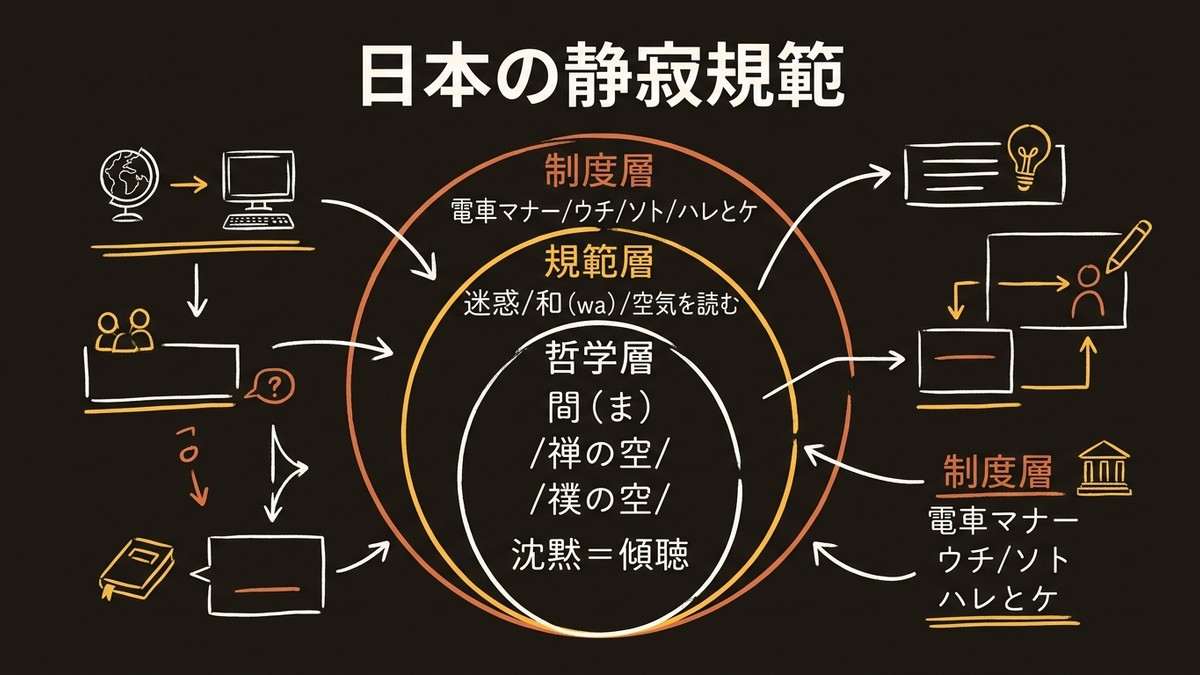
The Philosophical Layer: Ma (間) and the Semantics of Silence
The deepest layer is the philosophical and religious foundation. Ma (間) is a uniquely Japanese concept referring to "the meaningful void between things," with Zen's concept of emptiness (空) as its intellectual source [9]. A "pause" in conversation is not a gap but a signal of respect and attentive listening toward the other person [19]. Silence has historically been regarded as an expression of hara (腹, one's inner truth). The Japanese proverb "Silence is golden" (chinmoku wa kin) encapsulates this philosophy.
The Normative Layer: Meiwaku, Wa, and Reading the Air
The middle normative layer contains three core concepts. Meiwaku (迷惑) refers to "acts that disturb others' peace of mind" and serves as the basis for avoiding loud speech or phone calls in public. Wa (和) is the foundational value of prioritizing group harmony over individual desires [5]. And kuuki wo yomu (空気を読む) — the ability to read the situation and the group's emotional state without words, and behave accordingly [6] — functions as a self-reinforcing norm: if everyone on the train is quiet, you stay quiet too. The very fact that being labeled "KY" (kuuki ga yomenai, unable to read the air) carries social stigma demonstrates the strength of this norm.
The Institutional Layer: Train Etiquette and Uchi/Soto
In the outermost institutional layer, norms crystallize into explicit rules. In September 2003, JR East and 16 other major Kanto railway companies unified the rule to "power off near priority seats," which was later relaxed in October 2015 to "power off only during peak congestion" [2]. This evolution itself demonstrates that silence norms are not fixed but continuously negotiated by society.
Uchi (内, inside) / Soto (外, outside) is a foundational behavioral framework in Japan [16]. Public space belongs to the soto domain, where tatemae (public facade), self-restraint, and propriety are the norms. In uchi spaces — with family and close friends — casual language and emotional expression are permitted. This binary opposition forms the spatial grammar of silence norms.
A Comparative View Through Hofstede's Cultural Dimensions
The intensity of silence norms also appears in quantitative cultural dimension data. Combining Hofstede's cultural dimensions model [12] with research on interpersonal distance [8] yields the following comparison:
| Dimension | Japan | China | United States |
|---|---|---|---|
| Uncertainty Avoidance Index (UAI) | 92 (among world's highest) | Low (high tolerance for change) | 46 (moderate) |
| Individualism Score (IDV) | 46 (collectivist) | Low (strong collectivism) | 91 (individualist) |
| Interpersonal Distance (front) | 134.6 cm | 73.9 cm | — |
| Typical vocal behavior in public | Silence, no talking | Conversation and laughter are normal | Context-dependent |
| Primary signal of "intimacy" | Shared silence | Rènào (shared liveliness) | Verbal assertiveness |
Japan's UAI score of 92 indicates "strong reliance on rules, customs, and predictability" [12]. Its individualism score of 46 contrasts sharply with the United States' 91, reflecting a tendency to prioritize collective behavior. The silence on trains is one manifestation of these cultural dimensions in everyday space.
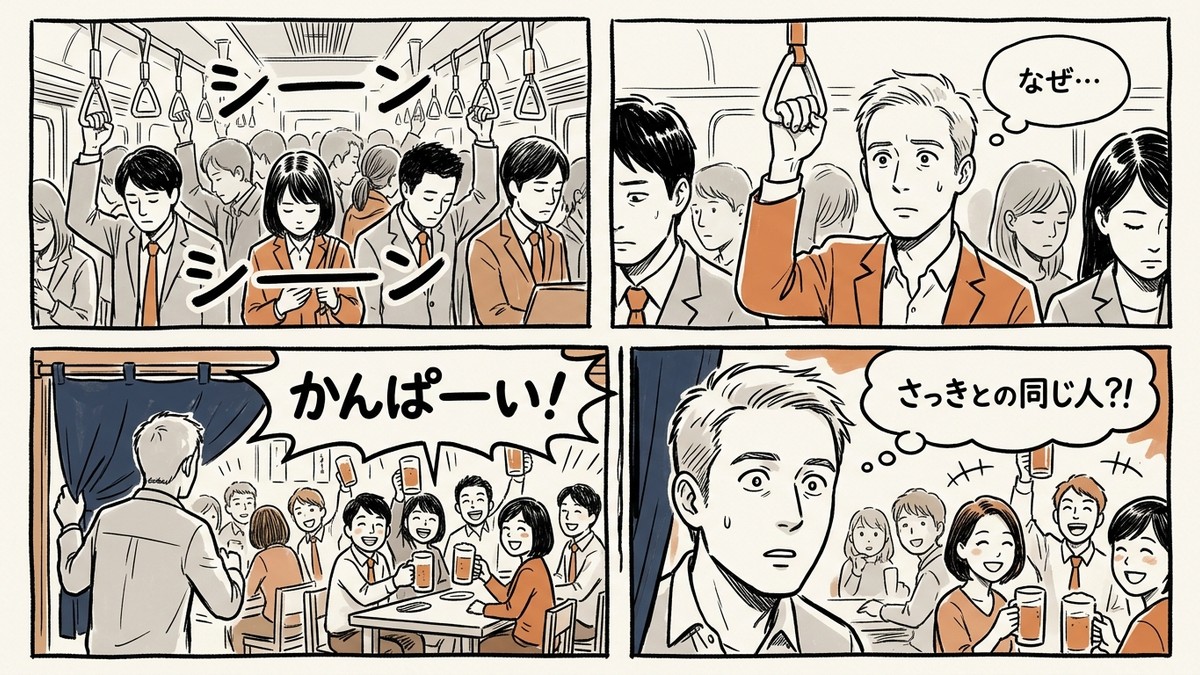
Hare and Ke: Why People Seem Like Different Persons on the Train vs. at the Izakaya
Equally important alongside Uchi/Soto is Hare and Ke — a temporal and situational binary opposition [7].
- Ke (日常, the everyday): Trains, libraries, workplaces. Silence is the norm, and emotional restraint is considered a mark of maturity.
- Hare (晴れ, the festive): Izakayas, hanami (cherry blossom viewing), karaoke, year-end gatherings. Noise and liveliness are actively encouraged.
Many foreign learners are bewildered by this "transformation" — from the silent commuter train to the moment they step through an izakaya's noren curtain and are greeted by loud "Irasshaimase!" and laughter. Yet from within Japanese culture, this is entirely consistent behavior: it is simply the switch between Hare and Ke.
This binary opposition also manifests in physical distance. Whereas the average frontal interpersonal distance for Chinese people is 73.9 cm, Japanese people maintain roughly twice that at 134.6 cm [8]. Despite sharing the same Sinographic cultural sphere, the physical and vocal distance in public spaces is strikingly different [18].
Also noteworthy are distinctly Japanese spatial arrangements such as hitori karaoke (solo karaoke), hitori yakiniku (solo grilled meat dining), and counter seats with partitions. These function as devices that create an uchi sense within the soto public space. Being freed from others' gaze allows one to enjoy hare individually — this is an expression of a distinctly Japanese form of intimacy: liberation of the self within silence.
Pragmatic Failure: How Silence Causes Communication Breakdowns
Let us now look at how this theoretical structure manifests as actual misunderstanding. Pragmatic transfer refers to communication failures that arise when speakers apply their native language's public space norms directly to Japanese-language situations [13]. Here are five typical patterns:
Pattern 1 — Misreading Silence After a foreign student speaks up in class, the room stays quiet. The Japanese students are listening attentively through silence, but the speaker feels "rejected" and stops contributing. Nakane's (2007) comparative study of Japan and Australia documented specific instances where Australian instructors interpreted Japanese students' silence as "disinterest" or "lack of understanding" [3].
Pattern 2 — Taking Indirect Expressions Literally An indirect refusal — "Well… (slight pause) …that might be difficult" (tatemae) — is interpreted literally as "there's room for consideration," prompting the listener to make another approach. Reading a negative message embedded in ma (pause) requires practice.
Pattern 3 — Using Uchi-Appropriate Behavior in Soto Settings Using uchi-type language with someone you have just met — calling them by their first name right away, asking probing personal questions — causes discomfort [13]. The well-intentioned desire to "close the distance" paradoxically produces the opposite effect.
Pattern 4 — Unconsciously Importing One's Home Volume Speaking on a train at the volume normal in one's home country draws nonverbal pressure from those around you (stares, people moving away). Because nothing is said explicitly, the learner cannot understand what went wrong.
Sociology explains the fundamental reason phone calls are avoided on trains as follows: passengers maintain a coexistence order by "pretending not to notice each other." A phone call forcibly delivers one-sided conversation sounds, destroying this tacit order [17]. Meiwaku is not an emotional aversion but a reaction to the collapse of an order-maintenance system.
Pattern 5 — Asymmetry in Face Protection Expressions like "it's a difficult situation…" are preferred over "I can't" because protecting the other person's face (social standing) takes priority. Learners from cultures that use direct negation as a sign of sincerity may perceive this as "dishonesty" or "vagueness of intent."
Conclusion: Moving Beyond Fundamental Differences in Defining Intimacy
Japan's silence is not an absence. It is a unique syntax of intimacy, sustained by the multilayered cultural logic of Ma, Uchi/Soto, and Hare/Ke.
In rènào cultures, "being lively together" is the signal of solidarity and trust. In Japan, "quietly observing the same norms together" confirms social belonging. Asking which is better holds no meaning. The question worth asking is: "In which syntax does the other person define intimacy?" The ability to answer this question is the key to fundamentally reducing pragmatic failure.
Here are three things you can start doing today:
- Read silence as "data": In Japanese conversation, always consider that silence may mean "deliberation," "attentive listening," or "indirect refusal" — not rejection or indifference. The longer the ma, the more weighty the message it often carries.
- Check your Uchi/Soto and Hare/Ke coordinates: Before choosing how to behave vocally, confirm whether the space you are in is soto (public) or ke (everyday). Staying quiet on the train and raising your voice at the izakaya is not a contradiction — it is the expression of a consistent cultural logic.
- Use lexical gaps as entry points for observation: When you encounter a Japanese word that cannot be translated into your native language (ma, kuuki, meiwaku, tatemae), there is always something deep about culture hidden there. Carefully "thawing out" those words becomes the frontier of pragmatic competence.
Learning a language is not about acquiring grammar and vocabulary. It is about acquiring the syntactic worldview that the language defines. Silence, too, is a language.
References
- "Chinese Vocabulary Module: 热闹 rènao," Tokyo University of Foreign Studies. https://www.coelang.tufs.ac.jp/mt/zh/vmod/v_search_detail.php?id=280&rf=3&ls=r
- "What guidelines are in place regarding mobile phone etiquette on trains?" East Japan Railway Company (JR East). https://jreastfaq.jreast.co.jp/faq/show/1090?category_id=39&site_domain=default
- Nakane, Ikuko, "Silence in Intercultural Communication: Perceptions and Performance," John Benjamins Publishing Company, 2007. https://benjamins.com/catalog/pbns.166
- "Wa (Japanese culture)," Wikipedia. https://en.wikipedia.org/wiki/Wa_(Japanese_culture)
- "Ba no kuuki wo yomu," Wikipedia. https://en.wikipedia.org/wiki/Ba_no_kuuki_wo_yomu
- "Hare and Ke," Wikipedia (Japanese). https://ja.wikipedia.org/wiki/ハレとケ
- "An Investigation Into Interpersonal and Peripersonal Spaces of Chinese People for Different Directions and Genders," Frontiers in Psychology / PubMed Central, 2020. https://pmc.ncbi.nlm.nih.gov/articles/PMC7290242/
- "A Perspective on the Japanese Concept of 'Ma'," Japan House Los Angeles. https://www.japanhousela.com/articles/a-perspective-on-the-japanese-concept-of-ma/
- "The identity of Chinese public space from Ancient times to Contemporary Society: The sociology of public behaviours in Chinese cities," ResearchGate (academic paper). https://www.researchgate.net/publication/332112347_The_identity_of_Chinese_public_space_from_Ancient_times_to_Contemporary_Society_The_sociology_of_public_behaviours_in_Chinese_cities
- "Analysis of Japanese Cultural Patterns — Based on Hofstede's Value Dimensions and Minkov's Cultural Dimensions," International Journal of Education and Humanities. https://drpress.org/ojs/index.php/ijeh/article/view/21302
- "Pragmatic Failures in Japanese Conversations Among Beginner Japanese Language Learners Leading to Face-Threatening Acts," ResearchGate (academic paper). https://www.researchgate.net/publication/388298569_Pragmatic_Failures_in_Japanese_Conversations_Among_Beginner_Japanese_Language_Learners_Leading_to_Face-Threatening_Acts
- "Constructing an Interior Public: uchi and soto in the Japanese Sharehouse," Home Cultures, Vol. 14, No. 2 (Taylor & Francis), 2017. https://www.tandfonline.com/doi/abs/10.1080/17406315.2017.1373442
- "Why Do We Get Irritated by People Talking on the Phone on Trains? A Sociologist Points Out: 'The Moment the In-Carriage Order, Maintained by Pretending Not to Notice, Is Broken'," PRESIDENT Online. https://president.jp/articles/-/84236?page=1
- "Identifying Contrasting Chinese and Japanese Cultural Values: Implications for Intercultural Youth Education," Scientific Research Publishing (SCIRP). https://www.scirp.org/journal/paperinformation?paperid=59695
- "Interpersonal communication on the Japanese concept 'Ma'," ResearchGate (academic paper). https://www.researchgate.net/publication/338407341_Interpersonal_communication_on_the_Japanese_concept_Ma''
