
Transform Your Japanese with 'Keturon kara moushiagemasu to'! 5 Essential Signpost Phrases You Can Use Starting Today

By NIHONGO-AI
AI Engineer/Japanese Language Educator
5/1/2026

Transform Your Japanese with 'Ketsuron kara moushiagemasu to'! 5 Essential Signpost Phrases You Can Use Starting Today
Introduction
"I gave a five-minute report and worked really hard at it. But then my boss said, 'So what's your point?'"
When teaching Japanese, I hear stories like this all the time. The grammar is correct. The vocabulary isn't wrong. And yet somehow the message doesn't get through — does that sound familiar to you?
The truth is, in most cases "not getting through" is not caused by grammar errors. What's missing is a "signpost phrase" — a single expression that indicates which direction the conversation is heading.
In this article, we'll cover the following three points:
- Why "signpost phrases" are especially necessary in Japanese
- Five phrases you can use right now for different situations, and how to use them
- Common mistakes and how to avoid them
Just adding one phrase can completely transform the impression your conversation makes.
What Are Signpost Phrases?
Imagine traveling without a map. Even if you're walking toward your destination, not knowing "where you are right now" is unsettling, isn't it?
Conversation is the same. Listeners are always thinking "Where is this story going?" as they listen. The words that tell them their "current location" are "signpost phrases."
In linguistics, this type of expression is called a "Discourse Marker" [7]. These are expressions that function as signals meaning "I'm about to give the conclusion," "the topic is changing," or "I'm about to say something important." The name sounds technical, but essentially they are "a map for the listener."
Japanese has a cultural tradition of kishōtenketsu (起承転結) — a narrative structure where the conclusion comes last [3]. The flow goes: introduction → development → twist → conclusion, with the answer arriving at the end. Japanese is also a language that entrusts much of its meaning to non-verbal "relationships" and "the atmosphere of the moment" [4]. Because of this, simply stringing together grammatically correct sentences can leave the listener feeling lost [10][11].
By adding just one signpost phrase, the listener can anticipate what's coming: "Ah, the conclusion is coming now," or "The topic is about to change."
5 Phrases You Can Use Right Now
Here are five phrases organized by "category" and "formality level."
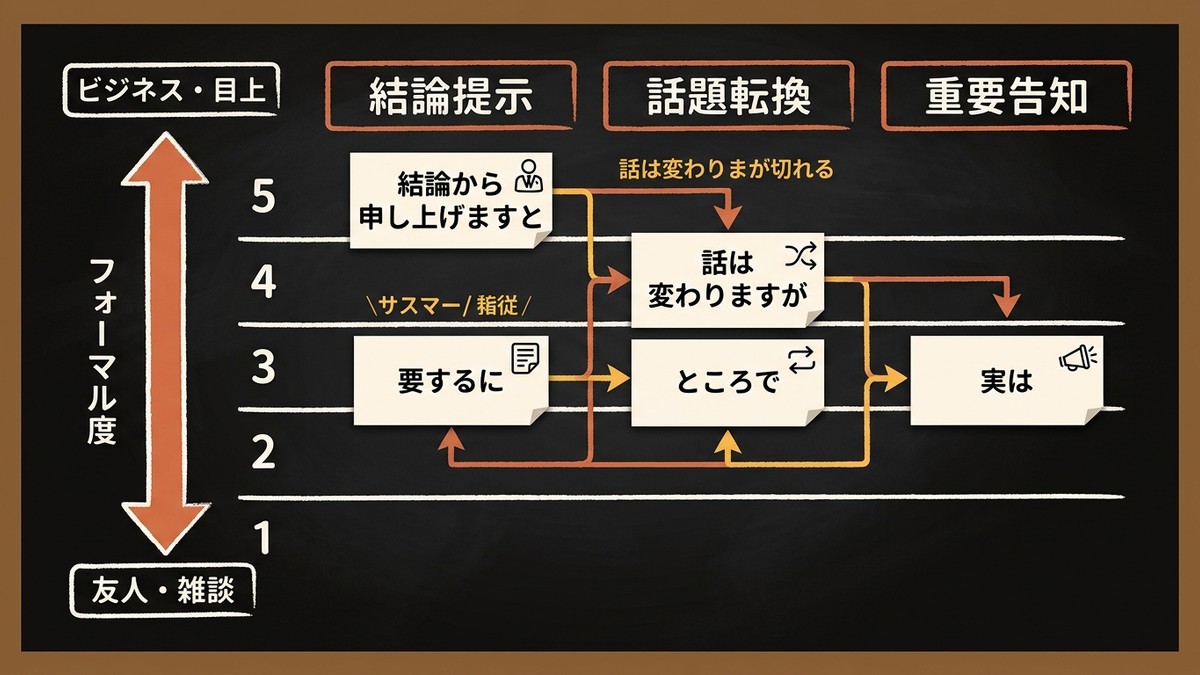
| Phrase | Category | Formality | Primary Use |
|---|---|---|---|
| 結論から申し上げますと (Ketsuron kara moushiagemasu to) | Stating the conclusion | ★★★★★ | Reporting to superiors, presentations |
| 要するに (Yōsuru ni) | Stating the conclusion | ★★★☆☆ | Summarizing explanations, meetings |
| 話は変わりますが (Hanashi wa kawarimasu ga) | Topic shift | ★★★★☆ | Formal topic transitions |
| ところで (Tokoro de) | Topic shift | ★★★☆☆ | Casual conversation, light transitions |
| 実は (Jitsu wa) | Important announcement | ★★★☆☆ | Introducing important topics, consultations |
Let's look at each phrase in detail.
Phrase 1: 結論から申し上げますと (Ketsuron kara moushiagemasu to — "To state the conclusion first")
This is the expression that performs best in business situations [1]. By declaring "I'm going to give the conclusion first," the listener can grasp the big picture before hearing the details. Use it at the beginning of reports and explanations.
Example (Business): "結論から申し上げますと、今月の売上目標は達成できる見込みです。" (Ketsuron kara moushiagemasu to, kongetsu no uriage mokuhyō wa tassei dekiru mikomi desu.) "To state the conclusion first, we expect to meet this month's sales target."
"申し上げます" (moushiagemasu) is an extremely polite humble form. In conversations with friends or when speaking to subordinates, change it to "結論から言うと" (Ketsuron kara iu to).
Casual version: "結論から言うと、明日は行けないんだ。ごめんね。" (Ketsuron kara iu to, ashita wa ikenain da. Gomen ne.) "To put it bluntly, I can't make it tomorrow. Sorry."
Phrase 2: 要するに (Yōsuru ni — "In short" / "To put it simply")
Use this after a long explanation when you want to say "in a nutshell." It's also effective for bringing order when the other person has lost track of the main point.
Example: "複数の問題が重なっていましたが、要するに、スケジュール管理の見直しが必要ということです。" (Fukusū no mondai ga kasanatte imashita ga, yōsuru ni, sukejūru kanri no minaoshi ga hitsuyō to iu koto desu.) "Multiple issues overlapped, but in short, we need to revisit our schedule management."
Phrase 3: 話は変わりますが (Hanashi wa kawarimasu ga — "Changing the subject")
Use this when one topic has ended and you want to switch to a different one [8]. It's a slightly formal expression that works well in business emails too.
Example: "プロジェクトの報告はここまでです。話は変わりますが、採用の件についても確認させてください。" (Purojekuto no hōkoku wa koko made desu. Hanashi wa kawarimasu ga, saiyō no ken ni tsuite mo kakunin sasete kudasai.) "That covers the project report. Changing the subject, I'd also like to go over the matter of hiring."
Phrase 4: ところで (Tokoro de — "By the way")
Use this to shift topics in conversations with friends or in light, casual situations [8]. It softens abrupt transitions.
Example: "仕事の話はこれくらいにして。ところで、来週の予定はどうですか?" (Shigoto no hanashi wa kore kurai ni shite. Tokoro de, raishū no yotei wa dō desu ka?) "Let's leave the work talk there. By the way, what are your plans for next week?"
Phrase 5: 実は (Jitsu wa — "Actually" / "The truth is")
This is a lead-in phrase that signals "I'm about to say something important" [9]. It draws the listener's attention and mentally prepares them. It's particularly effective when placed before a consultation or an important announcement.
Example: "実は、先週から体調を崩していまして……ご相談があります。" (Jitsu wa, senshū kara taichō wo kuzushite imashite… go-sōdan ga arimasu.) "Actually, I haven't been feeling well since last week… I'd like to talk to you about something."
Real-World Practice: Comparing With and Without Phrases
Let's compare how much of a difference the presence or absence of a phrase makes in actual situations.
Situation A: Work Report to a Superior
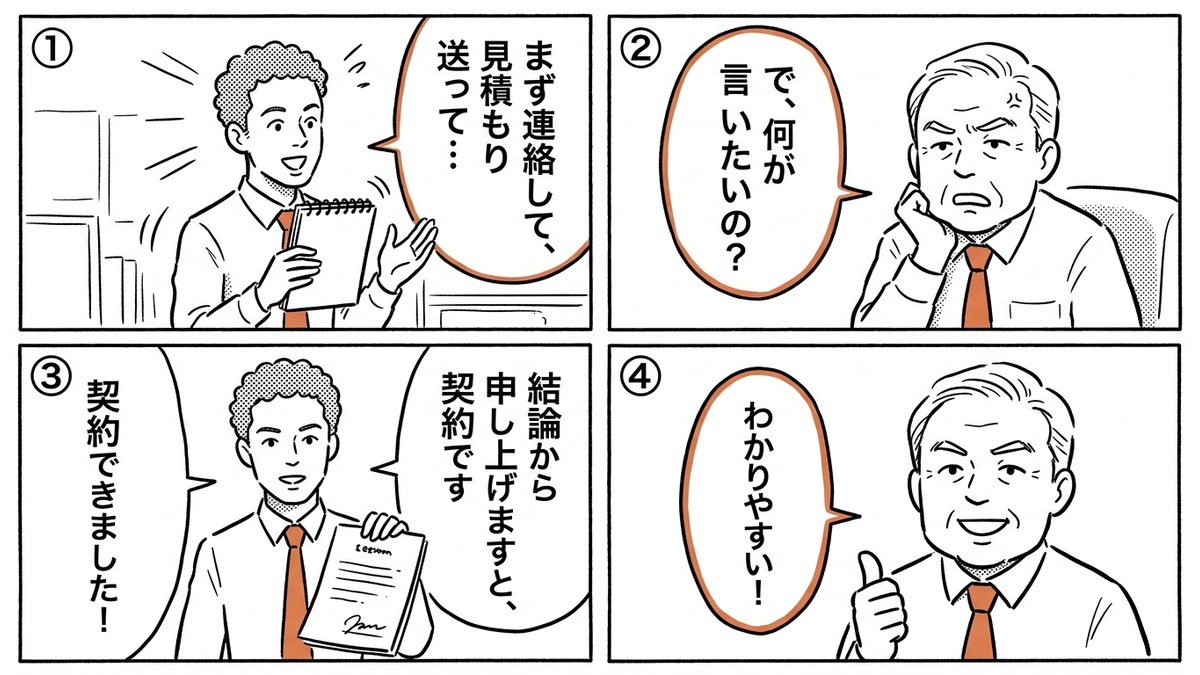
Without a phrase (NG): "先月はまず取引先に連絡して、見積もりを送って、修正依頼があって、再送して、最終的に契約できました。" (Sengetsu wa mazu torihikisaki ni renraku shite, mitsumori wo okutte, shūsei irai ga atte, saisō shite, saishūteki ni keiyaku dekimashita.) "Last month, I first contacted the client, sent a quote, got a revision request, resent it, and finally closed the contract." → Boss's reaction: "So what's your point?"
With a phrase (OK): "結論から申し上げますと、先月はA社との契約を締結しました。経緯をご説明しますと……" (Ketsuron kara moushiagemasu to, sengetsu wa A-sha to no keiyaku wo teiketsu shimashita. Keii wo go-setsumei shimasu to…) "To state the conclusion first, last month we signed a contract with Company A. To explain how we got there…" → Boss's reaction: "That's clear, thank you."
Listeners find it far easier to hear "the reason after knowing the answer" [1]. Even native Japanese speakers accustomed to kishōtenketsu — the vast majority of them prefer to hear the conclusion first in a business report context.
Situation B: Changing Topics in Casual Conversation
Without a phrase (NG): (In the middle of talking about work, suddenly) "来週、引っ越しなんですよね。" (Raishū, hikkoshi nan desu yo ne.) "I'm moving next week, actually." → Other person's reaction: (confused) "Huh, oh… is that right?"
With a phrase (OK): "仕事の話はここまでにして。ところで、来週引っ越すんですよね。" (Shigoto no hanashi wa koko made ni shite. Tokoro de, raishū hikkosun desu yo ne.) "Let's wrap up the work talk. By the way, you're moving next week, right?" → Other person's reaction: "Oh, really! Where are you moving?"
The single word "ところで" (tokoro de) prepares the other person for the fact that "the topic is changing" [8]. Without it, the other person can't keep up with the sudden shift, and the flow of conversation stalls.
Situation C: Making a Serious Announcement
Without a phrase (NG): "先月、健康診断で再検査になりました。" (Sengetsu, kenkō shindan de saiken'sa ni narimashita.) "Last month, I got flagged for a follow-up examination at my health checkup." → Other person's reaction: (without grasping the seriousness) "I see. Please take care of yourself."
With a phrase (OK): "実は、先月の健康診断で再検査になりまして……" (Jitsu wa, sengetsu no kenkō shindan de saiken'sa ni narimashite…) "The thing is, I got flagged for a follow-up at last month's health checkup…" → Other person's reaction: "Oh no, that's serious! Please tell me more."
The single word "実は" (jitsu wa) completely changes how the listener receives the message. This is a textbook example of "Pragmatic Failure" [1]. "Pragmatic Failure" refers to the phenomenon where, even if an expression is grammatically correct, a mismatch in how it is used creates a mismatch in what is intended. Situation C — where an announcement made without a signpost phrase was taken as "not a big deal" — is the perfect illustration of this.
Common Mistakes
Signpost phrases are useful, but using them incorrectly can backfire. Let's go over three things to watch out for.
Mistake 1: Using an Overly Formal Expression with Friends
"結論から申し上げますと" (Ketsuron kara moushiagemasu to) is an extremely polite expression. Using it in conversation with friends can create a sense of distance and feel unnatural [2].
NG example: (In a message to a friend) "結論から申し上げますと、明日は行けません。" (Ketsuron kara moushiagemasu to, ashita wa ikemasen.)
OK example: "結論から言うと、明日は行けないんだ。" (Ketsuron kara iu to, ashita wa ikenain da.) "To put it simply, I can't make it tomorrow."
In Japanese, when the formality level doesn't match the situation, the mismatch itself becomes a communication problem [2]. Refer to the table above to choose the phrase that fits your situation.
Mistake 2: Overusing the Same Phrase
Signpost phrases work precisely because they're used at the "right moments." Using them back to back will exhaust the listener.
NG example: "要するに、A案がいいです。実は、B案にも利点があります。ところで、C案はどうでしょう。要するに、どれも一長一短です。" (Yōsuru ni, A-an ga ii desu. Jitsu wa, B-an ni mo riten ga arimasu. Tokoro de, C-an wa dō deshō. Yōsuru ni, dore mo ichō issho desu.) "In short, Option A is best. Actually, Option B also has advantages. By the way, what about Option C? In short, they all have pros and cons."
A good rule of thumb is to use the same phrase no more than once within a single conversation.
Mistake 3: Using "実は" Before Something Unimportant
"実は" (jitsu wa) is a phrase that raises the listener's expectations. If what follows is mundane, it will leave them disappointed.
NG example: "実は、今日のランチはパスタでした。" (Jitsu wa, kyō no ranchi wa pasuta deshita.) "Actually, I had pasta for lunch today."
Save "実は" for topics that will make the listener lean in — consultations, important announcements, surprising news.
Summary
Let's review what we learned in this article.
- Signpost phrases are signals that show the listener their "current location" in the conversation [7]
- Even with correct grammar, the listener gets lost without signpost phrases [10][11]
- The 5 phrases should be used according to category and formality level
- Adding just one to fit the situation changes how your message lands
Here are three things you can do starting today:
- Try using "結論から申し上げますと" (Ketsuron kara moushiagemasu to) just once in tomorrow's report. It doesn't have to be perfect. Adding that single phrase will change how your boss responds.
- Practice shifting topics with "ところで" (tokoro de) in conversations with friends. Starting in situations where you can try things casually is the fastest path to improvement.
- Build the habit of putting "実は" (jitsu wa) before important conversations. This alone signals to the other person that "something important is being said."
Once you learn one signpost phrase, you can use it tomorrow. You don't have to learn all five at once. Just try one first. That is a sure first step toward natural Japanese.
References
- Thomas, Jenny, "Cross-Cultural Pragmatic Failure," Applied Linguistics, Vol. 4, No. 2, pp. 91–112, Oxford University Press, 1983. https://academic.oup.com/applij/article/4/2/91/167524
- Yogyanti et al., "Pragmatic Failures in Japanese Conversations Among Beginner Japanese Language Learners Leading to Face-Threatening Acts," KIRYOKU, Vol. 8, No. 2, Universitas Diponegoro, 2024. https://ejournal.undip.ac.id/index.php/kiryoku/article/view/66637
- Maynard, Senko K., "Principles of Japanese Discourse: A Handbook," Cambridge University Press, 1998. https://www.cambridge.org/core/books/principles-of-japanese-discourse/44AE353ECA0825D45B0025403BC2386B
- Hall, Edward T., "Beyond Culture," Anchor Press / Doubleday, 1976.
- Kawaguchi, Yuji, "Issues in the Analysis of Discourse Markers (DMs) (Workshop Presentation Materials)," Tokyo University of Foreign Studies (Presented at Seinan Gakuin University Workshop "Issues in Corpus Research"), 2025. https://www.tufs.ac.jp/ts/personal/ykawa/assets/images/kaken2020-2023/20250210_DM.pdf
- Shibasaki, Reijirou, "Discourse Markers in the Making: Pragmatic Differentiation of jijitsujoo from jijitsu in Modern through Present Day Japanese," East Asian Pragmatics, Vol. 6, No. 3, pp. 303–329, Equinox Publishing, 2021. https://journal.equinoxpub.com/EAP/article/view/20921
- "A Study of Discourse Markers in Japanese Utterances: Analysis through Text Mining Methods and Manual Inspection," Doshisha University Japanese Language and Japanese Culture Research, 2021. https://doshisha.repo.nii.ac.jp/record/28234/files/042000180001.pdf
- "A Study on the Pragmatic Proficiency of Japanese Language Learners and Its Problems: A Case Study of Compositions by Advanced Japanese Learners," Bulletin of the Hong Kong Association for Japanese-Language Education. https://www.japanese-edu.org.hk/jp/publish/gakkan/pdf/hkgk02306.pdf
- Asai, Mieko, "On Conjunctions in Expository Writing: A Comparison of Compositions by Native Japanese Speakers and Advanced Japanese Language Learners," Nagoya University Japanese Language and Japanese Culture Research. https://cir.nii.ac.jp/crid/1390853649585989888
