
Why 'Good Japanese' Still Gets Misunderstood: The Triangle of Ki-Shō-Ten-Ketsu, Discourse Markers, and Pragmatic Failure

By NIHONGO-AI
AI Engineer/Japanese Language Educator
5/10/2026

Why "Good Japanese" Still Gets Misunderstood: The Triangle of Ki-Shō-Ten-Ketsu, Discourse Markers, and Pragmatic Failure
Introduction
"I will now report on last week's progress. On Monday, I reviewed the documents. On Tuesday, I had a meeting with a client. On Wednesday, I identified the issues…"
After a five-minute report, a supervisor offered a single remark: "So, what's your point?"
This scenario is a classic example of the failure I have repeatedly encountered in business Japanese classes. The learner's grammar was accurate and their vocabulary was appropriate. Yet something was critically missing.
Even advanced Japanese language learners frequently experience communication failures at the discourse level [10][11]. The root of this problem lies not in a "grammar barrier" but in the "discourse barrier" that lies beyond it.
This article explores three key points.
- What structure does pragmatic failure take? (Thomas's 1983 framework)
- What does the ki-shō-ten-ketsu structure and high-context nature of Japanese demand of non-native speakers?
- How do discourse markers function to dispel the "fog of meaning"?
Two Categories of Pragmatic Failure and the Reality of Japanese Language Learning
Pragmatic failure refers to a communication breakdown in which a gap arises between the speaker's communicative intent and the listener's interpretation [1].
Thomas (1983) clearly classified this into two types [1].
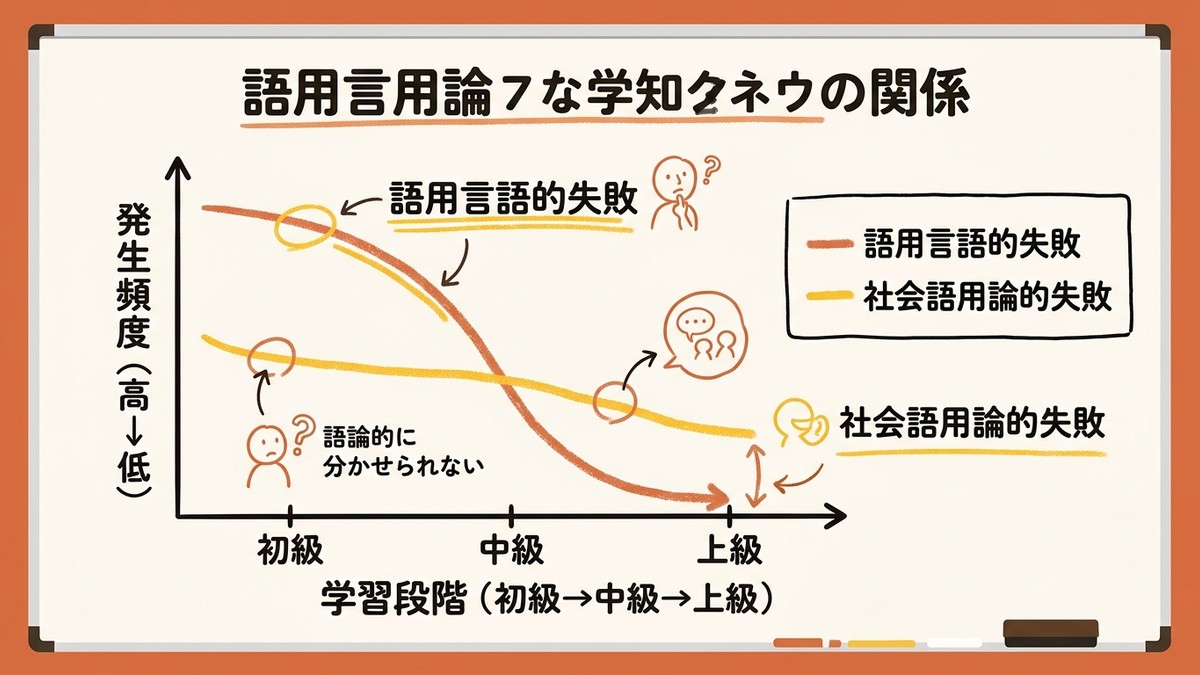
Pragmalinguistic failure is a formal problem in which a speaker inappropriately transfers strategies from their native language to their target language. The following examples illustrate this.
- "Where are you from?" (an overly direct question to someone one has just met)
- "Goodbye, Yamada-san!" (a farewell that is too casual for a business setting)
- "I come from Brazil. I live in Tokyo now. I…" (excessive use of first-person pronouns)
In each case, the result is a direct transfer of a native-language strategy—such as from English—into Japanese.
Sociopragmatic failure stems from differences in cultural norms and belief systems. It is a type of failure that is difficult to teach because it involves a lack of understanding of the social context—that is, why something is inappropriate.
Empirical research shows that pragmalinguistic failures occur more frequently than sociopragmatic failures among beginner learners [2]. Conversely, as proficiency advances, pragmalinguistic failures decrease while sociopragmatic failures persist—a structural problem.
Research targeting Japanese learners whose native language is Javanese also demonstrated that a lack of sociopragmatic knowledge impedes natural intercultural communication [6].
The "Fog of Meaning" Created by Ki-Shō-Ten-Ketsu and High-Context Structure
The reason Japanese appears "ambiguous" is not that speakers are intentionally being vague. It is because the language system itself is structured on the premise of high-context information transfer.
Hall (1976) classified cultures as either high-context or low-context [4]. In high-context cultures, much of the meaning is entrusted to elements "beyond words"—relationships, situations, and non-verbal cues.
Furthermore, Japanese discourse has distinctive structural patterns. Maynard (1998) systematically analyzed the discourse structure of Japanese [3]. Topic shifts in Japanese conversation tend to be "closure-oriented": speakers explicitly signal the end of the current topic before moving on to the next [8].
A "fog of meaning" arises when this structure collides with the linear discourse of Western languages. BLUF (Bottom Line Up Front) refers to a business discourse style common in English-speaking contexts, in which the conclusion is stated at the outset.
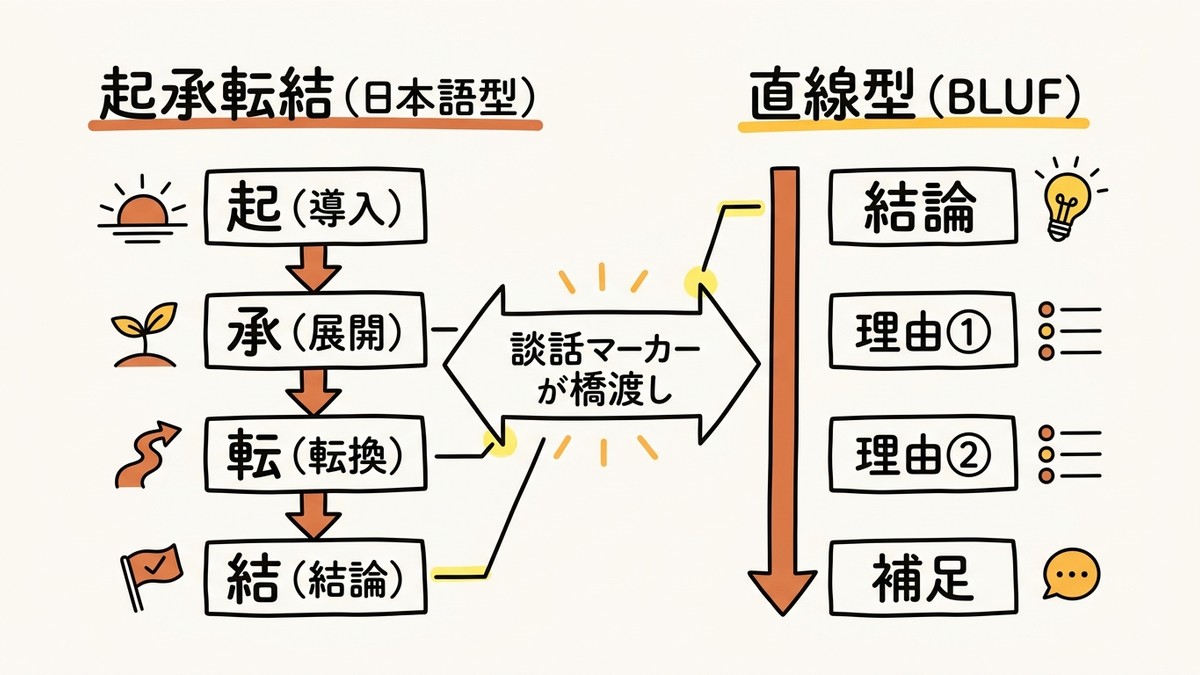
The following comparison table clarifies the structural difficulties that non-native speakers face.
| Aspect | Ki-Shō-Ten-Ketsu (Japanese style) | Linear (BLUF / English style) |
|---|---|---|
| Position of conclusion | Comes at the end | Comes at the beginning |
| Order of reasoning | Building up toward the conclusion | Reinforcing after the conclusion |
| Demand on the listener | Listen until the end and infer | Grasp the main point upfront, then follow the details |
| Risk of failure | "So, what's your point?" | "Why are you being so direct?" |
| Role of discourse markers | Markers of topic closure | Declaring the position of the conclusion; signaling structure |
Neither structure is inherently "correct." However, non-native speakers tend to apply their native language's discourse structure when using Japanese [12]. As a result, choices in case particles and sentence forms produce genre mismatches [12].
The Pragmaticization of Discourse Markers and the Three Functions of "Ketsuron kara mōshiagemasu to"
So how does one dispel this "fog of meaning"? This is where the role of discourse markers (DMs) comes in.
A discourse marker is a linguistic form that carries discourse-level functions not fully explained by grammatical category alone. It operates as a signal of communicative intent [7].
According to the pioneering research of Onodera (2004), Japanese DMs have undergone pragmaticization in the direction of "strengthening intersubjectivity" [5]. Intersubjectivity refers to the quality by which speaker and listener mutually recognize each other's perceptions and positions. Japanese DMs have historically developed as devices for adjusting this mutual awareness.
Kawaguchi's (2025) analysis of DMs classifies their functions as follows [7].
| Category | Function | Representative Expressions |
|---|---|---|
| Frame markers | Explicitly signal the structure and order of text | Mazu (First), tsugini (Next), ketsuron kara mōshiagemasu to (To state the conclusion first), ijō no koto kara (From the above) |
| Topic-shift markers | Announce a change of subject or new development | Tokoro de (By the way), hanashi wa kawarimasu ga (Changing the subject), chinamini (Incidentally) |
| Stance markers | Present the speaker's attitude toward their utterance | Jitsu wa (Actually), shōjiki mōshiagemasu to (To be honest), jissai no tokoro (In reality) |
Shibasaki (2021) conducted a detailed analysis of the process by which jijitsujoo (事実上) historically underwent pragmaticization into a DM [8]. This research demonstrates that DMs are not mere conjunctions but carry the function of marking the speaker's epistemic stance.
The expression ketsuron kara mōshiagemasu to ("To state the conclusion first") simultaneously performs the following three functions as a frame marker.
- Structural declaration function: It presents the listener in advance with a "discourse map" indicating that the speaker will proceed from conclusion to reasoning.
- High-context avoidance function: It explicitly signals to the listener that a linear structure, contrary to the Japanese "closure-oriented" tendency, is being adopted.
- Face-management function: It implicitly requests the listener's understanding—conveying the unspoken message, "I will be direct; please bear with me" [1].
Returning to the opening scenario: simply restructuring the report as "To state the conclusion first, the project is three days behind schedule. There are three reasons. First…" gives the listener a map of the entire presentation. "So, what's your point?" never arises.
Let us confirm this in other contexts as well.
Scene B (Topic shift): During a meeting, a learner suddenly changed the subject without using tokoro de ("By the way"). Japanese participants lost track of the conversational flow and froze. A single phrase—hanashi wa kawarimasu ga ("Changing the subject")—would have functioned as a clear signal for the transition.
Scene C (Serious announcement): "I have surgery next week" and "Actually… I have surgery next week" are received by the listener in entirely different ways. Without a stance marker, serious content is perceived as flat and unremarkable.
Persistent Issues Among Advanced Learners and Educational Implications
Advanced Japanese language learners can produce grammatically accurate sentences. Yet multiple studies have confirmed that they frequently sound unnatural at the discourse level [10][11].
The main persistent issues are as follows [10].
- Unnatural cohesion between sentences (misuse or underuse of connective expressions)
- Lack of lexical and expressive differentiation
- Insufficient consideration for the listener
- Inappropriate framing due to L1 interference
Empirical research by Asai (Nagoya University) focused on conjunctions in expository writing [11]. Significant differences were observed between native speakers and advanced learners in terms of frequency, variety, and placement of conjunctions. Native speakers use shikashi (however), mata (also), and shitagatte (therefore) in context-appropriate ways, whereas learners tend to rely on a limited set of conjunctions.
The following concrete examples illustrate the difference.
- NG: "Tanaka-san rested last week. She was in poor health. I did her work."
- OK: "Tanaka-san was absent last week due to poor health. Consequently, I took over her assigned duties."
This difference may seem minor, but when it accumulates, it significantly increases the cognitive load on the listener.
Here, an important pedagogical implication emerges: DM usage frequency increases with proficiency [11]. This means discourse markers are not "tools only for advanced learners." They are linguistic forms that should be explicitly taught from an early stage as "tools for becoming an advanced speaker."
When one Canadian learner first used ketsuron kara mōshiagemasu to in a report to their supervisor, the response was: "Oh, that's easy to follow!" The learner later said that this single comment remained deeply embedded in their memory as a pragmatic success experience. Moments when abstract theory transforms into felt understanding are born from experiences like this.
Conclusion
This article examined "why good Japanese still leads to misunderstanding" from three angles.
The first axis: Pragmatic failure theory. Within Thomas's (1983) [1] framework, failures are divided into pragmalinguistic and sociopragmatic types. The structural problem is that sociopragmatic failures persist as proficiency increases.
The second axis: Ki-shō-ten-ketsu and high-context structure. Hall's (1976) [4] high-context theory and the "closure-oriented" topic-shift patterns demonstrated by Maynard (1998) [3] collide with the linear thinking of non-native speakers. The "fog of meaning" arises at this point of collision.
The third axis: The bridging function of discourse markers. As Onodera (2004) [5] shows, Japanese DMs have developed in the direction of strengthening intersubjectivity. Mastering frame markers, topic-shift markers, and stance markers cultivates the ability to read and write the "logical map of discourse."
Three actionable suggestions for starting today:
- Bring a "discourse marker map" into the classroom: Share the three-category table with learners and incorporate activities to collect examples from actual conversations and writing. Simply categorizing them shifts learners' awareness toward DMs.
- Introduce BLUF practice into business scenarios: Conduct presentation practice that begins with ketsuron kara mōshiagemasu to. The conscious restructuring of discourse allows learners to experience the function of discourse markers firsthand.
- Compare conjunctions with native speaker texts: Place learners' expository writing alongside native speaker texts and conduct a comparative analysis of the types and placement of conjunctions [11]. Present the differences not as "errors" but as "discourse norms to be acquired."
Discourse markers are not "decorative expressions." They are guideposts that keep listeners from getting lost. When learners can use these guideposts freely, they have crossed the barrier of "perfect grammar that still fails to communicate."
References
- Thomas, Jenny, "Cross-Cultural Pragmatic Failure," Applied Linguistics, Vol. 4, No. 2, pp. 91–112, Oxford University Press, 1983. https://academic.oup.com/applij/article/4/2/91/167524
- Yogyanti et al., "Pragmatic Failures in Japanese Conversations Among Beginner Japanese Language Learners Leading to Face-Threatening Acts," KIRYOKU, Vol. 8, No. 2, Universitas Diponegoro, 2024. https://ejournal.undip.ac.id/index.php/kiryoku/article/view/66637
- Maynard, Senko K., "Principles of Japanese Discourse: A Handbook," Cambridge University Press, 1998. https://www.cambridge.org/core/books/principles-of-japanese-discourse/44AE353ECA0825D45B0025403BC2386B
- Hall, Edward T., "Beyond Culture," Anchor Press / Doubleday, 1976.
- Onodera, Noriko O., "Japanese Discourse Markers: Synchronic and Diachronic Discourse Analysis," John Benjamins Publishing (Pragmatics & Beyond New Series, 132), 2004. https://benjamins.com/catalog/pbns.132
- Supriatnaningsih et al., "Interlanguage Pragmatics Failure among Javanese Learners of Japanese," Humaniora, Universitas Gadjah Mada, 2021. https://journal.ugm.ac.id/jurnal-humaniora/article/view/67978
- Kawaguchi Yuji, "Issues in Discourse Marker (DM) Analysis (Workshop Presentation Materials)," Tokyo University of Foreign Studies (Presentation at Seinan Gakuin University Workshop "Issues in Corpus Research"), 2025. https://www.tufs.ac.jp/ts/personal/ykawa/assets/images/kaken2020-2023/20250210_DM.pdf
- Shibasaki, Reijirou, "Discourse Markers in the Making: Pragmatic Differentiation of jijitsujoo from jijitsu in Modern through Present Day Japanese," East Asian Pragmatics, Vol. 6, No. 3, pp. 303–329, Equinox Publishing, 2021. https://journal.equinoxpub.com/EAP/article/view/20921
- "A Study on Pragmatic Competence and Its Problems in Japanese Language Learners: A Case Study of Advanced Learner Compositions," Journal of the Hong Kong Japanese Language Education Research Association. https://www.japanese-edu.org.hk/jp/publish/gakkan/pdf/hkgk02306.pdf
- Asai Mieko, "On Conjunctions in Expository Writing: A Comparison of Compositions by Native Japanese Speakers and Advanced Japanese Language Learners," Nagoya University Japanese Language and Japanese Culture Research. https://cir.nii.ac.jp/crid/1390853649585989888
- Fujinaga-Gordon, Kiyono, "On the Interface of Grammar Errors and Pragmatic Failures in L2 Japanese," CAJLE 2017 Proceedings, Canadian Association for Japanese Language Education, 2017. https://www.cajle.ca/wp-content/uploads/2022/10/07CAJLE2017Proceedings_FujinagaKiyono-1.pdf
