
"The Body Leaves, but the Heart Remains" — The Deep Logic of Japanese Bowing Through Zanshin, Pragmatics, and Politeness Theory

By NIHONGO-AI
AI Engineer/Japanese Language Educator
5/22/2026

"The Body Leaves, but the Heart Remains" — The Deep Logic of Japanese Bowing Through Zanshin, Pragmatics, and Politeness Theory
Introduction — Where Is Politeness Actually Judged?
Foreign staff who have just begun working in Japan sometimes ask a puzzling question: "Why do Japanese people bow to someone on the phone when the other person can't even see them?"
It's true — the movement of your head doesn't reach the person on the other end of the line. And yet Japanese people bow anyway. Is this a meaningless act? On the contrary. This very behavior demonstrates that bowing is not merely a communication strategy but a culturally ingrained bodily habit [14].
There is another scene that leaves a powerful impression: staff at a ryokan or hotel continuing to bow with heads lowered until a guest's car has completely disappeared from view. Visitors from around the world have reported being deeply moved by this sight [14]. Why do they maintain the bow even after the other person can no longer perceive them?
This article approaches that question from three angles.
- The concept of zanshin in martial arts philosophy, and the process by which it transfers to everyday etiquette
- A pragmatic analysis of what bowing is actually doing linguistically
- Patterns of "pragmatic failure" that advanced Japanese learners tend to fall into, and the cultural background behind them
Understanding these three dimensions fundamentally transforms the way you perceive the bow at parting, in particular.
Zanshin — A Conceptual Bridge from Martial Arts to Everyday Etiquette
Zanshin (残心) refers to the mental state of maintaining awareness of and respect for one's partner even after a technique or movement has concluded — never relaxing one's focus. The Japan Karate Federation defines it as "the posture of keeping one's mind alert after a technique, showing no opening, while continuing to respect the opponent" [1]. It is a concept shared across virtually all martial and traditional arts, including kendo, judo, kyudo, and the tea ceremony [2].
There is a judo maxim: "Begin with a bow, end with a bow" [3]. The custom of opening and closing practice with a formal bow functions as a mechanism that simultaneously marks the completion of technique and confirms the social relationship. Zanshin is the philosophical core of this "closing bow."
Consider an example from kendo. The moment a valid strike is landed, if the practitioner relaxes and breaks their stance, the point is annulled as "zanshin nashi" — no zanshin. The way a movement ends is itself the criterion of evaluation.
Apply this to the farewell bow, and something becomes clear. After lowering and raising the head, whether one immediately averts their gaze or turns on their heel and walks away — these few seconds become the dividing line of perceived politeness.
The tea ceremony contains a parallel structure. After completing the tea preparation (temae), carefully returning each utensil to its proper place and withdrawing without disturbing the grain of the tatami is called shikatabazurai — "setting things right afterward." The completion of the movement is itself part of the act of respect.
The practical expression of zanshin in bowing is as follows: after raising one's head, one does not immediately move, but quietly meets the other person's eyes to convey "my heart is still here." These few seconds are the concrete manifestation of zanshin.
Pragmatic Positioning — What Is Bowing Actually Doing?
Bowing is a "nonverbal communicative sign," but its functions are not singular. Diegoli (2025) analyzed a Japanese web corpus and demonstrated that bowing is a highly sophisticated sign capable of simultaneously performing multiple speech acts — social actions accomplished through communication. Specifically, a single gesture can carry the distinct functions of apology, gratitude, greeting, and request. The same study analyzes bowing as situated "on a spectrum from supportive to remedial," with its meaning determined by context [4].
Let's look at some concrete examples.
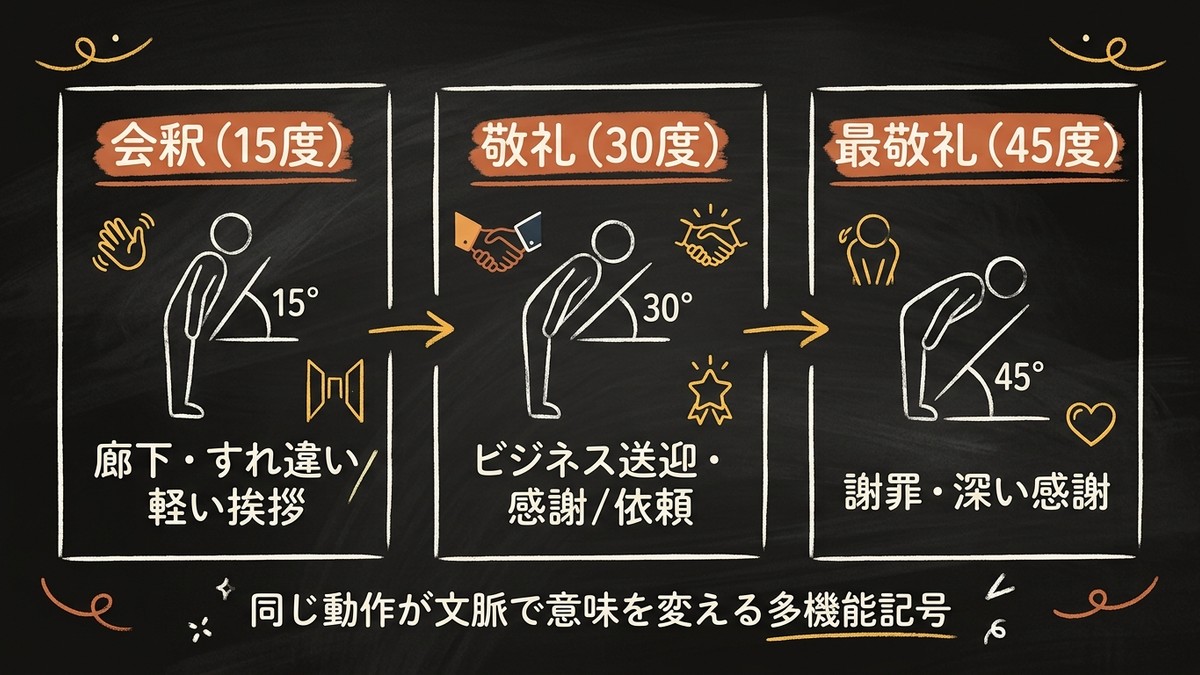
- Bowing as apology: saying "Mōshiwake gozaimasen" while bowing deeply at 45 degrees
- Bowing as gratitude: saying "Arigatō gozaimashita" while bowing at 30 degrees
- Bowing as greeting: silently offering a 15-degree nod when passing someone in a corridor
The same physical action performs entirely different speech acts depending on context. This is the essence of bowing as a "multifunctional pragmatic sign."
Next, consider its relationship to politeness theory. Brown and Levinson's classical theory grounds politeness in respect for "negative face" — the desire for autonomy free from imposition by others. However, Kiyama et al. (2012) empirically analyzed face-work behaviors in Japan and demonstrated that this premise does not necessarily translate to Japanese culture [6]. In Japan, there are many situations where expressing deference and respect appropriate to the relational context takes precedence over individual autonomy. Bowing is a prime example: it functions less as consideration for individual independence than as a maintenance of collective harmony and an expression of belonging to the relationship.
There is also an institutional dimension. Dunn (2017) analyzed Japanese corporate business-manner training as "aesthetic labor" [7] — work that embodies a brand image through appearance and bodily expression. Training the angle, speed, gaze, and vocal tone of a bow as a coordinated set is, from this perspective, labor that expresses a brand through the body. The contemporary Japanese business bow is not only a matter of individual courtesy but also a standardized, institutionally trained performance [7].
The table below summarizes bow types and their corresponding functions.
| Type | Angle | Primary Contexts | Speech Acts Performed |
|---|---|---|---|
| Eshaku (slight bow) | ~15° | Passing someone in a corridor; moving in front of others | Light greeting; acknowledgment of presence |
| Keirei (formal bow) | ~30° | Greeting/seeing off guests; business greetings; expressing thanks | Gratitude; greeting; request |
| Saikeirei (deepest bow) | ~45° | Apology; profound gratitude; formal occasions | Apology; deep gratitude; expression of reverence |
At farewells, the keirei (30 degrees) or deeper is generally used, with the relationship and setting serving as the calibration mechanism for degree of formality [8].
Pragmatic Transfer Failures in Learners
Even advanced Japanese learners who have mastered vocabulary and grammar can fall into "pragmatic failure" — a state where, despite using grammatically correct expressions, they lack the sociopragmatic knowledge of which situations call for what degree of courtesy performed for how long [13].
Here are the most common failure patterns related to bowing.
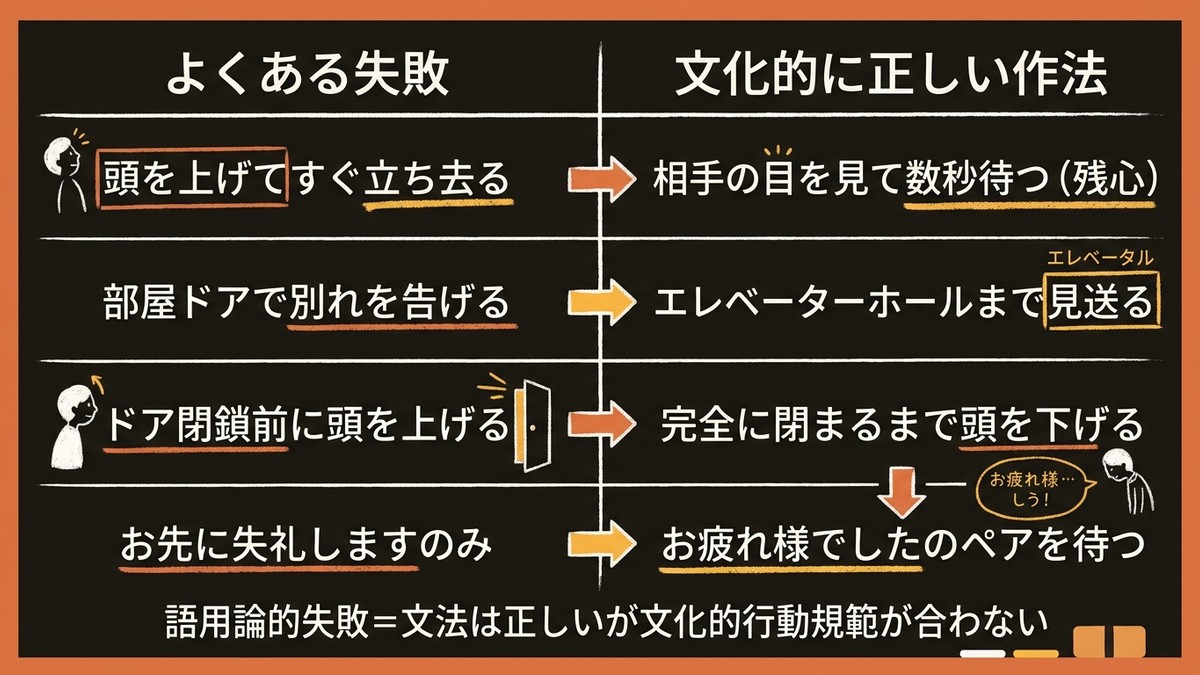
Failure Pattern 1: Absence of Zanshin The bow itself is executed correctly, but the moment the head is raised, the learner averts their gaze or immediately begins to walk away. To Japanese observers, this creates an impression of being "brusque" or "lacking sincerity."
Failure Pattern 2: Misunderstanding the Farewell Distance There is a hospitality maxim: "Three steps to welcome, seven steps to see off" [10]. Culturally, more weight is placed on the send-off. In business settings, the proper manner is to escort guests to the elevator lobby and continue bowing until the doors have closed completely [11]. For important clients, one accompanies them all the way to the entrance. Learners unfamiliar with this sense of distance tend to say their goodbyes at the point where they open the office door.
Failure Pattern 3: The Elevator Door Moment The correct etiquette is to bow deeply the moment the elevator doors begin to close and keep one's head lowered until they have shut completely [11]. Raising one's head and walking away while the doors are still half-open can be perceived by the person inside as a breach of courtesy. The sense of time — "until the other person is no longer visible" — is the practical expression of zanshin.
Failure Pattern 4: Misuse of Paired Utterance Structure The workplace phrase "Osaki ni shitsureishimasu" ("Excuse me for leaving first") does not stand alone. It is one half of a paired exchange, with "Otsukaresama deshita" ("Thank you for your hard work") as the expected response [12]. Saying only "Osaki ni shitsureishimasu" and leaving the room unilaterally closes the interaction without giving colleagues the opportunity to respond. Even when the words are correct, lack of awareness of the paired structure produces pragmatic failure.
Failure Pattern 5: Absence of Cultural Premise The contrast with Western farewells is instructive. After a hug or handshake, one turns and walks away without looking back [14]. In Western cultural contexts, this is in no way impolite. However, interpreted through the framework of Japanese culture, it can read as an absence of nagorioshire (名残惜しさ) — a lack of the feeling of reluctance to part.
The word nagorioshire (名残惜しい) expresses "the heart's gravity toward something that is already beginning to pass away" [9]. Prolonging a farewell is not a negative act; it functions as an expression of respect and affection — a way of conveying that you cherish the other person's time.
| Failure Pattern | Learner Behavior | Cultural Background and Correct Practice |
|---|---|---|
| Absence of zanshin | Averts gaze immediately after bowing | After raising the head, hold the other person's gaze for a moment to show "my heart is still here" |
| Misunderstanding farewell distance | Says goodbye at the office door | Escort to the elevator lobby and continue bowing until the doors close completely |
| Elevator door etiquette | Raises head when doors are half-closed | Keep head lowered until the doors have shut completely |
| Misuse of paired structure | Says "Osaki ni shitsureishimasu" and exits alone | Be conscious of the paired structure that elicits the other party's "Otsukaresama deshita" |
| Absence of cultural premise | Turns and walks away immediately after greeting | The time sense and bodily movement that embody nagorioshire are required |
Conclusion — The Cultural Logic Revealed by "How It Ends"
Simply focusing on whether a bow is performed or not never reaches the heart of Japanese etiquette. What matters is how it begins and how it ends.
The martial arts concept of zanshin embodies the philosophy of "never relaxing one's mind after the movement is complete" [1][2]. When this philosophy is applied to everyday etiquette, it gives rise to the behavioral principle of "continuing to bow until the other person has disappeared from sight." Pragmatically, bowing is not a single-function sign but a multifunctional nonverbal sign that carries apology, gratitude, greeting, and request depending on context [4]. Taking into account the cultural limits of politeness theory, Japanese bowing can be read as an embodiment of a cultural norm that prioritizes "maintaining collective relationships" over "consideration for individual autonomy" [6].
As the emotional vocabulary of nagorioshire suggests [9], the act of lingering over a farewell is a form of respect in Japanese culture. The person who bows while on the phone, and the staff who keep their heads lowered until a car has vanished — neither is acting irrationally. Both are acting with extraordinary fidelity to a cultural logic.
Here are three things you can begin practicing today.
- End your bow with zanshin in mind: After raising your head, form the habit of not moving immediately — hold the other person's gaze quietly for two or three seconds.
- Confirm the farewell distance: In business settings, treat the elevator lobby as your baseline for farewells, and continue bowing until the doors have closed completely [11].
- Be conscious of speech pairs: Learn paired expressions such as "Osaki ni shitsureishimasu" and "Otsukaresama deshita," and be mindful not to leave the exchange one-sided [12].
The way a bow ends is a mirror that measures Japanese language proficiency not through vocabulary or grammar, but through understanding of cultural logic.
References
- "残心(ざんしん)," Japan Karate Federation (公益財団法人 全日本空手道連盟). https://www.jkf.ne.jp/karate-word/kw-zamshin
- "残心," Wikipedia (Japanese). https://ja.wikipedia.org/wiki/残心
- "礼に始まり礼に終わる," Judo Channel (judo-ch.jp). https://www.judo-ch.jp/dictionary/terms/rei/
- E. Diegoli, "The affective meanings of bowing in a web corpus of Japanese," Journal of Pragmatics, vol. 251, Elsevier / ScienceDirect, 2025. https://www.sciencedirect.com/science/article/pii/S0378216625002607
- S. Kiyama, K. Tamaoka, M. Takiura, "Applicability of Brown and Levinson's Politeness Theory to a Non-Western Culture: Evidence From Japanese Facework Behaviors," Sage Open, 2012. https://journals.sagepub.com/doi/full/10.1177/2158244012470116
- C. D. Dunn, "Bowing Incorrectly: Aesthetic Labor and Expert Knowledge in Japanese Business Etiquette Training," in Japanese at Work: Politeness, Power and Personae in Japanese Workplace Discourse, Springer, 2017. https://link.springer.com/chapter/10.1007/978-3-319-63549-1_2
- "How to Bow: An Essential Form of Respect in Japan," nippon.com. https://www.nippon.com/en/guide-to-japan/gu020001/
- "名残惜しい," Kotobank. https://kotobank.jp/word/名残惜しい-588594
- "お迎え3歩、お見送り7歩," NIKKEI Style (Nikkei Inc.), 2013. https://style.nikkei.com/article/DGXDZO52019490S3A220C1W05001/
- "お客さまを「お見送り」する作法~「最後の数秒」で、お客さまの心をつかむ!," Insource (insource.co.jp). https://www.insource.co.jp/gam-batte/cs/article/service_cs_up62.html
- "Japanese Business Phrases at Work: お先に失礼します(Osaki ni Shitsureishimasu)," Coto Academy. https://cotoacademy.com/osaki-ni-shitsureishimasu/
- Yogyanti, "Pragmatic Failures in Japanese Conversations Among Beginner Japanese Language Learners Leading to Face-Threatening Acts," KIRYOKU, vol. 8, no. 2, Universitas Diponegoro, 2024. https://ejournal.undip.ac.id/index.php/kiryoku/article/view/66637
- "The Awkward Art of Saying Goodbye in Japan," GaijinPot Blog. https://blog.gaijinpot.com/awkward-art-saying-goodbye-japan/
