
When Do You Use 'Naruhodo' and 'Sō desu ne'? A Practical Guide to Aizuchi That Makes Japanese Conversations 10x Smoother

By NIHONGO-AI
AI Engineer/Japanese Language Educator
6/1/2026

When Do You Use 'Naruhodo' and 'Sō desu ne'? A Practical Guide to Aizuchi That Makes Japanese Conversations 10x Smoother
Introduction
When I was teaching at a Japanese language school, a student named Yun came to me with a concern. "Sensei, when I called my Japanese friend and went quiet for a moment, their voice suddenly turned cold… Did I make them angry?"
Yun hadn't made anyone angry. They had simply forgotten to use aizuchi. But in Japanese, just a few seconds of silence can be read by the other person as a sign that you're not listening.
After reading this article, you'll understand three things:
- What aizuchi is, and why it matters so much in Japanese
- When and at what timing to use it
- 20 ready-to-use phrases organized by situation
I'll keep the theory to a minimum. This is all about information you can use starting today.
What Is Aizuchi? Let's Start with the Basics
Aizuchi refers to the "responses" a listener gives while the other person is speaking. There are two types: verbal aizuchi (words like "un," "naruhodo," and "sō desu ne") and non-verbal aizuchi (nodding, changes in facial expression) [1][10].
Aizuchi serves seven functions [7]:
- Encouraging the speaker to continue
- Showing understanding ("I got it")
- Expressing agreement or empathy ("I agree")
- Displaying emotions such as surprise or joy
- Seeking confirmation ("Do you mean ○○?")
- Expressing refusal or disagreement (rare)
- Filling pauses, like saying "um…"
You don't need to memorize all of these right away. Just being aware of functions ①–③ is enough to noticeably change the atmosphere of a conversation.
How Often Should You Use It?
This is the part that surprises most people. In Japanese conversation, aizuchi appears an average of 15–20 times per minute [4]. That works out to roughly once every 3–4 seconds. Comparing this to English makes the difference very clear.
| Language | Aizuchi Frequency | Approximate Pace |
|---|---|---|
| Japanese | Once every 14 words | About once every 3–4 seconds |
| English | Once every 37 words | About once every 10 seconds |
| Japanese vs. English | Japanese is more than 2× as frequent | Considerably more often |
This frequency data comes from actual conversation analysis [4][8]. This is why native English speakers tend to naturally use fewer backchannels when speaking Japanese [6]. Because using them sparingly feels natural in English, the same habit tends to carry over into Japanese.
Timing Is Everything — Practical Rules for "When to Use It"
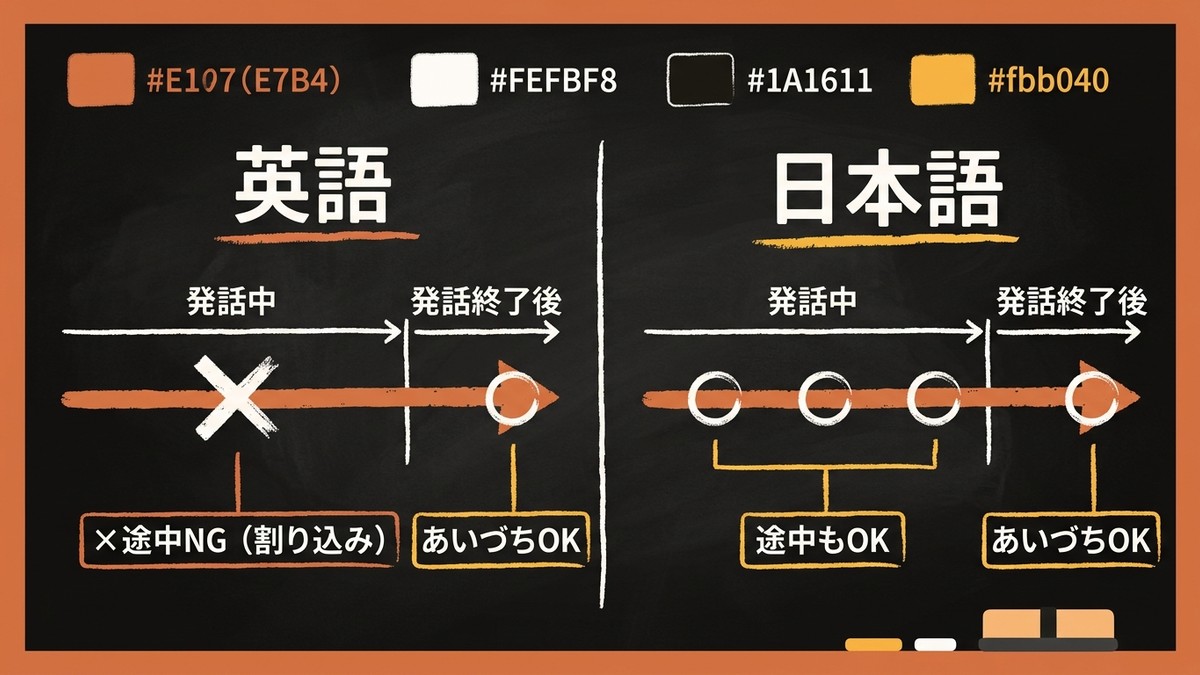
With aizuchi, when you use it matters just as much as which phrase you use. This is the biggest difference from English.
The English rule: React after the other person has finished speaking. Voicing a response mid-sentence can be interpreted as an interruption.
The Japanese rule: It's perfectly fine to use aizuchi while the other person is still talking. In fact, doing so mid-sentence is the natural thing to do [4].
Think of it like a traffic light:
- Green light (go ahead): At natural pause points in the conversation, when a sentence has reached a stopping point — even mid-sentence is fine
- Red light (hold back): When you respond loudly before the other person has finished their sentence
Experience It Through a Sample Conversation
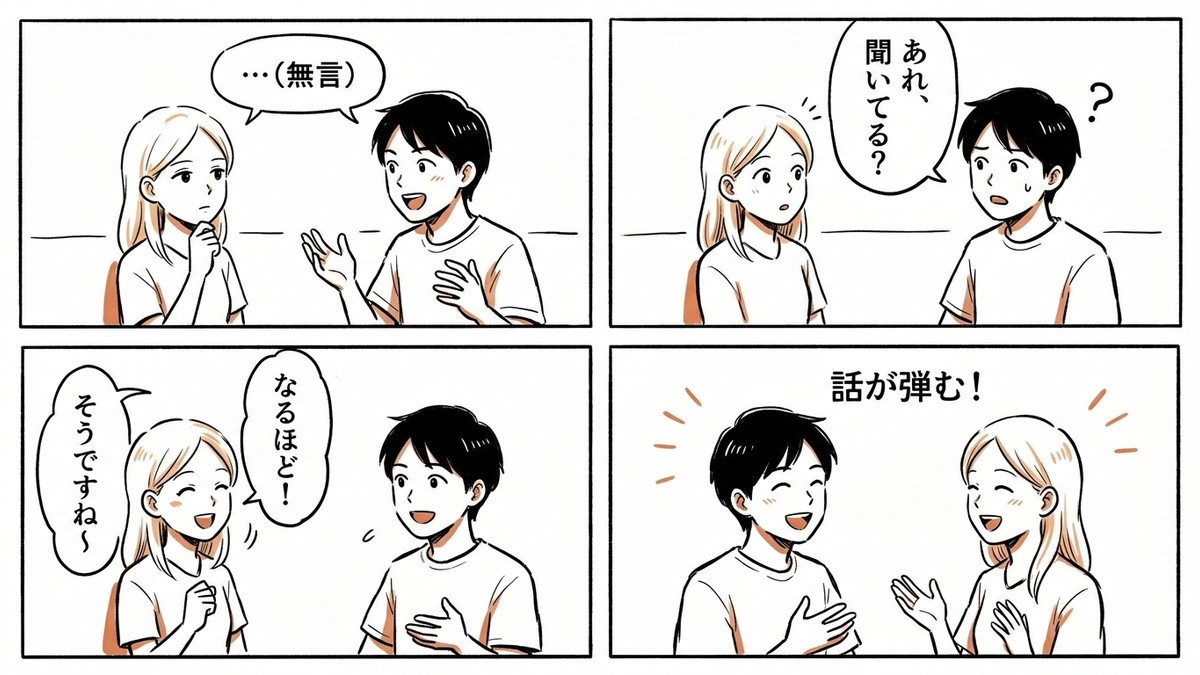
Without aizuchi:
Tanaka: "I went to Kyoto last week. The autumn leaves were beautiful, and I went to Kiyomizudera too…" Yun: "……(silence)……" Tanaka: "(Hmm, are they bored? Are they even listening?)"
With aizuchi:
Tanaka: "I went to Kyoto last week." Yun: "Oh, really!" Tanaka: "The autumn leaves were beautiful, and I went to Kiyomizudera too…" Yun: "That sounds wonderful! And then?" Tanaka: "(Great, they're really listening!)"
Comparing the two conversations, you can see how dramatically the impression changes with just the presence or absence of aizuchi.
Phone calls require extra care. Since the other person can't see you nod, verbal aizuchi is the only tool you have [4]. Repeating "hai" over and over sounds mechanical. Instead, cycle through phrases like "hai" → "naruhodo" → "sō nan desu ne" to keep things natural.
Phrase List by Situation — 20 Expressions You Can Use Today
I've organized them into four categories. Use casual expressions (for friends and peers) and formal expressions (for work and those senior to you) according to the situation.
Agreement and Empathy
- Casual: "Un, wakaru!" / "Sō sō!" / "Da yo ne~" / "Wakaru wakaru" / "Honto sore!"
- Formal: "Sō desu ne" / "Ossharu tōri desu" / "Gomottomo desu" / "Naruhodo, tashika ni"
Surprise and Admiration
- Casual: "Ee! Maji de?" / "Sugoi!" / "Maji ka~"
- Formal: "Sore wa sugoi desu ne" / "Odorokimashita" / "Sō nan desu ka!"
Encouragement (Signaling "Please tell me more")
- Casual: "E, sorede?" / "Honto ni?"
- Formal: "Hai, hai…" / "Naruhodo… (brief pause)"
Confirmation
- Casual: "A, ○○tte koto?"
- Formal: "Tsumari ○○ to iu koto deshō ka" / "○○ to iu rikai de yoroshii deshō ka"
Real-World Business Example
Imagine you're receiving a follow-up call from a business client:
Client: "About the materials we sent you the other day…" You: "Yes, I've had a look at them." Client: "There's a part about the pricing that I was a bit concerned about…" You: "Naruhodo, sō deshita ka. What specifically caught your attention?"
Adding a brief follow-up after "naruhodo" clearly conveys to the other person that you understand and are ready to hear more. The conversation moves forward more naturally than if you simply end with "hai."
In casual conversations with friends, using expressions like "Ee, sorede?" or "Wakaru wakaru" creates a warmer, more familiar atmosphere. Choosing your phrases to match the situation is the fastest way to improve.
3 Common Mistakes
① Using It Too Infrequently
Without aizuchi, you're sending the signal that you're not listening or not interested [6]. Japanese speakers unconsciously expect feedback from their conversation partner, so prolonged silence creates a sense of unease [3]. Aim for once every 4–5 seconds. If it feels like you might be doing it too much, you're probably at just the right level.
② Using It Too Late
Saying "un" only after the other person has completely finished speaking can disrupt the rhythm of the conversation. In Japanese, the key is to insert aizuchi at natural pause points during the speech. Weave in phrases like "sō desu ne" and "naruhodo" at each pause as the conversation flows. The moment after the speaker creates a brief pause — as if placing a period — is particularly easy to slot one in.
③ Defaulting to Only "Hai"
Saying "hai・hai・hai・hai・hai" five times in a row makes the other person wonder, "Are you really listening?" I've actually played recordings of beginner-level conversations in class, and students noticed for themselves: "That sounds like a robot…" Simply rotating through "hai," "naruhodo," and "sō desu ka" will make you sound much more natural right away. As you grow more comfortable, try adding emotionally expressive phrases like "Ee!" or "Sore wa sugoi desu ne."
Summary
The three keys to aizuchi are frequency, timing, and variety [1][4].
- Frequency: Aim for once every 3–5 seconds (if it feels like too much, you're probably at the right level)
- Timing: It's fine to use aizuchi at pause points mid-sentence (that's the Japanese way)
- Variety: Don't rely only on "hai" — mix in phrases for agreement, surprise, and encouragement
Choose just one action to try today:
- Consciously use "naruhodo" at least once in your next Japanese conversation
- On the phone, add a brief extra word after every "hai"
- Record yourself in a conversation using your phone's voice memo, and check how often you're using aizuchi
Aizuchi is a communication habit that Japanese speakers naturally develop from the time they are two or three years old [13]. That's exactly why it has become an unconscious given for native speakers. For learners, simply practicing consciously is enough to make conversations with native speakers flow far more smoothly. Even small steps, taken every day, will absolutely change your conversations.
References
- Mizutani, Nobuko, "Aizuchi-ron," Nihongo-gaku Vol.7 No.13, Meiji Shoin, 1988. https://cir.nii.ac.jp/crid/1574231874722008960
- "Is it true that 'Japanese people use aizuchi all the time'?" Kotoba Kenkyūkan (National Institute for Japanese Language and Linguistics). https://kotobaken.jp/qa/yokuaru/qa-162/
- "Backchannel: A feature of Japanese English," JALT2009 Conference Proceedings, 2009. https://jalt-publications.org/archive/proceedings/2009/E104.pdf
- Hatasa, Yukiko Abe, "Aizuchi responses in JFL classrooms: Teacher input and learner output," Selected Papers from the Conference on Pragmatics in the CJK Classroom, NFLRC, University of Hawai'i. https://nflrc.hawaii.edu/CJKProceedings/hatasa/hatasa.html
- "Aizuchi: Politeness Strategy in Japanese Conversation," ResearchGate, 2019. https://www.researchgate.net/publication/338278770_Aizuchi_Politeness_Strategy_in_Japanese_Conversation
- "Exploring aizuchi as resources in Japanese social interaction: The case of a political discussion program," ResearchGate. https://www.researchgate.net/publication/248451599_Exploring_aizuchi_as_resources_in_Japanese_social_interaction_The_case_of_a_political_discussion_program
- "Linguistic and non-linguistic aizuchi as considerate language behavior," J-STAGE (Discourse Communication Studies). https://www.jstage.jst.go.jp/article/tcg/22/0/22_17/_article/-char/ja
- Miyata, Susanne; Nisisawa, Hirokazu, "The acquisition of Japanese backchanneling behavior: Observing the emergence of aizuchi in a Japanese boy," Journal of Pragmatics, Vol.39(7), pp.1255-1274, Elsevier, 2007. https://www.sciencedirect.com/science/article/abs/pii/S0378216607000525
