
"Silence Signals Anger" Yet "Silence Has Aesthetic Beauty"? The Cultural Paradox Behind Japanese Aizuchi

By NIHONGO-AI
AI Engineer/Japanese Language Educator
6/2/2026

"Silence Signals Anger" Yet "Silence Has Aesthetic Beauty"? The Cultural Paradox Behind Japanese Aizuchi
Introduction
"Japanese speakers constantly jump in while you're talking" — this is the impression many foreign learners get the first time they have a conversation with a native Japanese speaker.
Here is a paradox worth examining.
Proposition A: "In Japanese, silence signals anger or refusal." Proposition B: "Japanese culture has an aesthetic of ma (間) — the beauty of silence and pause."
Both appear in books and are taught in classrooms. But if silence signals anger, how can silence also be beautiful? Can these two propositions truly coexist?
This article makes three points. First, Japanese aizuchi occurs at a quantifiably exceptional frequency. Second, that frequency has a structural inevitability rooted in kyōwa (co-construction of talk) and high-context culture. Third, the apparent paradox of "silence = anger" versus "the aesthetics of ma" can be resolved by recognizing how context shifts meaning.
First, consider the numbers. A study analyzing Japanese TV press conferences found that aizuchi appears on average once every 9.6 seconds [4]. In telephone conversations, the rate rises to once every 6.1 seconds [4]. Cases have been documented of North American businesspeople misreading silence during negotiations as refusal, rushing to fill it, and inadvertently weakening their own position [5]. Let us unravel this mystery of aizuchi and silence together.
Section 1 | The "Density" of Aizuchi in Numbers
To understand just how exceptional the frequency of Japanese aizuchi is, let us start with the facts.
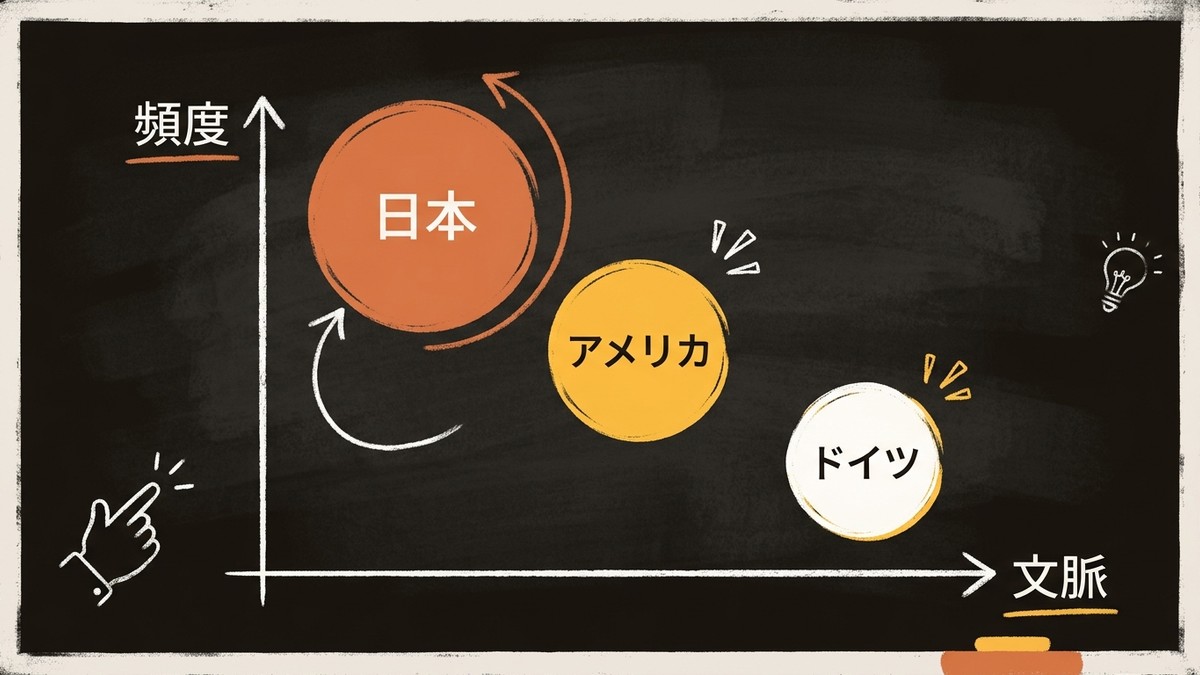
Japanese speakers are estimated to produce an average of 15 to 20 aizuchi per minute during conversation. The rate of aizuchi use among Japanese speakers is approximately twice that of Americans [8]. In more precise comparisons, Japanese speakers produce a backchannel response once every 14 words, whereas English speakers do so once every 37 words [4].
The repertoire of aizuchi forms is remarkably rich. Verbal forms include un, ee, naruhodo, sō desu ka, mā, hē, and sō desu ne, and the category extends to non-verbal nods and changes in facial expression [1][10]. Research has classified the functions of aizuchi into seven types [7].
| Function | Description | Representative Expressions |
|---|---|---|
| Continuity prompt | Signals "please keep talking" | un, un / ee, ee |
| Comprehension display | Confirms "I understand" | naruhodo / aa / hai |
| Agreement / empathy | Expresses agreement with content | sō desu yo ne / honto ni |
| Emotional expression | Expresses surprise or delight | e! / mā! / hē! |
| Confirmation | Requests clarification or repetition | sō desu ka? / hontō ni? |
| Rejection | Conveys a reluctant reaction | iya / demo / ūn |
| Filler | Serves as a placeholder | ā / eto |
Also notable is when this behavior first emerges. Miyata & Nisisawa (2007) conducted a longitudinal observation of a Japanese boy from age 1 year 5 months to 3 years 1 month [13]. Aizuchi placed at the end of utterances appeared first; "mid-utterance aizuchi," inserted during another speaker's turn, was acquired approximately six months later [13]. These mid-utterance forms carry only the meaning of "I'm listening, please continue" and do not express agreement or empathy [13].
The fact that this behavior is acquired between ages two and three suggests that aizuchi is not something consciously learned and applied, but rather a pattern inscribed into the body through socialization. For native Japanese speakers, producing aizuchi is nearly unconscious.
Section 2 | Why So Much? — Kyōwa and High-Context Culture
With the frequency established, we turn to the question of why it is so high. Two theoretical frameworks are relevant.
Mizutani Nobuko's Concept of Kyōwa
Mizutani Nobuko (1988) theorized Japanese conversation as kyōwa — co-construction of talk [1]. She observed that while conversation in Western languages follows a dokūwa (monologic) model, in which a single speaker completes each utterance alone, Japanese conversation follows a kyōwa (co-constructed) model, in which the listener actively participates in building the utterance together [1][11].
In other words, in Japanese conversation, a listener who simply waits in silence is not fully participating. Aizuchi serves as a way to "participate in the conversation without seizing the floor," thereby fulfilling the role of co-construction. Speakers, in turn, proceed on the assumption that this feedback will come.
High-Context Culture and the Signal of "I'm Listening"
In Edward T. Hall's framework of high-context culture, Japan is classified as a culture that relies heavily on non-verbal information, context, and shared tacit understanding [12]. In such cultures, there is a mutual expectation that meaning will come across without being explicitly stated. The flip side of this is a heightened need to continuously signal that one is listening [12].
Consider the speaker's perspective. Anxiety about whether one's words are getting through — whether one is boring the listener — intensifies the desire for feedback [3]. Aizuchi from the listener functions as a signal that relieves this anxiety.
This dynamic becomes especially clear in telephone conversations. In face-to-face interactions, non-verbal channels such as facial expressions and nods are available; on the phone, they are not. This loss of non-verbal cues drives up the proportion of verbal aizuchi, resulting in the high density of one response every 6.1 seconds [4]. The impulse to say "moshi moshi?" after a long silence on the phone — even with a close friend — stems from exactly this mechanism.
Section 3 | Deconstructing the Paradox — The Ambiguity of Silence and the Aesthetics of Ma
This is the heart of the article.
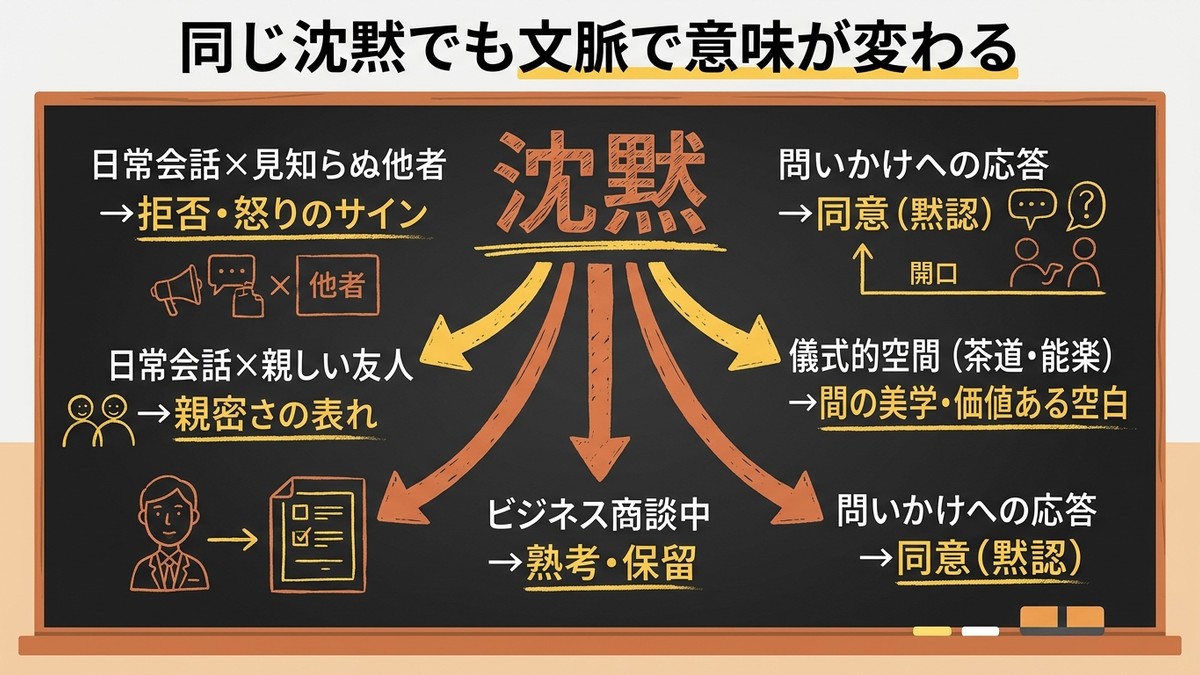
Silence in Japanese is polysemous: it can mean contemplation, intimacy, agreement, dissatisfaction, anger, or refusal [5][12]. Few languages assign such a wide range of meanings to a single phenomenon.
What Empirical Research Shows
Hasegawa & Gudykunst (1998) empirically compared how Japanese and American participants evaluate silence [2]. The findings are clear. Japanese participants rated silence with strangers more negatively than American participants did. However, they did not rate silence with close friends negatively [2]. Americans, by contrast, showed little variation in their evaluation of silence based on their relationship with the other person [2].
In short, "whether silence is negative for Japanese people depends strongly on the relationship and the context."
Why does silence with strangers become negative? In high-context cultures, directly expressing anger or dissatisfaction in words is considered taboo [5][12]. Because the direct channel for emotional expression is blocked, silence tends to function as an alternative means of conveying emotion. Silence with an unfamiliar person thus becomes linked to anxiety — "Did I say something rude?" or "Are they angry?" — in the listener's mind.
Why "The Aesthetics of Ma" Is a Different Matter
The concept of ma in Noh theater and the tea ceremony operates in a context fundamentally different from everyday conversation. In ritual spaces, silence carries active value as "a pause filled with meaning." Because all participants share the same contextual rules, the anxiety of "perhaps they are angry" simply does not arise.
"Everyday conversation that continuously calls for aizuchi" and "ritual space where silence is richly meaningful" operate under different contextual rules. The apparent paradox arises only when this difference in context is overlooked.
Similar misunderstandings occur in international meetings. Cases in which Western participants interpreted the silence of Japanese attendees as a sign of agreement, only to later discover that those attendees had harbored reservations all along, have been repeatedly documented in diplomatic and business contexts [5]. The meaning of silence cannot be read without knowing who is silent, with whom, and in what setting.
Practical Applications | Pragmatic Transfer and Implications for Learners and Educators
Let us translate the theory into practical concerns for learners.
"Pragmatic transfer" refers to the phenomenon of carrying the pragmatic rules of one's mother tongue — rules about when and how to use language — into a second language. Aizuchi is a textbook example of a domain where this transfer occurs prominently.
In English, the norm is to place backchannel responses only at grammatical completion points, where the speaker's turn has ended [4][6]. Inserting them mid-utterance is perceived as interruption or interference [4]. In Japanese, the opposite is true: producing aizuchi in the middle of someone's utterance is entirely natural and is precisely what enables the co-construction of kyōwa [1][6].
This asymmetry generates misunderstanding in both directions.
Misunderstanding Pattern A: English Native Speakers Speaking Japanese
English-speaking learners of Japanese tend to produce aizuchi less frequently in Japanese conversation [6]. This is because the norms of English — placing responses only at turn-completion points — are unconsciously carried over. Classroom research by Hatasa found that learners' aizuchi fell to less than half the appropriate frequency [6]. When this happens, native Japanese speakers feel that "this person isn't really listening," and their motivation to continue speaking diminishes.
Misunderstanding Pattern B: Japanese Speakers Speaking English
Conversely, when Japanese speakers produce frequent backchannel responses in English, English speakers feel uncomfortable, wondering why the other person keeps jumping in mid-sentence [4]. Research on Japanese English has documented that the backchannel characteristics of Japanese persist strongly in the English used by Japanese speakers [4].
The following table summarizes common contrasts in business settings.
| Situation | Japanese Norm | English Norm | Typical Misunderstanding |
|---|---|---|---|
| Silence during negotiations | Sign of consideration / deliberation | Sign of refusal or objection | English speaker fills the silence first and weakens their position [5] |
| Aizuchi during an utterance | Natural; evidence of co-participation | Perceived as interruption | English speaker feels the listener is being intrusive [4] |
| Absence of aizuchi | Interpreted as "not listening" | Normal listening behavior | Japanese speaker becomes anxious and loses momentum [6] |
| Expressing anger or dissatisfaction | Silence or vague phrasing | Direct verbal expression | The emotional meaning of silence goes unread [12] |
For educators, the key takeaway is this: aizuchi is a skill that is difficult to correct without explicit instruction [6]. Deliberately incorporating practice in the placement, timing, and variety of aizuchi into paired conversation activities can lead to significant gains in communicative competence.
Conclusion
Let us summarize the three main points of this article.
First, Japanese aizuchi occurs at the exceptional rate of once every 14 words — approximately 2.6 times more frequent than English (once every 37 words) [4]. This is underpinned by kyōwa, the norm of co-constructing conversation [1][11], and the constant demand for feedback generated by high-context culture [12].
Second, the paradox of "silence as anger" versus "the aesthetics of ma" dissolves once contextual differences are recognized. As Hasegawa & Gudykunst's research demonstrates [2], Japanese evaluations of silence depend strongly on the relationship with the other person and the situational context. Silence with a stranger in everyday conversation is evaluated negatively; silence in a ritual space carries rich meaning. These two are not contradictory.
Third, aizuchi is a domain prone to pragmatic transfer, and using Japanese or English while unconsciously applying the norms of one's mother tongue can lead to serious misunderstanding [4][6].
Three things you can start doing today.
If you are learning Japanese, listen back to recordings of your own conversations and check the frequency and timing of your aizuchi. Simply being conscious of inserting un, naruhodo, or sō desu ka at appropriate moments can transform the quality of your conversations.
If you teach Japanese, explicitly incorporate aizuchi practice — covering placement, timing, and variety — into your paired conversation activities. Without instruction, transfer is unlikely to be corrected on its own [6].
If you work in Japanese business contexts, resist the urge to immediately interpret silence as refusal [5]. Silence may well be a sign of deliberation. Simply adding a brief check-in — "What do you think?" — can make communication flow far more smoothly.
Acquiring Japanese is not merely a matter of memorizing vocabulary and grammar. Truly mastering the language means internalizing aizuchi — this entire communicative practice — into one's body and instincts. That is the path to genuine Japanese fluency.
References
- Mizutani Nobuko, "Aizuchi-ron," Nihongo-gaku Vol.7 No.13, Meiji Shoin, 1988. https://cir.nii.ac.jp/crid/1574231874722008960
- Tomohiro Hasegawa, William B. Gudykunst, "Silence in Japan and the United States," Journal of Cross-Cultural Psychology, Vol.29(5), SAGE Publications, 1998. https://journals.sagepub.com/doi/abs/10.1177/0022022198295005
- "Is it true that Japanese people give backchannel responses all the time?" Kotoba Kenkyūkan (National Institute for Japanese Language and Linguistics). https://kotobaken.jp/qa/yokuaru/qa-162/
- "Backchannel: A feature of Japanese English," JALT2009 Conference Proceedings, 2009. https://jalt-publications.org/archive/proceedings/2009/E104.pdf
- "Silence in Japanese Business Culture and Communication," Commisceo Global. https://commisceo-global.com/articles/silence-in-japanese-business-culture-and-communication/
- Hatasa, Yukiko Abe, "Aizuchi responses in JFL classrooms: Teacher input and learner output," Selected Papers from the Conference on Pragmatics in the CJK Classroom, NFLRC, University of Hawai'i. https://nflrc.hawaii.edu/CJKProceedings/hatasa/hatasa.html
- "Aizuchi: Politeness Strategy in Japanese Conversation," ResearchGate (academic paper), 2019. https://www.researchgate.net/publication/338278770_Aizuchi_Politeness_Strategy_in_Japanese_Conversation
- "Exploring aizuchi as resources in Japanese social interaction: The case of a political discussion program," ResearchGate (academic paper). https://www.researchgate.net/publication/248451599_Exploring_aizuchi_as_resources_in_Japanese_social_interaction_The_case_of_a_political_discussion_program
- "Verbal and Non-Verbal Aizuchi as Considerate Linguistic Behavior," J-STAGE (Discourse Communication Studies). https://www.jstage.jst.go.jp/article/tcg/22/0/22_17/_article/-char/ja
- "A Study on the Theory of Kyōwa," CiNii Research. https://cir.nii.ac.jp/crid/1050001202948304128
- "Japanese – Communication," Cultural Atlas (SBS Australia). https://culturalatlas.sbs.com.au/japanese-culture/japanese-culture-communication
- Miyata, Susanne; Nisisawa, Hirokazu, "The acquisition of Japanese backchanneling behavior: Observing the emergence of aizuchi in a Japanese boy," Journal of Pragmatics, Vol.39(7), pp.1255-1274, Elsevier, 2007. https://www.sciencedirect.com/science/article/abs/pii/S0378216607000525
